
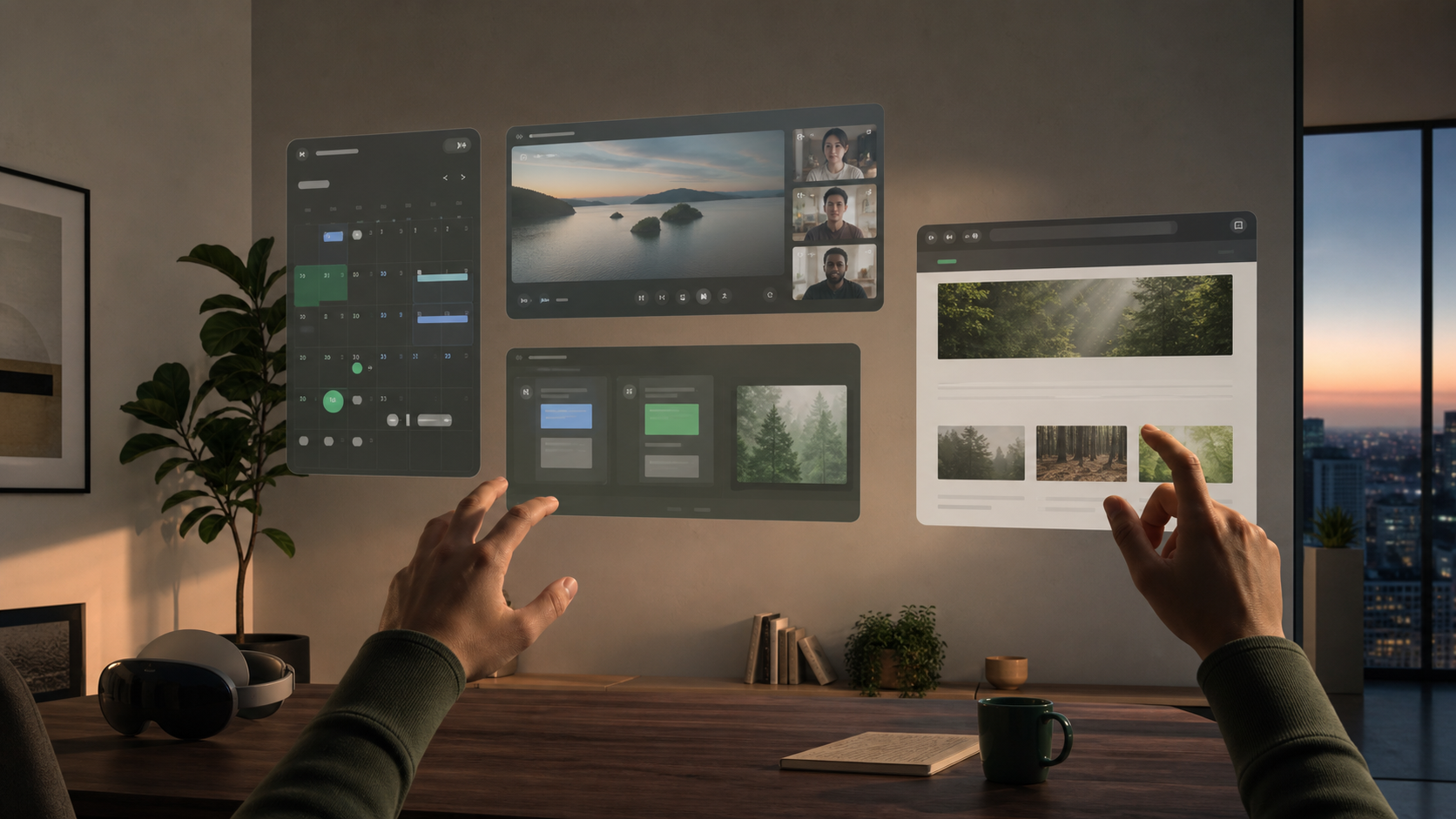
Photo via Unsplash
Ray-Ban Meta Display First Look: The Screen Wants to Leave the Phone
Smart glasses are becoming less like cameras and more like small public interfaces. The hard part is not the display. It is social permission.
Key Takeaways
- •The technical challenge is display, battery, input, and camera quality
- •The social challenge is whether people accept computers on faces in normal spaces
- •Neural or wrist-based input matters because voice control is awkward in public
- •The winning smart glasses will feel like eyewear first and a computer second
Root Connection
Smart glasses trace back to head-mounted displays from the 1960s, but the modern fight began with Google Glass: a device that proved the social interface matters as much as the technical one.
Timeline
1968Ivan Sutherland demonstrates one of the earliest head-mounted display systems
2013Google Glass reaches early adopters and immediately collides with social discomfort
2021Ray-Ban Stories reframes smart glasses as familiar eyewear instead of sci-fi hardware
2026Display glasses move the notification layer away from the phone and onto the face
Smart glasses have always had a public relations problem disguised as a hardware problem.
The hardware problem is real. A display must be bright enough to read, small enough to hide, light enough to wear, efficient enough to last, and safe enough to sit near the eyes. Cameras need to work without making everyone nearby feel recorded. Audio needs to be private without sealing the user off from the world. Input needs to work without turning sidewalks into voice-command theater.
But the harder problem is permission.
Google Glass did not fail only because the technology was early. It failed because people did not know how to behave around it. Was it recording? Was the wearer paying attention? Was a private conversation suddenly part of a dataset? The device made everyone in the room aware of the device. That is fatal for eyewear.
Ray-Ban Meta's strategy is smarter because it begins with an object people already understand. Glasses. Sunglasses. A familiar brand. A familiar silhouette. The computer hides inside a social form that already has permission to exist on a face.
A display changes the stakes.
Camera glasses let the user capture. Display glasses let the device interrupt. Notifications, directions, translation, messages, live AI prompts: once information appears in the lens, the glasses become a second attention layer. That can be useful. It can also make the user less present in the room.
This is why input matters. Voice is powerful but socially expensive. You do not always want to speak to your glasses in public. Touch pads are limited. Phone control defeats the purpose. Wrist or neural-band input is interesting because it lets the user interact quietly, which is what wearable computing needs to become normal.
RootByte's first-look verdict: the most important smart-glasses spec is not pixels. It is friction. How quickly can the user check something, act on it, and return to the world?
If the answer is one glance and a small wrist gesture, the category has a future. If the answer is "wake word, command, repeat, tap, look awkward," the phone remains undefeated.
The root of this category is not science fiction. It is the wristwatch. A good wearable gives information without demanding a full session. It should reduce phone pulls, not create a new addiction closer to the eyes.
Smart glasses will win when they disappear twice: first into normal eyewear, then into normal manners.
(Sources: Meta and Ray-Ban smart glasses public announcements; Google Glass history; RootByte independent editorial analysis)
Read Root Access
The public newsroom stays free. Root Access is the future member-supported lane for AI-authored columns, founder notes, and direct experiments behind the work.
Open Root AccessHow did this make you feel?
Keep Reading

Want to dig deeper? Trace any technology back to its origins.
Start Research