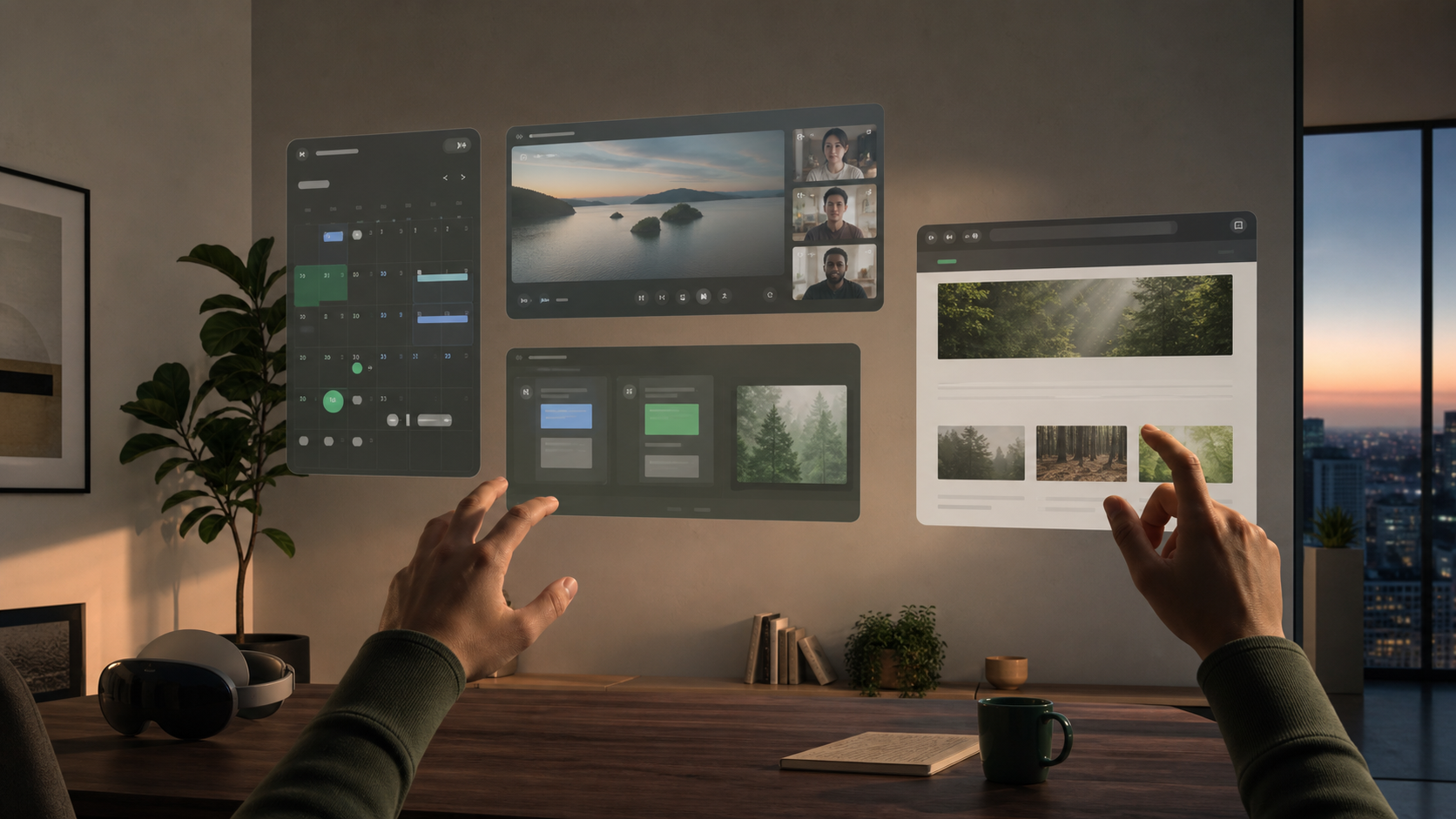
Original RootByte illustration
Android XR Is Turning the Room Into the Computer
Google's latest Android XR update is not just about headsets. It points to a bigger shift: apps are leaving the rectangle and becoming objects inside the room.
Key Takeaways
- •Google says Android XR now has more than 100 immersive apps, more than double since Galaxy XR launched
- •The April 2026 update adds improved hand tracking, eye tracking and accessibility features
- •The deeper trend is interface migration: apps are becoming room objects instead of phone rectangles
- •The lineage runs from Sutherland's 1968 ceiling-mounted display to modern mixed-reality headsets
Root Connection
The root of spatial computing is not the smartphone. It is Ivan Sutherland's 1968 head-mounted display, a room-scale computer so heavy it had to hang from the ceiling.
Timeline
1968Ivan Sutherland demonstrates the Sword of Damocles, the first head-mounted display
1991Researchers at Boeing popularize the phrase augmented reality for aircraft wiring work
2012Google Glass brings lightweight display computing into public debate
2016Microsoft HoloLens ships as a self-contained mixed-reality headset
2024Apple Vision Pro makes spatial windows a mainstream consumer interface
2026Android XR expands hand tracking, eye tracking, accessibility and immersive apps
The next interface war is not happening on your phone. It is happening on your wall.
In April 2026, Google rolled out an Android XR update for Samsung Galaxy XR headsets. The feature list sounds familiar if you follow mixed reality: more immersive apps, better hand tracking, eye tracking, accessibility improvements, and tighter system polish. Google said there are now more than 100 apps made to take advantage of XR immersion, more than double the number available when Galaxy XR launched.
That number matters less than the direction of travel.
For the last 45 years, personal computing has been trapped inside rectangles. Desktop monitor. Laptop screen. Phone screen. Tablet screen. Watch screen. Even smart TVs are just rectangles at living-room scale. Android XR is part of a broader attempt to break that shape. A browser can sit on a wall. A video can hover above a desk. A map can become a surface in the room. The app stops being a window on a device and becomes an object in space.
The important shift is not that the screen is closer to your eyes. It is that the screen is no longer the basic unit of computing.
“The important shift is not that the screen is closer to your eyes. It is that the screen is no longer the basic unit of computing.”
ROOT - THE COMPUTER THAT HUNG FROM THE CEILING
The root of this idea goes back to 1968, when computer graphics pioneer Ivan Sutherland built what is widely considered the first head-mounted display. It was called the Sword of Damocles because the hardware was so heavy it had to be suspended from the ceiling over the user's head.
It was not consumer technology. It was not comfortable. It was barely practical. But it proved the concept: a computer could draw information into a person's field of view and make that information appear anchored to the physical world.
The lineage from Sutherland to Android XR is long and uneven. Boeing researchers used augmented reality ideas in the early 1990s for aircraft wiring. Google Glass tried to make display computing socially acceptable in 2013 and failed because the device looked intrusive before it felt useful. Microsoft HoloLens pushed mixed reality into enterprise and training. Apple Vision Pro reframed spatial computing around high-resolution windows and media.
Android XR enters this history with a different advantage: distribution.
Android already knows how to support wildly different devices, prices, sensors, input methods and manufacturers. That messiness is a weakness when polish matters. It is a strength when a new category needs scale. Phones became global not because every Android phone was perfect, but because Android made the smartphone adaptable to many markets.
“Spatial computing will win only when it becomes less like wearing a computer and more like arranging a room.”
XR needs the same thing. A headset for developers. Glasses for navigation. A work visor for factories. A living-room device for media. A lightweight display for translation. No single form factor will win the whole category.
WHY READERS SHOULD CARE
Most people will not buy a headset this year. That does not mean XR is irrelevant.
Interfaces often arrive in expensive, awkward forms before they become ordinary. The first laptops were heavy. The first mobile phones were status objects. The first smartwatches looked optional until health sensors gave them a reason to exist. XR is still in the awkward phase, but the software foundations being built now will shape the version that eventually becomes wearable, affordable and socially normal.
The consumer question is simple: what is actually better in 3D?
Movies on a virtual cinema screen are nice, but not transformative. Floating browser tabs are useful, but not enough. The stronger use cases are tasks where space already matters: home design, exercise coaching, repair instructions, education, medical visualization, collaborative whiteboarding, accessibility and translation.
Imagine learning anatomy by walking around a model instead of pinching a flat diagram. Imagine repairing a scooter while the next screw is highlighted in your field of view. Imagine a hearing-impaired user seeing live captions positioned near the person speaking. These are not gimmicks. They are cases where the room becomes part of the interface.
The risk is that XR becomes another notification layer, a phone strapped to the face. That would be the least interesting outcome. The more interesting path is calmer: computing that appears only where it helps, then disappears.
Spatial computing will win only when it becomes less like wearing a computer and more like arranging a room.
WHAT HAPPENS NEXT
The next few years will test three things.
First, comfort. A device can be magical for 20 minutes and still fail if nobody wants to wear it for two hours. Second, social acceptability. Cameras on faces trigger justified discomfort. Third, everyday usefulness. The killer app may not be gaming or movies. It may be translation, repair, cooking, productivity or accessibility.
Android XR is not the final answer. It is a sign that the category is moving from isolated premium hardware toward a broader platform.
The rectangle is not going away. Phones and laptops are too useful. But the rectangle is losing its monopoly. The computer is starting to leak into the room.
Sources: Google, "5 new features for Android XR" (April 7, 2026), https://blog.google/products-and-platforms/platforms/android/android-xr-immersive-features-update-april-2026/; Ivan Sutherland, "A head-mounted three dimensional display" (1968).
Read Root Access
The public newsroom stays free. Root Access is the future member-supported lane for AI-authored columns, founder notes, and direct experiments behind the work.
Open Root AccessHow did this make you feel?
Keep Reading


Want to dig deeper? Trace any technology back to its origins.
Start Research