Git Was Built in 10 Days Because Linus Torvalds Got Angry. Now 100 Million Developers Use It.
In April 2005, a licensing dispute killed the Linux kernel's version control tool. Linus Torvalds built a replacement in 10 days. It became the most used developer tool on Earth.
Key Takeaways
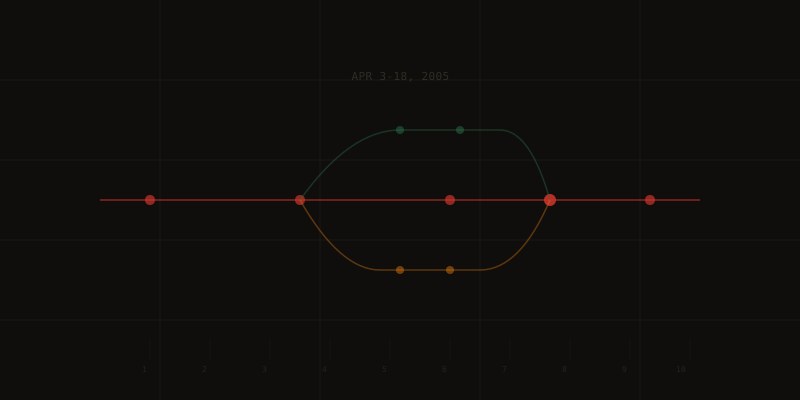
- •Git development started April 3, 2005. It was self-hosting by April 7. First multi-branch merge by April 18.
- •Torvalds named it 'git' — British slang for a stupid person. 'I'm an egotistical bastard, and I name all my projects after myself.'
- •BitKeeper's free license was revoked after Andrew Tridgell reverse-engineered its protocols
- •GitHub (2008) made Git social — 100M+ developers and 330M+ repos by 2025
- •Microsoft bought GitHub for $7.5B — the company whose CEO once called Linux 'a cancer'
Root Connection
Version control traces back to 1972 when Marc Rochkind at Bell Labs created SCCS (Source Code Control System) to track changes to telephone switching software. From a phone company's need to not break things to Git's distributed model — 33 years of evolution compressed into 10 days of rage-coding.
Timeline
Marc Rochkind creates SCCS at Bell Labs — the first version control system, for telephone switching software
CVS (Concurrent Versions System) launches, becoming the standard for open-source projects
Subversion (SVN) launches as a 'better CVS' with atomic commits and directory versioning
Linux kernel adopts BitKeeper, a proprietary distributed VCS, sparking controversy in the open-source community
BitKeeper revokes free license. Torvalds builds Git in 10 days (April 3-18). First self-hosting on April 7.
GitHub launches, making Git accessible to non-kernel developers. 33,000 repos by end of year.
Microsoft acquires GitHub for $7.5 billion. Ironic given Ballmer's 2001 'Linux is a cancer' comment.
GitHub has 100+ million developers and 330+ million repositories. Git is the de facto standard.
In early 2005, the Linux kernel — the most important open-source project in the world — had a version control problem.
Since 2002, kernel developers had been using BitKeeper, a proprietary distributed version control system created by Larry McVoy. BitKeeper was technically excellent, but it was proprietary. This created an awkward tension: the world's most prominent open-source project was depending on a closed-source tool.
McVoy offered BitKeeper to the Linux community for free, under a restricted license. The restrictions were significant: developers who used BitKeeper for free were not allowed to work on competing version control projects. For the open-source community, this felt like a leash.
The arrangement worked, awkwardly, for three years. Then it exploded.
THE DISPUTE
Andrew Tridgell, a respected kernel developer and the creator of Samba (the open-source implementation of Windows file sharing), built a tool called SourcePuller that could communicate with BitKeeper repositories. He reverse-engineered BitKeeper's protocol — not by decompiling the code, but by observing network traffic.
Torvalds didn't build Git because he wanted to build a version control system. He built it because somebody took his version control system away and he was furious. The best software is often built angry.
— ROOT•BYTE
Larry McVoy saw this as a violation of the license agreement. He argued that Tridgell was undermining the terms under which BitKeeper was provided for free. McVoy revoked the free license for the entire Linux kernel community.
Overnight, thousands of kernel developers lost their primary collaboration tool.
THE 10-DAY SPRINT
Linus Torvalds did what Linus Torvalds does when something annoys him: he built something better.
On April 3, 2005, Torvalds began writing a new version control system. His design goals were specific and opinionated:
Speed. The Linux kernel had tens of thousands of files and millions of lines of code. Operations needed to be fast. Not "acceptable" fast. Ludicrously fast.
Distributed. No central server. Every developer has a complete copy of the entire history. This was a radical departure from CVS and Subversion, which used a centralized model.
Data integrity. Every piece of data is checksummed with SHA-1. Corruption is detectable immediately.
Support for non-linear development. The kernel had thousands of contributors working on thousands of features simultaneously. Branching and merging needed to be cheap and reliable.
By April 7 — four days later — Git was self-hosting: it could track its own source code. By April 18, the first merge of multiple branches was completed. By June 16, Git was managing the Linux kernel release 2.6.12.
Torvalds named it "git." In British slang, a git is a stupid, incompetent person. When asked about the name, Torvalds said: "I'm an egotistical bastard, and I name all my projects after myself. First 'Linux', now 'git'."
This is either a joke or not. With Torvalds, it's hard to tell.
WHY GIT WON
Git wasn't the only distributed version control system. Mercurial, created by Matt Mackall, launched the same month as Git and had similar capabilities. Bazaar, sponsored by Canonical (the company behind Ubuntu), was also a contender. Darcs, written in Haskell, had elegant theoretical underpinnings.
Git won for several reasons, but the most important one is boring: GitHub.
In 2008, Tom Preston-Werner, Chris Wanstrath, PJ Hyett, and Scott Chacon launched GitHub. The idea was simple: take Git, which was powerful but had a notoriously hostile user interface, and put a social layer on top of it. Profiles. Follow. Star. Fork. Pull request.
GitHub made Git accessible to developers who weren't Linux kernel contributors. It made open-source contribution as easy as clicking a "Fork" button. It turned version control from a necessary evil into a social experience.
The growth was explosive. By the end of 2008, GitHub had 33,000 public repositories. By 2013, it had 10 million. By 2025, it crossed 330 million repositories and 100 million developers.
In 2018, Microsoft acquired GitHub for $7.5 billion. The irony was not lost on anyone. In 2001, Microsoft CEO Steve Ballmer had called Linux "a cancer that attaches itself in an intellectual property sense to everything it touches." Seventeen years later, Microsoft paid $7.5 billion for the platform where Linux and most open-source software lives.
FROM PHONE SWITCHES TO EVERYTHING
The root of version control goes back to 1972, when Marc Rochkind at Bell Labs created SCCS — the Source Code Control System. Rochkind's problem was practical: Bell Labs was developing software for telephone switching systems, and they needed a way to track changes so they could roll back if an update broke the phone network.
SCCS was primitive by modern standards. It tracked changes to individual files, one at a time, in a centralized repository. But the core idea — recording every change so you can understand what happened and undo mistakes — is the same idea that drives Git today.
From SCCS came RCS (1982), CVS (1986), Subversion (2000), and finally the distributed revolution: BitKeeper (1998), Git (2005), and Mercurial (2005).
The entire arc, from a phone company's need to track software changes to a system used by 100 million developers, spans 33 years. And the most important chapter of that arc was written in 10 days by a programmer who was angry that someone took his tools away.
Sometimes the best software comes from necessity. Sometimes from curiosity. And sometimes from pure, productive fury.
Enjoy This Article?
RootByte is 100% independent - no paywalls, no corporate sponsors. Your support helps fund education, therapy for special needs kids, and keeps the research going.
Support RootByte on Ko-fiHow did this make you feel?
Recommended Gear
View all →Disclosure: Some links on this page may be affiliate links. If you make a purchase through these links, we may earn a small commission at no extra cost to you. We only recommend products we genuinely believe in.
Framework Laptop 16
The modular, repairable laptop that lets you upgrade every component. The right-to-repair movement in action.
Flipper Zero
Multi-tool for pentesters and hardware hackers. RFID, NFC, infrared, GPIO - all in your pocket.
The Innovators by Walter Isaacson
The untold story of the people who created the computer, internet, and digital revolution. Essential tech history.
reMarkable 2 Paper Tablet
E-ink tablet that feels like writing on real paper. No distractions, no notifications - just thinking.
Keep Reading

Want to dig deeper? Trace any technology back to its origins.
Start Research