Open Source Runs 96% of the World's Servers. It Started Because One Man Couldn't Fix a Printer.
In 1980, Richard Stallman couldn't get source code for a Xerox printer driver. He launched a movement that now powers the entire internet.
Key Takeaways
- •Stallman couldn't fix a Xerox printer because the source code was proprietary — it radicalized him
- •He announced the GNU Project in 1983 and invented the GPL license
- •Linus Torvalds wrote the Linux kernel in 1991 as a 'hobby' — it now runs 96% of top web servers
- •GitHub has 100M+ developers and 330M+ repositories
- •Steve Ballmer called Linux 'a cancer' in 2001. Microsoft now runs on it.
Root Connection
Richard Stallman's Xerox printer rage (1980) → Linux running 96% of the world's servers (2025)
ROOT
Sometime in 1980, the MIT Artificial Intelligence Laboratory received a brand-new Xerox 9700 laser printer. It was a significant upgrade — faster, sharper, more capable than the lab\'s previous printer. It also jammed. Constantly. Paper would get stuck in the mechanism, and the print queue would back up for hours while researchers waited for someone to physically walk to the printer room and clear the jam. Most of the time, people didn\'t even know the printer was jammed until they went to collect their printout and found nothing.
Richard Matthew Stallman, a programmer at the AI Lab, had solved this exact problem before. With the lab\'s previous printer — a Xerox Graphics Printer donated years earlier — Stallman had modified the printer driver\'s source code to send an automatic notification to every user in the print queue whenever the printer jammed. The person closest to the printer would clear the jam. The system worked beautifully. It was a small hack, a few lines of code, but it saved hundreds of person-hours.
Stallman wanted to do the same thing with the new Xerox 9700. But there was a problem: Xerox refused to provide the source code for the printer\'s software. The driver was proprietary — a compiled binary with no human-readable code. Stallman couldn\'t modify what he couldn\'t read. He learned that a researcher at Carnegie Mellon University had a copy of the source code, obtained through an academic relationship with Xerox. Stallman visited Carnegie Mellon and asked for it. The researcher refused. He had signed a non-disclosure agreement with Xerox prohibiting him from sharing the code.
Stallman was stunned. This was new. In the culture of the MIT AI Lab — and in the broader academic computing culture of the 1960s and 1970s — sharing code was as natural as sharing scientific papers. Software was a collaborative artifact. The idea that a corporation could prevent a researcher from sharing code with a colleague felt, to Stallman, like a moral violation. It wasn\'t just inconvenient. It was wrong.
This moment — a refused request for a printer driver — radicalized Richard Stallman. Over the next three years, he watched the software industry transform. Companies that had once distributed source code as a matter of course began locking it down. AT&T, which had freely distributed Unix source code to universities since the early 1970s, began charging licensing fees and restricting redistribution with System V Unix in 1983. The era of proprietary software was arriving, and Stallman saw it as an existential threat to the freedom of computer users.
On September 27, 1983, Stallman posted a message to the Usenet newsgroup net.unix-wizards announcing the GNU Project — a plan to build a complete, free operating system compatible with Unix. GNU stood for "GNU\'s Not Unix" (a recursive acronym, because programmers). In 1985, he published the GNU Manifesto, a passionate, sometimes combative document laying out his philosophy. He also founded the Free Software Foundation (FSF) to support the project.
Stallman\'s definition of "free" was precise and deliberate. It had nothing to do with price. "Free as in freedom, not free as in beer," he would say repeatedly. The four freedoms: the freedom to run the program for any purpose, to study how it works (requiring source code access), to redistribute copies, and to modify and distribute modified versions. To enforce these freedoms legally, Stallman invented the GNU General Public License (GPL) — a copyright license that uses copyright law to guarantee freedom rather than restrict it. Any software released under the GPL must make its source code available, and any derivative works must also be released under the GPL. Stallman called this "copyleft" — a hack of copyright law itself.
Through the 1980s, the GNU Project built an extraordinary collection of tools: the GCC compiler (1987), GNU Emacs (1985), the GNU Debugger (1986), GNU Bash (1989), and dozens of utilities that replicated and often improved upon their Unix counterparts. By 1990, GNU had almost everything needed for a complete operating system — except the most critical piece: the kernel, the core program that manages hardware and runs everything else. The GNU kernel project, called Hurd, was plagued by design indecision and delays.
On August 25, 1991, a 21-year-old computer science student at the University of Helsinki named Linus Torvalds posted a message to the Usenet group comp.os.minix: "I\'m doing a (free) operating system (just a hobby, won\'t be big and professional)." He had written a kernel. He called it Linux. Combined with GNU\'s tools, it formed a complete, free operating system: GNU/Linux. The missing piece had arrived — not from Stallman\'s foundation, but from a Finnish college student\'s hobby project.
TODAY
The numbers in 2025 are staggering. Linux runs 96.3% of the top 1 million web servers on the internet. It runs 100% of the TOP500 supercomputers in the world — every single one. It runs Android, which is installed on over 3 billion active devices worldwide. It runs the vast majority of IoT devices, embedded systems, smart TVs, routers, and network infrastructure. It powers the cloud: AWS, Google Cloud, and Microsoft Azure all run primarily on Linux. When you load a web page, stream a video, send a message, or ask an AI a question, the chances are overwhelming that Linux is involved at multiple points in the chain.
GitHub, acquired by Microsoft for $7.5 billion in 2018, hosts over 330 million repositories and has more than 100 million developers. It is the world\'s largest collection of source code, and the vast majority of it is open source. The platform has become essential infrastructure for software development — a fact that makes Microsoft\'s ownership deeply ironic, given that Microsoft\'s former CEO Steve Ballmer called Linux "a cancer that attaches itself in an intellectual property sense to everything it touches" in 2001. Today, Microsoft is one of the largest contributors to open-source projects on GitHub. They released Visual Studio Code as open source. They built the Windows Subsystem for Linux. The cancer won.
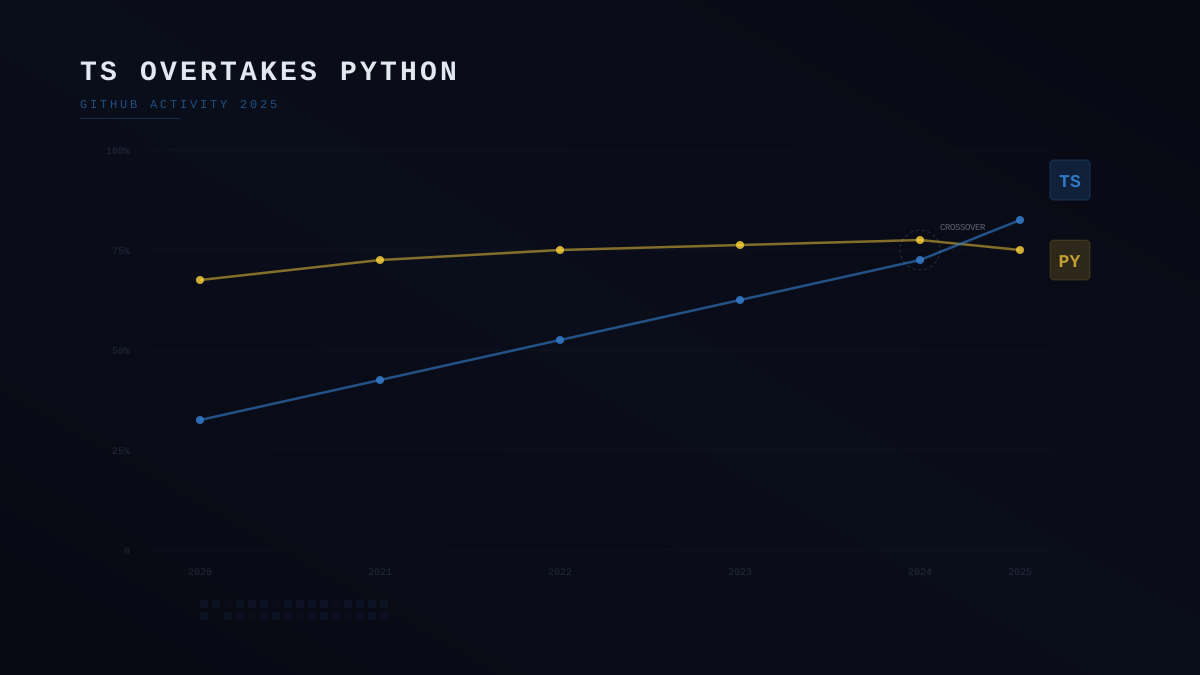
The scale of open-source software in daily life is difficult to overstate. WordPress powers 43% of all websites on the internet. Apache and nginx — both open source — serve the overwhelming majority of web traffic. Python, the most popular programming language in the world, is open source. So are Node.js, Rust, Go, TypeScript, and most of the languages that power modern software development. TensorFlow and PyTorch, the two dominant frameworks for artificial intelligence and machine learning, are open source — released by Google and Meta respectively. Kubernetes, the container orchestration platform that runs modern cloud infrastructure, was open-sourced by Google in 2014. Docker, which revolutionized how software is deployed, is open source.
The business of open source is enormous. Red Hat, the enterprise Linux company, was acquired by IBM in 2019 for $34 billion — the largest software acquisition in history at the time. Canonical (Ubuntu), SUSE, Elastic, MongoDB, HashiCorp, Confluent, and dozens of other companies have built billion-dollar businesses on open-source foundations. The model works: give away the software, sell support, hosting, enterprise features, and expertise. Open source won the software industry not by defeating proprietary software in the marketplace, but by becoming the foundation on which the marketplace is built.
Enjoy This Article?
RootByte is 100% independent - no paywalls, no corporate sponsors. Your support helps fund education, therapy for special needs kids, and keeps the research going.
Support RootByte on Ko-fiHow did this make you feel?
Recommended Gear
View all →Disclosure: Some links on this page may be affiliate links. If you make a purchase through these links, we may earn a small commission at no extra cost to you. We only recommend products we genuinely believe in.
Framework Laptop 16
The modular, repairable laptop that lets you upgrade every component. The right-to-repair movement in action.
Flipper Zero
Multi-tool for pentesters and hardware hackers. RFID, NFC, infrared, GPIO - all in your pocket.
The Innovators by Walter Isaacson
The untold story of the people who created the computer, internet, and digital revolution. Essential tech history.
reMarkable 2 Paper Tablet
E-ink tablet that feels like writing on real paper. No distractions, no notifications - just thinking.
Keep Reading


Want to dig deeper? Trace any technology back to its origins.
Start Research