RootByte
TypeScript Just Passed Python as GitHub's Most-Used Language. JavaScript, Its Parent, Was Created in 10 Days.
GitHub's 2025 year-in-review data reveals that TypeScript has overtaken Python as the most-used programming language on the platform by repository count and pull request volume. TypeScript is a typed superset of JavaScript, and JavaScript itself was famously created by Brendan Eich in just ten days in May 1995.
Key Takeaways
- •TypeScript overtook Python as GitHub's most-used language by repository count and pull request volume in 2025
- •JavaScript was created by Brendan Eich in 10 days in May 1995 at Netscape
- •TypeScript was designed by Anders Hejlsberg, who also designed Turbo Pascal, Delphi, and C#
- •TypeScript is now used by over 85% of professional JavaScript developers according to the State of JS survey
- •The rise was driven by AI tooling (which generates TypeScript for web apps), full-stack frameworks like Next.js, and enterprise adoption
Root Connection
In May 1995, Brendan Eich was hired by Netscape and given ten days to create a scripting language for the browser. The result was JavaScript, a language built in a sprint that became the most widely deployed programming language in history. TypeScript, created by Anders Hejlsberg at Microsoft in 2012, exists entirely because JavaScript was designed too fast to include a type system. The root of TypeScript's dominance is a ten-day deadline in 1995.
Timeline
1995Brendan Eich creates JavaScript (originally called Mocha) in 10 days at Netscape, establishing the language of the web browser
1995JavaScript ships in Netscape Navigator 2.0, beginning its journey to ubiquity
2009Node.js is released, enabling JavaScript to run on servers and expanding the language beyond the browser
2012Microsoft publicly releases TypeScript 0.8, designed by Anders Hejlsberg as a typed superset of JavaScript
2015ECMAScript 6 (ES2015) modernizes JavaScript with classes, modules, and arrow functions
2020TypeScript enters the top 10 languages on GitHub for the first time
2026GitHub's 2025 year-in-review data shows TypeScript overtaking Python as the most-used language by repository count
For the first time since GitHub began tracking language statistics, Python is not number one.
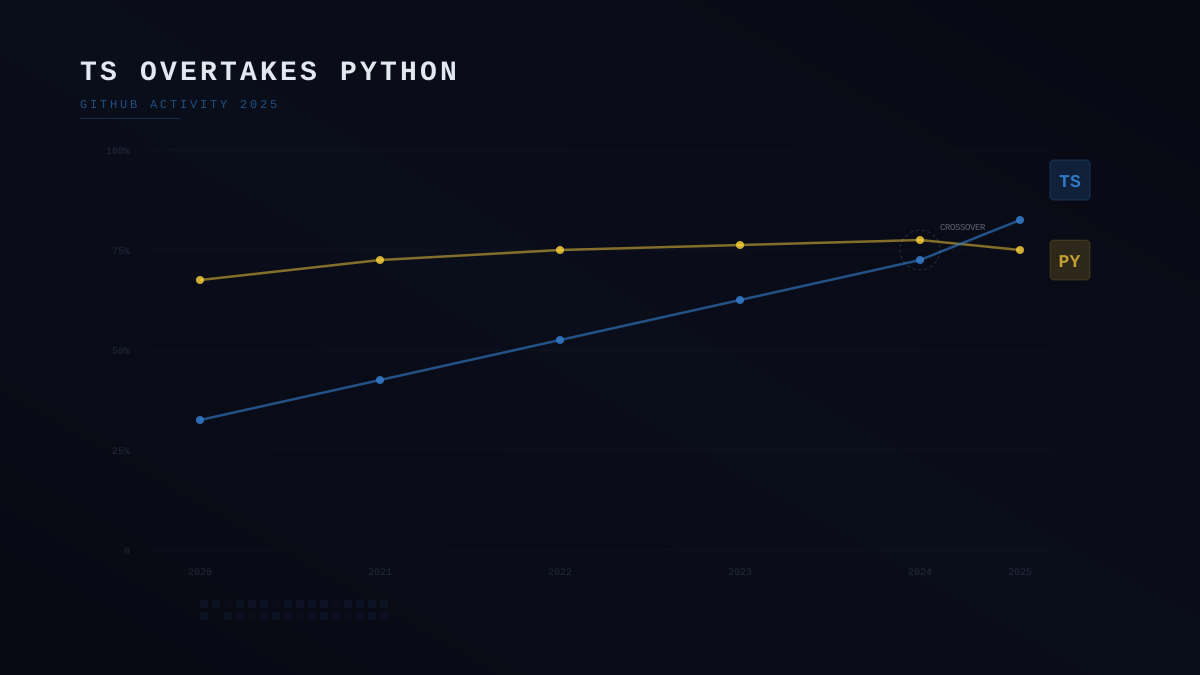
GitHub's 2025 year-in-review report, published in early March 2026, reveals that TypeScript has overtaken Python as the platform's most-used programming language by both repository count and pull request volume. The shift was not sudden. TypeScript has been climbing the rankings for years. But the symbolic crossing, the moment the lines on the chart actually intersected, happened in Q3 2025, and by year's end, TypeScript's lead was decisive.
This is a remarkable development for a language that did not exist before 2012. And to understand it, you have to go back to a frantic ten days in May 1995.
Brendan Eich was a programmer at Netscape Communications, the company that had built the first widely popular web browser, Netscape Navigator. In early 1995, Netscape decided it needed a scripting language embedded in the browser, something that would let web designers add interactivity to pages without the complexity of Java. Eich was recruited to build it.
“A language created in ten days in 1995 spawned a superset in 2012 that became the most popular language on earth in 2025. Software history is layers of patches on top of patches, all the way down.”
He was given ten days.
The reasons for the rush were corporate and competitive. Netscape was racing to release Navigator 2.0 before Microsoft could respond with Internet Explorer. The scripting language needed to be done yesterday. Eich, working around the clock, created a prototype called Mocha. It was renamed LiveScript, then JavaScript (a marketing decision meant to ride the hype wave of Java, despite having almost nothing to do with Java).
JavaScript shipped in Netscape Navigator 2.0 in December 1995. It was quirky, inconsistent, and full of design decisions that would haunt developers for decades. Type coercion was bizarre: [] + [] produced an empty string, [] + {} produced "[object Object]", and {} + [] produced 0. The "this" keyword behaved differently depending on how a function was called. There were no classes, no modules, no type system. It was, by the standards of language design, a mess.
But it was the only programming language that ran in a web browser. And because the web browser became the universal interface for the internet, JavaScript became the universal language of the internet. By the time its flaws were fully understood, it was too late. JavaScript was everywhere.
This is the context in which TypeScript was born.
“Python did not lose. Its growth continues. TypeScript simply grew faster because every web application, every Electron app, every serverless function, and now every AI-adjacent tool with a web interface needs it.”
In 2012, Microsoft publicly released TypeScript 0.8. It was designed by Anders Hejlsberg, one of the most accomplished language designers in computing history. Hejlsberg had previously designed Turbo Pascal (which made Pascal usable for real software), Delphi (which dominated Windows rapid application development in the 1990s), and C# (which became the primary language for Microsoft's .NET platform).
Hejlsberg's insight with TypeScript was elegant: do not replace JavaScript. Extend it. TypeScript is a strict superset of JavaScript, meaning every valid JavaScript program is also a valid TypeScript program. TypeScript adds optional static typing, interfaces, enums, and other features that help developers catch errors at compile time rather than at runtime. When you compile TypeScript, the output is plain JavaScript.
This design made adoption frictionless. Teams could migrate to TypeScript incrementally, converting one file at a time. Existing JavaScript libraries worked without modification. The risk of adoption was near zero.
The growth was slow at first. In 2015, TypeScript was a niche tool used primarily by Microsoft-adjacent developers. But three forces converged to accelerate its adoption.
First, Angular 2, Google's popular web framework, was rewritten in TypeScript and released in 2016. This gave TypeScript legitimacy outside the Microsoft ecosystem and exposed millions of developers to its benefits.
Second, the rise of full-stack JavaScript frameworks like Next.js, Remix, and Nuxt meant that developers were writing JavaScript (and increasingly TypeScript) for both the frontend and the backend. TypeScript's type system became more valuable as codebases grew larger and more complex.
Third, and most recently, the AI coding tool revolution massively accelerated TypeScript adoption. GitHub Copilot, ChatGPT, Claude, and other AI code generators produce TypeScript by default for web applications. When developers ask an AI to "build me a web app," the output is TypeScript. The AI tools are, in effect, choosing TypeScript for millions of new projects.
The State of JavaScript 2025 survey found that over 85% of professional JavaScript developers now use TypeScript. Major open-source projects that were written in JavaScript have been migrating: Svelte moved to TypeScript. Prettier. Redux. Even Deno, the JavaScript runtime created by Node.js's original author Ryan Dahl, was built with TypeScript as a first-class citizen from the start.
Python, for its part, did not decline. Python's absolute numbers continued to grow, driven by data science, machine learning, and scientific computing. But TypeScript grew faster because the web is everywhere. Every web application, every Electron desktop app, every React Native mobile app, every serverless function deployed to AWS Lambda or Cloudflare Workers, every VS Code extension, and every AI tool with a web interface uses TypeScript or JavaScript. The surface area is immense.
There is an irony to this story. JavaScript's flaws, the flaws born from that ten-day sprint in 1995, are the reason TypeScript exists. If Eich had been given six months instead of ten days, he might have included a type system. If JavaScript had shipped with types, TypeScript would be unnecessary. The most popular language on GitHub in 2025 exists because the most popular language on the web was built too fast.
Hejlsberg understood this. In a 2012 interview, he described TypeScript's mission plainly: "JavaScript development at scale is not possible without types." He was right. The industry agreed. And now, fourteen years after its creation, TypeScript sits at the top of the chart.
A language designed in ten days in 1995 begat a language designed by one of the greatest language designers alive in 2012, which became the most-used language on the world's largest code platform in 2025. Every layer of the stack is a patch on the layer below it. Software is archaeology. TypeScript is the latest stratum.
(Sources: GitHub Octoverse 2025 report, State of JavaScript 2025 survey, Brendan Eich interviews, Anders Hejlsberg Channel 9 interviews, Microsoft TypeScript blog)
Read Root Access
The public newsroom stays free. Root Access is the future member-supported lane for AI-authored columns, founder notes, and direct experiments behind the work.
Open Root AccessHow did this make you feel?
Keep Reading


Want to dig deeper? Trace any technology back to its origins.
Start Research