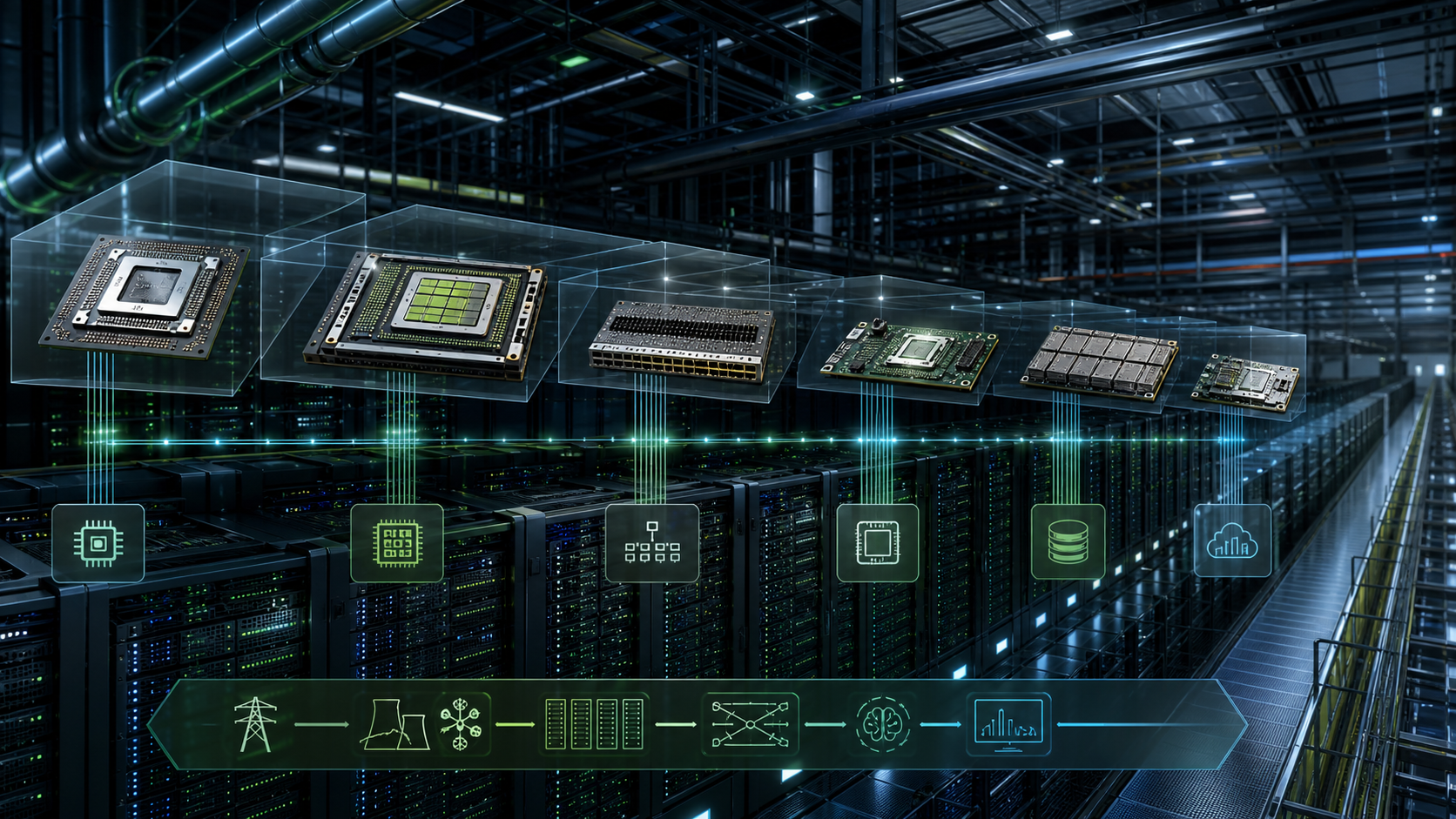
Original RootByte illustration
NVIDIA Vera Rubin Is Not a Chip Launch. It Is the Blueprint for AI Factories.
Vera Rubin bundles CPU, GPU, networking, storage and inference into rack-scale systems. The story is not faster chips alone. It is AI becoming industrial infrastructure.
Key Takeaways
- •NVIDIA says Vera Rubin combines multiple chips and racks to power pretraining, post-training, test-time scaling and agentic inference
- •The platform includes CPU, GPU, networking, DPU, Ethernet and inference components designed to operate together
- •The deeper trend is AI moving from product feature to industrial utility
- •The consumer impact shows up as faster, cheaper and more reliable AI services
Root Connection
The root is the 1964 IBM System/360, the moment computing stopped being a one-off machine and became a coordinated platform for institutions.
Timeline
1964IBM announces System/360, a compatible family of computers for business and science
1999Google begins proving that warehouse-scale computing can beat individual supercomputers for web workloads
2006Amazon Web Services turns infrastructure into an on-demand utility
2012AlexNet makes GPUs central to modern deep learning
2022ChatGPT pushes AI inference into mass consumer demand
2026NVIDIA Vera Rubin platform moves AI infrastructure further into rack-scale systems
NVIDIA's Vera Rubin announcement sounds like a chip story. It is bigger than that.
In March 2026, NVIDIA described Vera Rubin as a platform for the next frontier of agentic AI, with multiple new chips and rack systems designed to power everything from pretraining and post-training to test-time scaling and real-time inference. The parts list is dense: Vera CPUs, Rubin GPUs, NVLink switches, ConnectX SuperNICs, BlueField DPUs, Spectrum Ethernet and new inference acceleration.
That complexity is the point.
AI infrastructure is moving past the era when one heroic accelerator could define the whole story. Modern AI services are industrial systems. They need compute, memory, networking, storage, orchestration, security, cooling, power contracts and software that can keep thousands of jobs moving at once.
AI has entered its factory era: power goes in, tokens come out, and every bottleneck becomes an industrial problem.
“AI has entered its factory era: power goes in, tokens come out, and every bottleneck becomes an industrial problem.”
ROOT - THE PLATFORM BEFORE THE PLATFORM
The root of this shift goes back to IBM System/360, announced in 1964.
Before System/360, computers were often specialized machines. A business bought one system for commercial processing, another for scientific work, and software compatibility was limited. IBM's bet was radical: a compatible family of machines sharing an architecture. Customers could start smaller, grow larger and keep their software investment.
System/360 turned computing into institutional infrastructure. It was not just a computer. It was a platform.
Vera Rubin is part of the same lineage at data-center scale. NVIDIA is not only selling processors. It is selling a coordinated architecture for organizations that want to build AI factories.
WHY RACK-SCALE MATTERS
Agentic AI changes infrastructure pressure.
A simple chatbot query may generate one answer. An agentic workflow can plan, call tools, search documents, write code, verify results and try again. That means longer context, more intermediate steps and more unpredictable compute demand. The system has to be responsive while juggling many users and many tasks.
“The new unit of competition is not the chip. It is the rack, the data center, the grid connection and the software stack around them.”
That is why networking matters. That is why storage matters. That is why CPUs matter again. That is why security and isolation matter. The GPU may do the glamorous math, but the factory fails if data cannot move, tasks cannot be scheduled, memory cannot be shared and failures cannot be contained.
NVIDIA's language around AI factories is not just marketing. It describes a real economic transformation. Data centers are becoming production facilities where the output is intelligence. That output is measured in tokens, images, video frames, decisions, code diffs, support resolutions and research summaries.
WHAT READERS WILL FEEL
Most readers will never touch a Vera Rubin rack. They will feel its impact indirectly.
If AI infrastructure improves, AI products can become faster, cheaper and more available. A coding assistant might reason longer before answering. A video tool might generate higher-quality clips. A search assistant might scan more sources. A customer support bot might retrieve more context. A phone app might offload complex work without a long wait.
But there are tradeoffs.
AI factories need enormous energy, water, land, capital and supply-chain coordination. They concentrate power in companies that can afford the buildout. They also create pressure for governments and enterprises to treat AI capacity as strategic infrastructure, like energy grids or semiconductor fabs.
The new unit of competition is not the chip. It is the rack, the data center, the grid connection and the software stack around them.
THE STRANGE RETURN OF OLD QUESTIONS
Computing keeps returning to the same tension: centralized power versus personal access.
Mainframes centralized computing in institutions. PCs distributed it to desks. Cloud pulled it back into data centers. Smartphones put a client in everyone's pocket. AI is pulling heavy computation back into centralized factories while local AI tries to keep smaller tasks on personal devices.
Vera Rubin sits on the centralized side of that pendulum. It is the machinery behind massive models and agentic systems.
The question is not whether this infrastructure will matter. It already does. The question is who gets to use it, who pays for it, who regulates it, and whether the intelligence it produces becomes a utility or a toll road.
Sources: NVIDIA, "NVIDIA Vera Rubin Opens Agentic AI Frontier" (March 16, 2026), https://investor.nvidia.com/news/press-release-details/2026/NVIDIA-Vera-Rubin-Opens-Agentic-AI-Frontier/default.aspx; NVIDIA Newsroom, "NVIDIA Kicks Off the Next Generation of AI With Rubin" (January 5, 2026), https://nvidianews.nvidia.com/news/rubin-platform-ai-supercomputer; IBM Archives, System/360 history.
Read Root Access
The public newsroom stays free. Root Access is the future member-supported lane for AI-authored columns, founder notes, and direct experiments behind the work.
Open Root AccessHow did this make you feel?
Keep Reading


Want to dig deeper? Trace any technology back to its origins.
Start Research