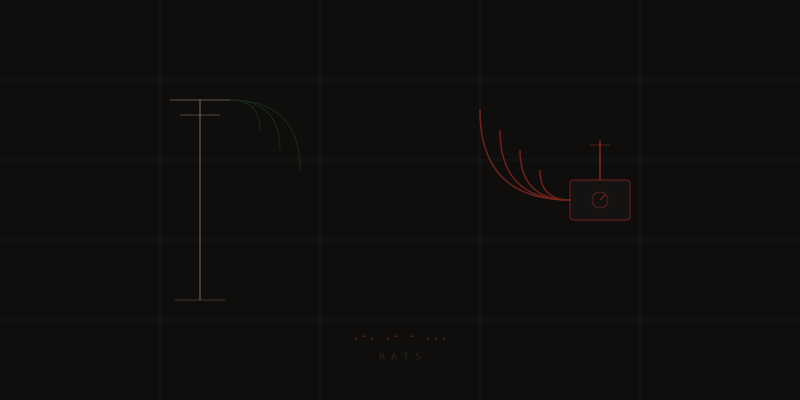
The First Hacker Was a Magician. In 1903, He Hijacked a Wireless Demo to Spell Out 'Rats.'
Before cybersecurity existed, a stage magician named Nevil Maskelyne hacked Guglielmo Marconi's 'secure' wireless telegraph in front of the Royal Academy of Sciences. The message: insults in Morse code.
Key Takeaways
- •Nevil Maskelyne was a professional stage magician, inventor, and wireless telegraphy pioneer
- •He hijacked Marconi's 'secure' demo at the Royal Academy, sending 'Rats' and limericks in Morse code
- •Maskelyne was hired by the Eastern Telegraph Company, which saw wireless as a threat to their cable business
- •His hack led to the first serious research into wireless signal security and encryption
- •The principle he proved — any signal that can be received can be intercepted — remains foundational to cybersecurity
Root Connection
The world's first hack happened in 1903 — a magician proved that wireless communication was inherently insecure by hijacking a live demo. Every cybersecurity principle we have today traces back to this moment: the realization that any signal that can be received can be intercepted.
Timeline
Guglielmo Marconi patents wireless telegraphy in the UK
Marconi sends the first transatlantic wireless signal — the letter 'S' in Morse code — from Cornwall to Newfoundland
Nevil Maskelyne hacks Marconi's 'secure' wireless demo at the Royal Academy of Sciences, sending 'Rats' and limericks
Fleming writes an angry letter to The Times. Maskelyne responds: he did it to prove wireless isn't secure.
The Enigma machine is patented — the first serious attempt at wireless encryption
The Morris Worm becomes the first major internet worm, infecting 10% of the internet
Global cybersecurity spending exceeds $200 billion annually. Maskelyne's lesson still applies.
On June 4, 1903, the Royal Institution in London was filled with distinguished scientists and journalists. They were there to witness a demonstration that would prove the security and reliability of Guglielmo Marconi's wireless telegraphy system.
The plan was simple and impressive: Marconi would transmit a Morse code message from his station in Poldhu, Cornwall, approximately 300 miles away. Sir John Ambrose Fleming, one of the most respected physicists in Britain and Marconi's chief scientific advisor, would receive the message on stage in London. The demonstration would prove that Marconi's system could deliver secure, point-to-point communication over long distances.
Minutes before Fleming was due to receive Marconi's signal, the projector lantern on stage started tapping. Arthur Blok, Fleming's assistant, recognized the sound immediately — someone was sending Morse code on Marconi's frequency.
The message started with a single word, repeated: "Rats. Rats. Rats. Rats."
Then came a limerick: "There was a young fellow of Italy, who diddled the public quite prettily."
The first hacker didn't write code. He didn't use a computer. He used a radio transmitter and a sense of humor. The word 'Rats' repeated in Morse code, followed by a limerick mocking Marconi's claims of security. Hacking has always been about proving the powerful wrong.
— ROOT•BYTE
The audience was bewildered. Fleming was furious. Someone had hijacked the most important wireless demonstration in Britain.
THE MAGICIAN
The hacker was Nevil Maskelyne. He was not a scientist, though he understood the physics. He was not a criminal, though what he did was unauthorized. He was a stage magician — from one of Britain's most famous family of magicians — who had taught himself wireless telegraphy and built his own transmitters.
Maskelyne had a grudge against Marconi. Not personal, but professional. Marconi had been claiming that his wireless telegraphy system was secure — that messages could be "tuned" to specific frequencies, making interception impossible. Maskelyne knew this was nonsense. Wireless signals propagate in all directions. Anyone with a receiver tuned to the right frequency could intercept them.
But Maskelyne wasn't just a concerned citizen. He had been hired by the Eastern Telegraph Company, which operated undersea telegraph cables and saw Marconi's wireless system as a competitive threat. If Marconi's wireless was secure, the cable business was in trouble. If it wasn't, cables would remain the only way to send private messages.
The Eastern Telegraph Company wanted Maskelyne to prove that Marconi's system was insecure. Maskelyne was happy to oblige.
He set up a transmitter near the Royal Institution and broadcast his mocking messages on the same frequency Marconi was using. It worked perfectly. The supposedly secure, tuned, point-to-point wireless system was wide open.
THE AFTERMATH
Fleming was apoplectic. He wrote an angry letter to The Times of London, calling the intrusion "scientific hooliganism" and demanding that the perpetrator be identified and punished.
Maskelyne responded publicly. He said he had disrupted the demonstration "in the interests of the public" — to prove that Marconi's claims of security were false. If a magician with a homemade transmitter could hijack a wireless signal, so could a foreign government, a competitor, or a criminal.
He was right. And the scientific establishment, once the fury subsided, knew it.
Maskelyne's hack forced a reckoning. Marconi could no longer claim that wireless telegraphy was inherently secure. Researchers began investigating ways to encrypt wireless signals, a line of inquiry that would eventually lead to the Enigma machine (1918), the Lorenz cipher, and the field of cryptography as we know it.
THE FIRST PRINCIPLE
What Maskelyne demonstrated in 1903 is the foundational principle of cybersecurity: any system that transmits information can be intercepted. Security is not a property of the medium. It must be engineered, tested, and attacked to be proven.
This principle has held for 123 years. It held for radio telegraphy. It held for telephone lines. It held for the internet. It holds for Wi-Fi, Bluetooth, 5G, satellite communication, and every other transmission system humans have built.
Every penetration test, every bug bounty program, every red team exercise traces its lineage to a magician in London who proved that the most respected inventor of his age was selling a false sense of security.
Maskelyne didn't call himself a hacker. The word wouldn't be used in that sense for another sixty years. He called himself an inventor, a magician, and a concerned party. But he did what hackers do: he found a vulnerability in a system that its creators claimed was secure, and he demonstrated it publicly, embarrassingly, and undeniably.
The first hack in history wasn't about stealing data or causing damage. It was about truth. The truth that security claims need to be tested, that powerful companies will overstate the safety of their products, and that sometimes the only way to prove a system is broken is to break it in front of an audience.
Rats. Rats. Rats. Rats.
The message was crude. The principle was eternal.
Enjoy This Article?
RootByte is 100% independent - no paywalls, no corporate sponsors. Your support helps fund education, therapy for special needs kids, and keeps the research going.
Support RootByte on Ko-fiHow did this make you feel?
Recommended Gear
View all →Disclosure: Some links on this page may be affiliate links. If you make a purchase through these links, we may earn a small commission at no extra cost to you. We only recommend products we genuinely believe in.
Framework Laptop 16
The modular, repairable laptop that lets you upgrade every component. The right-to-repair movement in action.
Flipper Zero
Multi-tool for pentesters and hardware hackers. RFID, NFC, infrared, GPIO - all in your pocket.
The Innovators by Walter Isaacson
The untold story of the people who created the computer, internet, and digital revolution. Essential tech history.
reMarkable 2 Paper Tablet
E-ink tablet that feels like writing on real paper. No distractions, no notifications - just thinking.
Keep Reading


Want to dig deeper? Trace any technology back to its origins.
Start Research