The First Computer Virus Said 'I'm the Creeper: Catch Me If You Can.' It Was 1971.
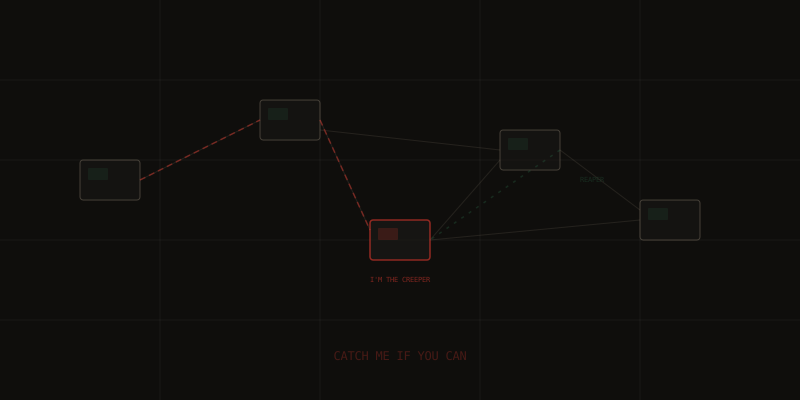
Before ransomware, before phishing, before cyberwarfare — there was Creeper. A self-replicating program that jumped between ARPANET computers in 1971, leaving a taunting message. Then someone built Reaper to hunt it down.
Key Takeaways
- •Creeper (1971) was the first self-replicating program, created by Bob Thomas at BBN Technologies
- •It ran on ARPANET — the precursor to the internet — infecting DEC PDP-10 mainframes running TENEX
- •Max 28 machines could be infected — that was the entire TENEX network on ARPANET
- •Reaper (1972) was the first antivirus — built by Ray Tomlinson (inventor of email) to hunt and delete Creeper
- •Von Neumann theorized self-replicating programs in 1949, 22 years before one actually existed
Root Connection
Creeper was an experiment, not an attack. But it proved that self-replicating programs could spread across networks — a concept that would define cybersecurity for the next 55 years. The first antivirus, Reaper, was written to chase Creeper down. The cat-and-mouse game has never stopped.
Timeline
John von Neumann publishes 'Theory of Self-Reproducing Automata' — the theoretical foundation for computer viruses
Bob Thomas at BBN creates Creeper, the first self-replicating program, on ARPANET. It displays 'I'M THE CREEPER: CATCH ME IF YOU CAN'
Ray Tomlinson (inventor of email) creates Reaper — the first antivirus program, designed to hunt and delete Creeper
Brain, the first PC virus, is created by two Pakistani brothers to protect their medical software from piracy
The Morris Worm infects ~6,000 computers (10% of the internet), leading to the first Computer Fraud conviction
WannaCry ransomware attacks 200,000 computers in 150 countries. Damages estimated at $4-8 billion.
Global cybersecurity market exceeds $200 billion. AI-generated malware emerges as the next frontier.
In 1971, the internet as we know it did not exist. But its ancestor did. ARPANET, the Advanced Research Projects Agency Network, connected a handful of universities and research institutions through dedicated telephone lines and packet-switching nodes. It was small. At its peak in the early 1970s, about 28 machines ran the TENEX operating system on the network.
One of those machines, at BBN Technologies in Cambridge, Massachusetts, was being used by a programmer named Bob Thomas.
Thomas was working on a practical question: could a program move itself from one computer to another across the network? Not a copy of a file. Not a message. A running program that would transfer itself to a new machine and execute there.
He wrote Creeper.
THE FIRST VIRUS
The first computer virus wasn't malicious. It didn't steal data or demand ransom. It was a proof of concept that left a playful message: 'I'm the Creeper: Catch me if you can.' The first antivirus was written to catch it. The entire $200-billion cybersecurity industry started as a game of tag.
— ROOT•BYTE
Creeper was simple by any modern standard. It was a self-replicating program that used ARPANET's file transfer protocol to copy itself from one DEC PDP-10 mainframe to another. When it arrived on a new machine, it displayed a message on the teletype terminal:
I'M THE CREEPER : CATCH ME IF YOU CAN
That's all it did. No data theft. No file corruption. No ransom demand. Just a taunt. A digital "tag, you're it."
In its original form, Creeper was a traveler, not a colonizer. When it copied itself to a new machine, it deleted itself from the previous one. There was only ever one instance of Creeper at any given time, hopping from machine to machine like a frog on lily pads.
Then Ray Tomlinson got involved.
Tomlinson is better known for another invention: he's the man who created email in 1971 and chose the @ symbol to separate user from machine in email addresses. But he also modified Creeper. Tomlinson's version didn't delete itself from the old machine when it moved. It left a copy behind. Now there were multiple instances of Creeper spreading across the network.
This modification turned Creeper from a traveling program into a replicating one. It is this version — Tomlinson's — that most accurately fits the definition of a computer virus: a program that copies itself to new hosts without the user's knowledge or consent.
THE FIRST ANTIVIRUS
Tomlinson didn't just make Creeper worse. He also wrote the cure.
Reaper was a program designed to move through ARPANET, find instances of Creeper, and delete them. It was, in essence, the first antivirus software — a program whose sole purpose was to hunt down and eliminate another program.
Reaper used the same propagation mechanism as Creeper. It spread across the network autonomously, searching for Creeper on each machine it reached. When it found Creeper, it deleted it. When it didn't find Creeper, it moved on.
The symmetry is remarkable. The first virus and the first antivirus were created within months of each other, by people who worked in the same building, using the same technology. The cat-and-mouse game that defines modern cybersecurity — malware evolves, defenses adapt, malware evolves again — was established in its very first iteration.
THE THEORETICAL ROOT
Creeper wasn't the first time someone had imagined self-replicating programs. That distinction belongs to John von Neumann, the polymath who contributed to quantum mechanics, game theory, nuclear weapons, and computer architecture.
In 1949, von Neumann delivered a series of lectures at the University of Illinois on his "Theory of Self-Reproducing Automata." He demonstrated mathematically that a machine could, in principle, build a copy of itself if given the right instructions. The theory was abstract — von Neumann was thinking about physical machines, not software. But his framework applied perfectly to computer programs.
Twenty-two years later, Bob Thomas proved von Neumann right.
FROM PRANK TO PANDEMIC
Creeper was an experiment. Nobody was harmed. The entire "infection" was limited to at most 28 machines, all operated by researchers who were more intrigued than alarmed.
But the principle it demonstrated — that a program could autonomously spread across a network — was a preview of everything that followed.
In 1986, two Pakistani brothers, Basit and Amjad Farooq Alvi, created Brain, the first virus for IBM PCs. They wrote it to protect their medical software from piracy. It spread via floppy disks and infected the boot sector. Like Creeper, it was more prank than weapon — it even included the brothers' names, address, and phone numbers.
In 1988, Robert Morris, a Cornell graduate student, released the Morris Worm. It was supposed to gauge the size of the internet. Instead, it replicated out of control, infecting approximately 6,000 computers — about 10% of the entire internet at the time. Morris became the first person convicted under the Computer Fraud and Abuse Act.
And then the stakes escalated. Viruses became tools of crime, espionage, and warfare. ILOVEYOU (2000) caused $10 billion in damage. Stuxnet (2010) destroyed Iranian nuclear centrifuges. WannaCry (2017) paralyzed hospitals, factories, and government agencies across 150 countries.
The global cybersecurity industry now exceeds $200 billion in annual spending. Billions of dollars, millions of professionals, entire government agencies — all of it dedicated to a problem that Bob Thomas demonstrated with a playful message on a teletype in 1971.
I'M THE CREEPER : CATCH ME IF YOU CAN
Fifty-five years later, we're still trying to catch it.
Enjoy This Article?
RootByte is 100% independent - no paywalls, no corporate sponsors. Your support helps fund education, therapy for special needs kids, and keeps the research going.
Support RootByte on Ko-fiHow did this make you feel?
Recommended Gear
View all →Disclosure: Some links on this page may be affiliate links. If you make a purchase through these links, we may earn a small commission at no extra cost to you. We only recommend products we genuinely believe in.
Framework Laptop 16
The modular, repairable laptop that lets you upgrade every component. The right-to-repair movement in action.
Flipper Zero
Multi-tool for pentesters and hardware hackers. RFID, NFC, infrared, GPIO - all in your pocket.
The Innovators by Walter Isaacson
The untold story of the people who created the computer, internet, and digital revolution. Essential tech history.
reMarkable 2 Paper Tablet
E-ink tablet that feels like writing on real paper. No distractions, no notifications - just thinking.
Keep Reading


Want to dig deeper? Trace any technology back to its origins.
Start Research