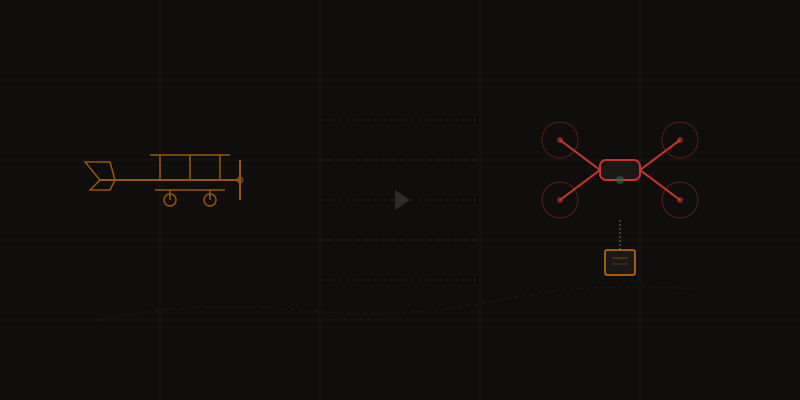
Amazon Delivers Packages by Drone. The First Unmanned Aircraft Was Built for War in 1917.
Sperry and Hewitt built an unmanned gyroscope-stabilized biplane in 1917. It was designed to fly into ships and explode. Now that technology delivers your packages.
Key Takeaways
- •The Hewitt-Sperry Automatic Airplane of 1917 was the world's first drone — a flying bomb guided by gyroscopes
- •The word 'drone' comes from the Queen Bee, a 1935 British target aircraft
- •DJI controls over 70% of the global consumer drone market
- •Amazon Prime Air and Wing have completed over 200,000 drone deliveries
- •Cheap FPV kamikaze drones costing $500 are destroying million-dollar equipment in Ukraine
Root Connection
Hewitt-Sperry Automatic Airplane (1917) → Amazon Prime Air and DJI consumer drones (2024)
ROOT
In the spring of 1917, the United States was weeks away from entering World War I. The US Navy, desperate for any technological edge against the German Imperial Navy, funded one of the strangest weapons projects of the war: an unmanned biplane that could fly itself into an enemy ship and explode on impact. They called it the Hewitt-Sperry Automatic Airplane — and it was, by every modern definition, the world\'s first drone.
The two men behind it were unlikely collaborators. Peter Cooper Hewitt was a wealthy inventor — the son of Abram Hewitt, a former mayor of New York City — who had already made his name inventing the mercury-vapor lamp. Elmer Ambrose Sperry was an engineering genius who founded the Sperry Gyroscope Company and had been perfecting gyroscopic stabilization systems for the Navy\'s ships and torpedoes. Their idea was deceptively simple: take a standard Curtiss N-9 biplane, remove the pilot, and replace him with a gyroscopic autopilot system connected to an aneroid barometer for altitude control. The aircraft would launch from a catapult, fly a pre-set distance toward its target using gyroscope-guided heading, and then nose-dive into whatever was below it — carrying a payload of explosives.
Test flights began on Long Island, New York, at the Sperry Gyroscope Company\'s facility near Amityville. The early results were promising but deeply imperfect. The "aerial torpedo," as the Navy classified it, could maintain heading and altitude with surprising accuracy over short distances. But controlling the exact range — knowing precisely when to dive — proved maddening. Several test flights ended with the unmanned biplane sailing past its target and crashing into Long Island farmland, much to the alarm of local residents. The war ended in November 1918 before the weapon could be deployed in combat.
But the idea didn\'t die. In 1918, Charles Kettering — the same engineer who invented the electric starter motor for cars — built the Kettering "Bug" for the Army. It was cheaper and simpler: a papier-mâché and wood biplane with a 40-horsepower engine, designed to be expendable. The Bug could fly 75 miles at 50 mph, then drop its wings and fall as a bomb. The Army ordered production but, again, the armistice came first.
The next critical leap came from Britain. In 1935, the Royal Navy converted de Havilland Tiger Moth biplanes into radio-controlled target aircraft for anti-aircraft gunnery practice. They named the project Queen Bee — and this is where the word "drone" was born. The male honeybee, the drone, serves no purpose except to be used by the hive. The name stuck. Every unmanned aircraft since has carried it.
Israel transformed drones from curiosities into weapons of modern warfare during the 1970s and 1980s. The Tadiran Mastiff, first flown in 1973, was a small reconnaissance drone that proved devastatingly effective during the 1982 Lebanon War. Israel used drones to identify and bait Syrian surface-to-air missile batteries, allowing manned jets to destroy them with minimal risk. The US military took notice. By 2000, the CIA was flying General Atomics Predator drones over Afghanistan for surveillance. After September 11, 2001, Predators were armed with Hellfire missiles — and the age of armed drone warfare began.
Meanwhile, in a university dorm room in Shenzhen, China, a 26-year-old engineering student named Frank Wang was building something very different. In 2006, he founded DJI (Dà-Jiāng Innovations) with a focus on flight controller systems for hobbyist helicopters. Within a decade, DJI would make drones accessible to anyone with a few hundred dollars — and completely transform what "drone" means to civilians.
TODAY
DJI controls over 70% of the global consumer drone market in 2025. Their Mavic, Mini, and Air series have made aerial photography and videography accessible to millions of creators, farmers, surveyors, and hobbyists. A DJI Mini 4 Pro costs under $800 and shoots 4K video with obstacle avoidance — technology that would have been classified military hardware two decades ago. DJI\'s dominance is so complete that the US government has repeatedly tried to ban their products over data security concerns, pushing bills like the Countering CCP Drones Act through Congress.
Delivery drones are no longer science fiction — they\'re infrastructure. Amazon Prime Air has been in limited rollout since 2024, delivering packages under 5 pounds within a 7.5-mile radius in select Texas and California communities. Wing, Alphabet\'s drone delivery subsidiary, has completed over 200,000 deliveries across the US, Australia, and Finland. Walmart has partnered with Zipline — originally founded to deliver blood and medical supplies in Rwanda — to deliver household goods in parts of Arkansas and Texas. The logistics are real: drone delivery reduces last-mile costs by up to 90% compared to truck delivery for small packages.
Agriculture may be where drones have the most transformative impact. DJI\'s Agras T40 can spray 21 acres per hour with precision application of pesticides, fertilizers, and seeds. In China alone, agricultural drones service over 150 million acres annually. Multispectral imaging drones can detect crop disease, water stress, and nutrient deficiency weeks before a human eye would notice — saving billions in crop losses.
The Ukraine war, beginning in 2022, has rewritten the rules of drone warfare with terrifying speed. Cheap first-person-view (FPV) kamikaze drones — some costing as little as $500 — are destroying tanks, armored vehicles, and fortified positions worth millions. Both sides have established dedicated drone units. The conflict has become the world\'s largest proving ground for autonomous warfare technology, with AI-assisted targeting systems being tested in real combat. It is the most significant evolution in military drone use since the Predator.
Drone racing has emerged as a legitimate sport, with the Drone Racing League (DRL) broadcasting races on NBC and attracting millions of viewers. Pilots wearing FPV goggles fly custom-built quads at speeds exceeding 90 mph through neon-lit courses. In the US, the FAA Part 107 certification has created a regulated commercial drone industry — over 350,000 certified remote pilots operate legally for photography, inspection, mapping, and delivery services. The global drone market is valued at over $45 billion by 2025 and growing at 13% annually.
Enjoy This Article?
RootByte is 100% independent - no paywalls, no corporate sponsors. Your support helps fund education, therapy for special needs kids, and keeps the research going.
Support RootByte on Ko-fiHow did this make you feel?
Recommended Gear
View all →Disclosure: Some links on this page may be affiliate links. If you make a purchase through these links, we may earn a small commission at no extra cost to you. We only recommend products we genuinely believe in.
Framework Laptop 16
The modular, repairable laptop that lets you upgrade every component. The right-to-repair movement in action.
Flipper Zero
Multi-tool for pentesters and hardware hackers. RFID, NFC, infrared, GPIO - all in your pocket.
reMarkable 2 Paper Tablet
E-ink tablet that feels like writing on real paper. No distractions, no notifications - just thinking.
Playdate Handheld Console
The tiny yellow gaming handheld with a crank. A love letter to indie games and playful design.
Keep Reading



Want to dig deeper? Trace any technology back to its origins.
Start Research