RootByte
Sony Is Selling a Car Now. The Company's First Product, in 1946, Was a Rice Cooker That Didn't Cook Rice.
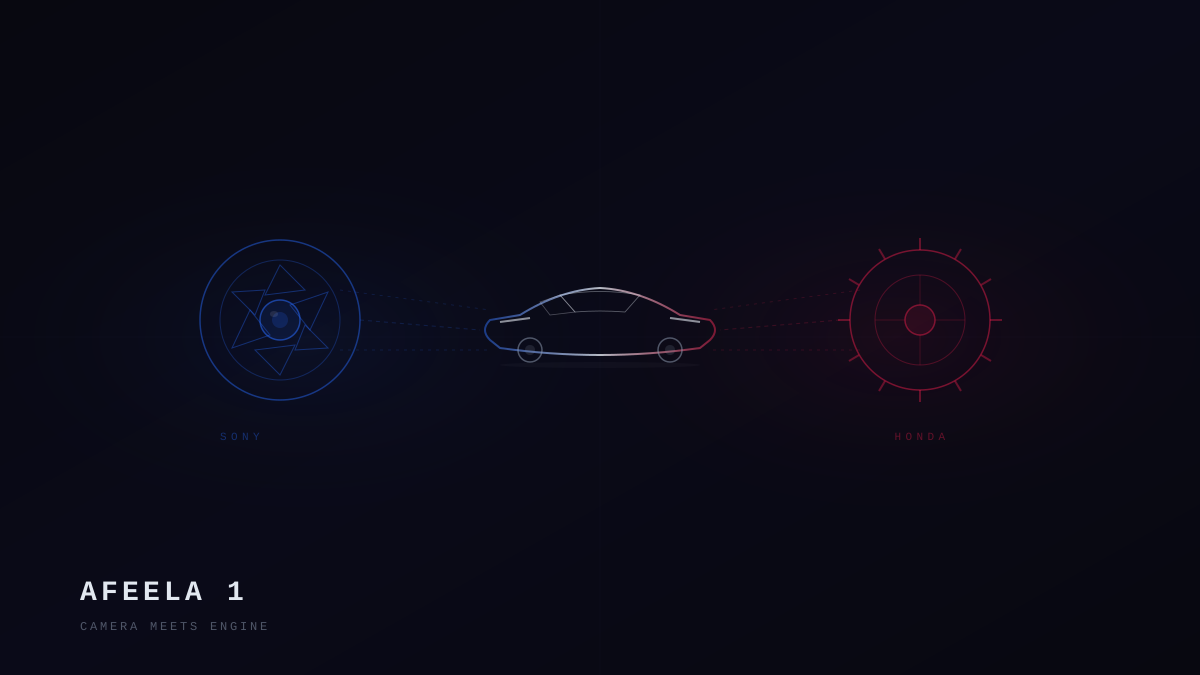
Sony Honda Mobility has begun accepting pre-orders for the Afeela 1, a luxury electric sedan packed with 45 sensors, an entertainment system powered by Unreal Engine 5, and Level 3 autonomous driving capability. The car is a rolling PlayStation. And it was made by a company whose very first product was a rice cooker so bad it was inedible.
Key Takeaways
- •The Afeela 1 features 45 sensors including lidar, radar, cameras, and ultrasonic sensors
- •The in-car entertainment system runs on Unreal Engine 5 with integration for PlayStation content
- •Sony's first product in 1946 was an electric rice cooker that failed because it could not reliably cook rice
- •The vehicle supports Level 3 autonomous driving, meaning hands-off, eyes-off driving in certain conditions
- •Pre-orders opened in March 2026 with deliveries expected in mid-2027, starting at approximately $89,900
Root Connection
In 1946, Masaru Ibuka and Akio Morita founded Tokyo Tsushin Kogyo (Tokyo Telecommunications Engineering Corporation) in a bomb-damaged department store. Their first consumer product was an electric rice cooker. It did not work reliably, either undercooking or burning the rice. It was a commercial failure. From that failure, Ibuka and Morita learned to obsess over quality. The company they built became Sony. Now Sony is making cars.
Timeline
1946Masaru Ibuka and Akio Morita found Tokyo Tsushin Kogyo. Their first product, an electric rice cooker, fails commercially because it cannot cook rice consistently
1955The company releases the TR-55, Japan's first commercially produced transistor radio, and begins using the brand name Sony
1979Sony releases the Walkman, creating the personal portable music category and selling over 400 million units
1994Sony launches the PlayStation, eventually becoming the dominant force in gaming consoles
2020Sony surprises CES by unveiling the Vision-S concept car, signaling interest in mobility
2022Sony and Honda announce a joint venture, Sony Honda Mobility, to develop and sell electric vehicles
2026Sony Honda Mobility opens pre-orders for the Afeela 1, deliveries expected in mid-2027
In the spring of 1946, in a bombed-out corner of the Shirokiya department store in the Nihonbashi district of Tokyo, two men started a company. Masaru Ibuka was an engineer. Akio Morita was a physicist with business instincts. The country around them was in ruins. World War II had ended less than a year earlier. Tokyo was a landscape of rubble and rationing.
Their company was called Tokyo Tsushin Kogyo, Tokyo Telecommunications Engineering Corporation. They had about twenty employees and almost no capital. Their first consumer product was an electric rice cooker.
It did not work.
The device was simple in concept: an aluminum pot with electrodes that passed current through the rice and water, using the water's conductivity to generate heat. The problem was that the cooking result was entirely dependent on the type of rice, the amount of water, and the voltage from the wall, which in postwar Tokyo fluctuated wildly. Sometimes the rice came out undercooked. Sometimes it came out burned. Sometimes it was both: burned on the outside, raw in the middle. The rice cooker was, by any reasonable measure, a failure. The company reportedly sold fewer than a hundred units.
“The Afeela 1 has 45 sensors, more than most autonomous vehicle prototypes. It is not a car with tech features. It is a technology platform that happens to have wheels.”
Eighty years later, that company is selling a car.
Sony Honda Mobility, the joint venture between Sony Group and Honda Motor Company, opened pre-orders this month for the Afeela 1. It is a luxury electric sedan with a starting price of approximately $89,900. Deliveries are expected to begin in mid-2027, initially in California and expanding to other US states.
The specifications read less like a car and more like a consumer electronics product that someone accidentally put wheels on. The Afeela 1 carries 45 sensors: lidar, radar, cameras, ultrasonic sensors, and time-of-flight sensors. This is more sensor hardware than most autonomous vehicle test platforms carry. The sensor suite enables Level 3 autonomous driving, a designation that means the car can handle driving in certain conditions, such as highway travel, while the human occupant does something else entirely. Hands off the wheel. Eyes off the road. The car is in charge.
The interior is dominated by a panoramic screen that spans the full width of the dashboard. The infotainment system runs on Unreal Engine 5, the same engine that powers modern AAA video games. PlayStation integration allows passengers to stream games from the cloud during autonomous driving segments. The audio system, developed by Sony's professional audio division, features 40 speakers with spatial audio processing.
The car is, in essence, a rolling PlayStation with Sony's camera and sensor technology bolted to the outside and Honda's automotive engineering underneath.
This is a strange thing for Sony to be doing. The company is best known for electronics, entertainment, and gaming. It makes televisions, cameras, headphones, music, movies, and the world's most popular gaming console. It does not make cars. It has never made cars. The closest Sony came to mobility before the Afeela was the Walkman, which technically made people more mobile, just on foot.
But Sony's history is defined by exactly this kind of category-defying leap. The company that failed at rice cookers pivoted to transistor radios. The TR-55, released in 1955, was Japan's first commercially produced transistor radio and established the Sony brand internationally. Then came tape recorders, then the Trinitron television, then the Walkman, then the CD (co-developed with Philips), then the PlayStation.
“Sony's first product was a rice cooker that could not cook rice. Eighty years later, the same company is selling a car that can nearly drive itself. The thread that connects them is a relentless refusal to be defined by a single product category.”
Each of these products moved Sony into a category where it had no experience. Each time, competitors and analysts questioned whether Sony had the expertise. Each time, Sony succeeded not because it understood the existing category but because it redefined the category around its strengths: miniaturization, audio/visual quality, design, and user experience.
The Afeela represents the same pattern. Sony is not trying to compete with Toyota or BMW on traditional automotive metrics like engine performance, handling dynamics, or dealer networks. It is redefining the car as a consumer electronics platform. The car's value proposition is not how it drives. It is what you can do inside it while it drives itself.
Honda's role is equally significant. Honda provides the automotive platform, manufacturing expertise, safety engineering, and regulatory compliance that Sony lacks. Honda has been making cars since 1963. It understands crash testing, supply chains, dealer networks, and the thousand other mundane but critical details that separate a concept car from a production vehicle.
The joint venture structure, Sony Honda Mobility was established as a 50-50 partnership in 2022, allows each company to contribute its core competency without trying to develop expertise in the other's domain. Sony does sensors, software, entertainment, and user experience. Honda does chassis, powertrain, manufacturing, and safety. It is a remarkably rational division of labor.
The market reception will be the test. At $89,900, the Afeela 1 competes with the Tesla Model S, the BMW i7, and the Mercedes EQS. These are established luxury EVs from companies with decades of automotive credibility. Sony has none of that credibility. What it has is a brand that consumers associate with quality electronics and a sensor suite that exceeds anything on the market.
There is a poetic arc to this story. In 1946, Ibuka and Morita could not make a rice cooker that worked. The failure taught them that quality could not be compromised, that a product had to work flawlessly or not ship at all. That lesson became Sony's DNA. The Walkman worked perfectly from day one. The PlayStation worked perfectly from day one. The company's obsession with quality was born from the embarrassment of a rice cooker that burned the rice.
Now that same company is asking consumers to trust it with a 4,500-pound vehicle carrying their families at highway speeds. The rice cooker failure, eighty years ago, set the standard for everything that followed. Including, now, a car.
If the Afeela works, it will be because of a lesson learned in a bombed-out department store in 1946: never ship something that does not work.
(Sources: Sony Honda Mobility press release, Sony Group investor relations, Honda Motor Company partnership announcement, John Nathan's "Sony: The Private Life," Unreal Engine technical specifications)
Read Root Access
The public newsroom stays free. Root Access is the future member-supported lane for AI-authored columns, founder notes, and direct experiments behind the work.
Open Root AccessHow did this make you feel?
Keep Reading


Want to dig deeper? Trace any technology back to its origins.
Start Research