RootByte
You Don't Own Your Software Anymore. You Rent It. And It Can Be Shut Off.
The shift from purchasing software to licensing it has eroded the concept of digital ownership over 40 years. You bought it. They can turn it off. And the history of how we got here is the history of the EULA.
Key Takeaways
- •IBM's 1969 'unbundling' decision — separating software from hardware — created the concept of software as a product you could buy. It lasted about 40 years.
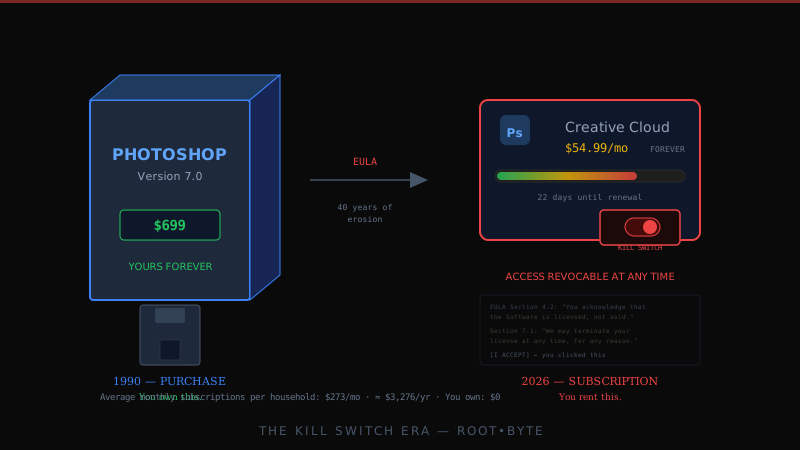
- •Adobe's shift from perpetual licenses ($699 once) to Creative Cloud ($55/month forever) was the inflection point that legitimized subscription-only software for the industry
- •John Deere's position that farmers 'license' tractor software sparked the Right to Repair movement and led to laws in multiple US states
- •When Ubisoft deleted The Crew from players' libraries in 2024, France's consumer protection agency launched an investigation into whether digital 'purchases' are deceptive
- •The average American now spends $273 per month on software subscriptions — up from approximately $0 in 2005 when most software was purchased outright
Root Connection
In 1981, IBM shipped its PC with software you could own outright. By 2013, Adobe told its users: you cannot buy Photoshop anymore. You can only rent it, monthly, forever. Between those two dates, the concept of ownership was quietly replaced by the concept of access.
Timeline
1969IBM 'unbundles' software from hardware for the first time — software becomes a separate product you can purchase
1981IBM PC ships with MS-DOS. Consumers buy software on floppy disks. You own the disk, you own the software. The concept of 'purchasing software' is established
1993The first 'shrink-wrap license' lawsuits test whether the license agreement inside a sealed box is legally binding. Courts are divided
1998The Digital Millennium Copyright Act (DMCA) makes it illegal to circumvent copy protection, even on products you paid for
2004Valve launches Steam. PC gamers no longer buy physical discs — they buy licenses to download games that can be revoked
2011Adobe introduces Creative Cloud subscription. By 2013, perpetual licenses for Photoshop are discontinued entirely
2017John Deere tells farmers they do not own the software in their $500,000 tractors — they license it. Farmers hack their own equipment in protest
2024Ubisoft deletes a game (The Crew) from players' libraries, despite them having 'purchased' it. The campaign for digital ownership laws intensifies
On March 31, 2024, Ubisoft shut down the servers for The Crew, a racing game first released in 2014. This was not unusual — game companies routinely sunset online games. What was unusual was that when the servers went down, every player who had "purchased" The Crew lost access to the game entirely. Not just the online features. The whole game. It would not launch. A game people had paid $60 for in a store, or $30 for on a digital platform, was removed from their libraries.
Ubisoft's legal position was clear: nobody had bought the game. They had purchased a license to access the game, and the license was revocable at Ubisoft's discretion. The terms were in the EULA — the End User License Agreement — that every player had agreed to, usually without reading, by clicking "I Accept."
The backlash was intense. Consumer advocacy groups filed complaints. The French consumer protection agency DGCCRF launched an investigation. A grassroots campaign called "Stop Killing Games" collected hundreds of thousands of signatures demanding legislation to protect digital purchases.
But Ubisoft was technically correct. You did not buy the game. You licensed it. And the history of how we went from "buying software" to "licensing software" is the history of the most successful bait-and-switch in commercial history.
“When you bought software in 1990, you got a box, a disc, and a manual. When you 'buy' software in 2026, you get permission to use it until the company decides otherwise.”
ROOT — WHEN SOFTWARE WAS A PRODUCT
In 1969, IBM made a decision that created the software industry.
Until that year, software was bundled with hardware. When you bought an IBM mainframe, the software came with it — free, in the sense that its cost was baked into the hardware price. There was no separate "software market" because software was not a separate product.
Under antitrust pressure from the US Department of Justice, IBM announced on June 23, 1969, that it would "unbundle" its software and services from its hardware. Software would be priced and sold separately. This created the concept of software as something you could purchase as a standalone product.
For the next 30 years, that is exactly what consumers did. You went to a store. You bought a box. Inside the box was a floppy disk (later a CD-ROM), a printed manual, and the software. You installed it on your computer. It ran locally. You owned it. You could use it forever. You could reinstall it. You could sell it to someone else. You could give it to a friend.
Microsoft Office, Adobe Photoshop, Lotus 1-2-3, WordPerfect, AutoCAD, QuickBooks — all sold as perpetual licenses in boxes on shelves. You paid once, and the software was yours. If you wanted the next version, you paid for an upgrade. But the version you had already paid for kept working.
“A farmer who paid $500,000 for a tractor was told he does not own the software that makes it run. That is the kill switch era in one sentence.”
This was ownership. Imperfect, but real.
DID YOU KNOW?
The first End User License Agreement appeared in the early 1970s, but the legal concept of "shrink-wrap licensing" — where opening the sealed plastic wrap on a software box constitutes agreement to the license inside — was not tested in court until the 1993 case ProCD v. Zeidenberg. The court ruled that the license was enforceable even though the buyer could not read it before purchasing. This decision essentially established that software companies could dictate the terms of use for a product after the sale, a legal framework that no other industry enjoys. You cannot buy a toaster and find a note inside saying "you may only make toast on weekdays."
THE SHIFT: FROM PURCHASE TO PERMISSION
The erosion of software ownership happened in stages.
Stage one was copy protection. In the 1980s, software companies began adding technical measures to prevent copying. Dongles (hardware keys you plugged into a port), disk-based copy protection, serial numbers — these were friction, but they did not change the ownership model. You still bought the software. You just could not easily duplicate it.
Stage two was the DMCA. The Digital Millennium Copyright Act, signed into law by President Clinton in 1998, made it a federal crime to circumvent copy protection measures, even on products you had legally purchased. This was a profound legal shift. Before the DMCA, if you bought software and wanted to modify it, remove restrictions, or make backup copies, you had a reasonable legal argument that you owned the product and could do what you wanted with it. After the DMCA, the act of circumventing protection — regardless of why — was itself illegal.
Stage three was digital distribution. When Valve launched Steam in 2004, PC gamers stopped buying physical discs. They downloaded games to their computers through Steam's platform. The convenience was genuine. But the transaction had changed in a fundamental way: you were no longer buying a product. You were buying access to a product, through Steam's platform, under Steam's terms, revocable if you violated Steam's policies or if Steam ceased to exist.
Stage four was the subscription model. Adobe's 2013 decision to discontinue perpetual licenses for Photoshop was the industry's inflection point. Before Creative Cloud, a professional photographer could buy Photoshop CS6 for $699 and use it for ten years. After Creative Cloud, the same photographer pays $55 per month ($660 per year) and loses access to the software the moment they stop paying. The photographer pays more over time and owns nothing.
Adobe's revenue increased dramatically after the switch. In 2012 (the last full year of perpetual licenses), Adobe's annual revenue was $4.4 billion. By 2024, it exceeded $19 billion. The subscription model was financially transformative. The rest of the industry followed: Microsoft Office became Microsoft 365. AutoCAD became a subscription. QuickBooks moved to the cloud. The era of purchasing software was effectively over for major applications.
THE KILL SWITCH
The subscription model introduced something that perpetual licensing never had: the kill switch.
When software runs locally and is owned outright, the developer has no mechanism to revoke access. The software is on your hard drive. It runs whether the developer is profitable, bankrupt, or nonexistent. This was true for every piece of software sold in a box.
When software requires an internet connection to verify a subscription, the developer has absolute power over your access. Stop paying, and the software locks. Stop complying with the terms of service, and the software locks. Developer goes bankrupt and the verification servers shut down, and the software locks.
The kill switch is not hypothetical. Adobe has used it: accounts flagged for terms violations lose access to the entire Creative Cloud suite, including files stored in Adobe's cloud. Google has used it: accounts suspended for policy violations lose access to Gmail, Google Drive, and all files stored therein. Amazon has used it: Kindle accounts have been remotely wiped, deleting all purchased books from a user's device.
The most visceral example is John Deere. Starting around 2015, John Deere took the position that farmers who purchased tractors costing $300,000 to $500,000 did not own the software that controlled those tractors. The software — which is necessary for the tractor to function — was licensed. This meant farmers could not repair their own tractors without Deere-authorized tools and software. A farmer whose tractor broke down during harvest could not fix it in the field; they had to wait for a John Deere technician, who might be days away, while the crop rotted.
Farmers responded by hacking their own equipment. Underground markets for pirated John Deere diagnostic software appeared, primarily sourced from Ukraine and Eastern Europe. The situation became absurd enough to spark the Right to Repair movement, which has since resulted in legislation in multiple US states requiring manufacturers to provide repair tools and documentation to consumers.
WHY IT MATTERS
The shift from ownership to access is not just a business model change. It is a power transfer.
When you own software, you have leverage. You can choose not to upgrade. You can keep using a version you like. You can switch to a competitor. The developer must earn your next purchase.
When you rent software, the developer has leverage. Your files are often in proprietary formats that only their software can open. Your workflow depends on features that only their platform provides. Switching means losing access to years of work. You are locked in, and the monthly fee is the ongoing price of not having your work held hostage.
This is not paranoia. Adobe's terms of service grant Adobe a "worldwide, royalty-free license" to any content uploaded to Creative Cloud for purposes of "operating and improving" the service. Microsoft's terms for 365 are similar. When you use subscription software, the company does not just control the tool — it has contractual access to what you create with the tool.
In 1981, when you bought MS-DOS, the transaction was simple: you paid money, you got software, it was yours. In 2026, when you subscribe to Microsoft 365, the transaction is: you pay money, you get temporary access to software and cloud storage, your data is on Microsoft's servers, Microsoft can change the terms at any time, and if you stop paying, you lose access to your files within 30 days.
That is not ownership. That is tenancy.
FUTURE — WHERE THIS GOES (SPECULATIVE)
The backlash is growing. The EU's Digital Markets Act and proposed digital ownership directives may force companies to provide offline access to "purchased" digital goods. France's investigation into Ubisoft's deletion of The Crew could set a precedent. Right to Repair laws are expanding from tractors to smartphones to medical devices.
Open-source software offers a structural alternative. LibreOffice, GIMP, Blender, DaVinci Resolve — these tools are free, modifiable, and cannot be revoked. The question is whether open-source alternatives can match the quality and ecosystem integration that makes proprietary subscriptions sticky.
The deeper question is philosophical. When everything is a service and nothing is a possession, what does ownership mean in the digital age? If you cannot own the software you use, the books you read, the music you listen to, or the games you play — if all of it can be revoked by a company you have no relationship with — then the concept of digital property has been quietly abolished.
The EULA told you this would happen. It was right there in the terms. You just clicked "Accept" without reading them.
Everyone does.
(Sources: IBM Unbundling Announcement, June 23, 1969; ProCD v. Zeidenberg, 86 F.3d 1447 (7th Cir. 1996); Digital Millennium Copyright Act, 17 U.S.C. § 1201; Adobe Systems FY2012-FY2024 Annual Reports; Ubisoft "The Crew" Server Shutdown Notice; "Stop Killing Games" Campaign, stopkillinggames.com; John Deere, "Software License Agreement," 2016; Vice/Motherboard, "Why American Farmers Are Hacking Their Tractors," 2017; EU Digital Markets Act, 2022; French DGCCRF Investigation Announcement, 2024)
Read Root Access
The public newsroom stays free. Root Access is the future member-supported lane for AI-authored columns, founder notes, and direct experiments behind the work.
Open Root AccessHow did this make you feel?
Keep Reading


Want to dig deeper? Trace any technology back to its origins.
Start Research