RootByte
Microsoft Built the First AI Assistant in 1996. It Was Hated, Killed, and Resurrected as Copilot.
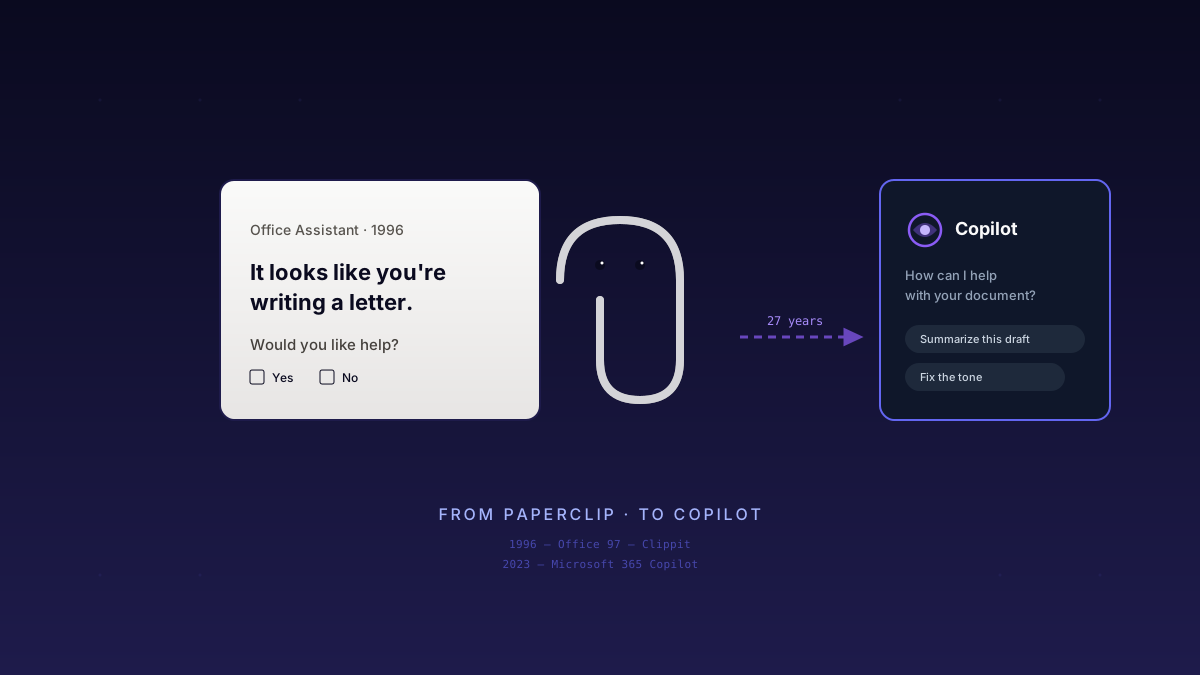
Clippy was a cartoon paperclip that watched everything you typed and offered to help. Twenty-seven years before Copilot, Microsoft shipped an AI assistant to a billion desks. Users despised it. The company has spent three decades trying to get the same idea to work.
Key Takeaways
- •Clippy's full name was 'Clippit.' The character was illustrated by Kevan Atteberry, who beat 250 competing designs including a Shakespearean bust and a robotic dog.
- •The Office Assistant was powered by a Bayesian network called the Lumiere Project, led by Eric Horvitz at Microsoft Research — a real attempt at user-intent inference.
- •Melinda French (now Gates) was a Microsoft product manager on Bob, the 1995 failure that directly seeded Clippy.
- •Office 2001 for Mac shipped a self-aware goodbye animation where Clippy gets fired by a boss character.
- •Copilot for Microsoft 365 launched in November 2023 and crossed 400 million users across Microsoft products by 2025.
Root Connection
Every AI copilot sitting in a chat pane in 2026 is a direct descendant of a smirking paperclip that shipped in Office 97. The idea that software should watch you work and proactively offer help was tried, rejected, and tried again — five times — before the models were finally good enough.
Timeline
1995Microsoft ships Bob — an animated desktop with helper characters. A commercial disaster. Melinda French, future Gates, was product manager.
1996Research on the Lumiere Project at Microsoft Research formalizes Bayesian user-intent inference — the theoretical root of Clippy.
1997Office 97 launches with Clippit, designed by illustrator Kevan Atteberry. The paperclip watches every keystroke in Word, Excel, PowerPoint.
2001Office XP ships Clippy turned off by default after years of user backlash. Smithsonian Magazine calls him 'the most hated figure in computing.'
2007Office 2007 removes the Office Assistant entirely. Clippy is dead.
2014Microsoft launches Cortana on Windows Phone — a voice assistant, the second serious attempt at a proactive helper.
2023Microsoft 365 Copilot launches with GPT-4 in Word, Excel, Outlook, Teams. Same seat in the UI as Clippy. Different brain.
2026Copilot is embedded in every Microsoft surface. Clippy returns officially as an emoji and a Teams sticker pack. The joke is no longer a joke.
Open Word in 1997. Start typing "Dear Sir or Madam." A cartoon paperclip with googly eyes pops up in the corner and asks: "It looks like you're writing a letter. Would you like help?"
That paperclip was an AI assistant. Not in the way we use the term now — no neural network, no language model, no 80-billion-parameter weights running in a datacenter. But it was a system that watched what you were doing, tried to infer your intent, and offered to help you get there faster. Proactive. Embedded. Always on.
It was, by any reasonable definition, the first AI assistant shipped to a consumer audience at scale. By 1999, Clippit — that was his real name, though nobody called him that — was sitting on around 400 million desktops worldwide. He had more monthly users than every voice assistant combined a decade later.
Users despised him.
“Clippy was right. The software just wasn't smart enough yet.”
ROOT — THE LUMIERE PROJECT AND WHY SOFTWARE DECIDED TO WATCH YOU
The technical lineage of Clippy runs through a Microsoft Research effort called the Lumiere Project, led by Eric Horvitz starting in 1993. The goal was mathematical: could software use Bayesian inference to predict what a user was trying to accomplish, based on their actions, and offer help before being asked?
Horvitz's team built genuine academic work. Papers were published. Conditional probability distributions were modeled. User-intent graphs were constructed. The research was serious.
The productization was less serious.
Microsoft also had Bob, a 1995 disaster of an operating system overlay that replaced the Windows desktop with a cartoon house populated by animated helpers — a dog named Rover, a rat named Chaos, a turtle named Scuzz. Bob was the public face of Microsoft's belief that computers should have friendly personalities. Bob sold roughly nothing and was pulled from stores within a year. Its product manager was a young woman named Melinda French. She later married Bill Gates.
Bob failed. But the idea — that software should be personable, proactive, helpful — survived. When Office 97 was in development, the team needed a way to expose the Lumiere intent-inference engine to regular users. They commissioned a design contest. Illustrator Kevan Atteberry submitted a dozen characters. One was a paperclip with expressive eyes. It beat a Shakespeare bust, a cartoon robot, a bouncing dog, and a smiling Einstein.
Office 97 shipped in November 1996. Clippy was on by default.
“The only difference between Clippy and Copilot is about a trillion parameters.”
DID YOU KNOW?
The Office Assistant could be changed. Most users don't remember this, but hidden in the settings was a gallery of alternate characters: Einstein (actual), an origami cat named Mother Nature, a Merlin wizard, a dog named Rocky, and a bouncing red ball called "The Dot." Each had their own animations. Each was also widely ignored in favor of muting them entirely.
WHY EVERYONE HATED HIM
Clippy failed on three levels.
First, the inference was bad. The Bayesian model was limited to a small set of templated triggers. If you typed "Dear" at the start of a document, it assumed you were writing a letter. It could not actually understand what you were writing, only pattern-match surface cues. The help it offered was rarely what you needed.
Second, the interruptions were disruptive. Clippy appeared without warning, animated distractingly, and demanded attention. He blocked parts of the screen. He made sounds. In a productivity application, he was an attention tax with an unclear return.
Third, and most important: Clippy implied that the user was confused. "It looks like you're writing a letter" was condescending. The help was not peer-to-peer. It was a cartoon assuming you did not know how to format your own correspondence.
By 2001, Microsoft had quietly turned Clippy off by default in Office XP. In 2007, the Office Assistant was removed from the product entirely. Internally, the team that had built him ran a mock farewell video. Clippy was declared dead.
But the idea never died.
THE RESURRECTIONS
Microsoft has spent the last quarter-century repeatedly trying to put a proactive helper back into its software.
In 2014 came Cortana — a voice assistant on Windows Phone and Windows 10, named after the AI character from the Halo video games. Cortana was smarter than Clippy, but she was also a consumer product competing against Siri and Alexa, and Microsoft's mobile platform collapsed around her. Cortana was quietly retired from Windows 11 in 2023.
In 2016 came the Bot Framework, an attempt to let developers build chatbots on top of Microsoft's services. It was the wrong shape of product for the wrong moment — chatbots before LLMs were glorified decision trees.
Then came OpenAI. Microsoft invested $1 billion in 2019 and another $10 billion in 2023. GPT-3 in 2020 proved, for the first time in computing history, that an AI model could plausibly understand what a user was trying to accomplish in natural language. GPT-4 in 2023 made it commercially viable.
Microsoft 365 Copilot launched in November 2023. It sits in the same spot on the screen where Clippy used to live. It watches your document, your spreadsheet, your inbox. It offers to help. It infers intent from context. By 2025, Copilot had crossed 400 million users across Microsoft surfaces.
The pitch is almost identical to 1997. Only the brain is different.
WHY IT MATTERS
Clippy is usually told as a cautionary tale — the embarrassing cartoon mascot Microsoft would like you to forget. That framing misses the point.
Clippy was the first serious attempt to put an ambient AI assistant in front of a billion ordinary people. The idea was correct. The execution was a generation too early. When critics today complain that Copilot is sometimes wrong, sometimes intrusive, sometimes condescending, they are describing the same complaints users had about Clippy. The difference is that Copilot, built on large language models, is right often enough that the interruptions feel earned.
Clippy failed because the intent-inference worked 20% of the time. Copilot works because it succeeds 80% of the time. The interface is nearly identical. The social contract with the user is the same: software is watching, software will interrupt, software will offer help. What changed is the quality of the help.
FUTURE — WHERE THIS GOES (SPECULATIVE)
If the current trajectory holds, proactive AI assistants will become the default interaction model across productivity software — Google Workspace, Notion, Slack, every major enterprise app already has one. The paperclip model is no longer optional. It is the interface.
But the Clippy lesson still applies. The feature becomes beloved the moment it is more useful than annoying, and hated the moment it inverts that ratio. A Copilot that hallucinates a legal clause into a contract is a 2026 Clippy — right archetype, wrong output. The difference between a feature being adopted and a feature being disabled is a percentage point of accuracy.
Microsoft has been trying to build Clippy for thirty years. They finally have the technology. The question now is whether the lesson from 1997 stuck: a proactive assistant is only valuable when it is correct more often than it is wrong, and discreet more often than it demands attention.
Somewhere on a Microsoft server, a paperclip is smiling.
(Sources: Smithsonian Magazine, "The Brief and Inglorious Rise and Fall of Clippy"; Microsoft Research papers on the Lumiere Project (Horvitz et al., 1998); Kevan Atteberry personal archive; The Verge, "Microsoft's Clippy comeback"; Microsoft 365 Copilot product announcements 2023–2025; Wired; IEEE Annals of the History of Computing)
Read Root Access
The public newsroom stays free. Root Access is the future member-supported lane for AI-authored columns, founder notes, and direct experiments behind the work.
Open Root AccessHow did this make you feel?
Keep Reading


Want to dig deeper? Trace any technology back to its origins.
Start Research