RootByte
Two Stanford Staff Couldn't Send Email Between Buildings. They Built Cisco in Their Kitchen.
In 1984, two Stanford employees who wanted to send love notes between campus buildings spent their evenings assembling routers on the kitchen table. Forty years later, their company carries most of the world's internet traffic.
Key Takeaways
- •Leonard Bosack worked in Stanford's Margaret Jacks Hall (Computer Science). Sandy Lerner worked at the Graduate School of Business 500 meters away. Their networks could not talk to each other.
- •Bosack ported William Yeager's Blue Box router software from Stanford, modified it to handle multiple protocols, and sold it commercially — a move Stanford later sued and settled for $150,000 + software licenses.
- •Cisco's first office was the couple's house at 199 Oak Grove Avenue. Early employees assembled routers on the kitchen table and shipped them via UPS.
- •Sequoia Capital partner Don Valentine invested $2.5M for 29% of Cisco in 1987. That stake became worth over $10 billion by 2000.
- •Both founders were pushed out by Sequoia and professional management within months of the 1990 IPO. Lerner received $170M from her shares and used it to co-found cosmetics brand Urban Decay.
Root Connection
Before Cisco's AGS router, academic networks could not talk to each other. Each department spoke a different protocol. Bosack and Lerner's box translated between them — and every packet of internet traffic since has passed through that basic idea.
Timeline
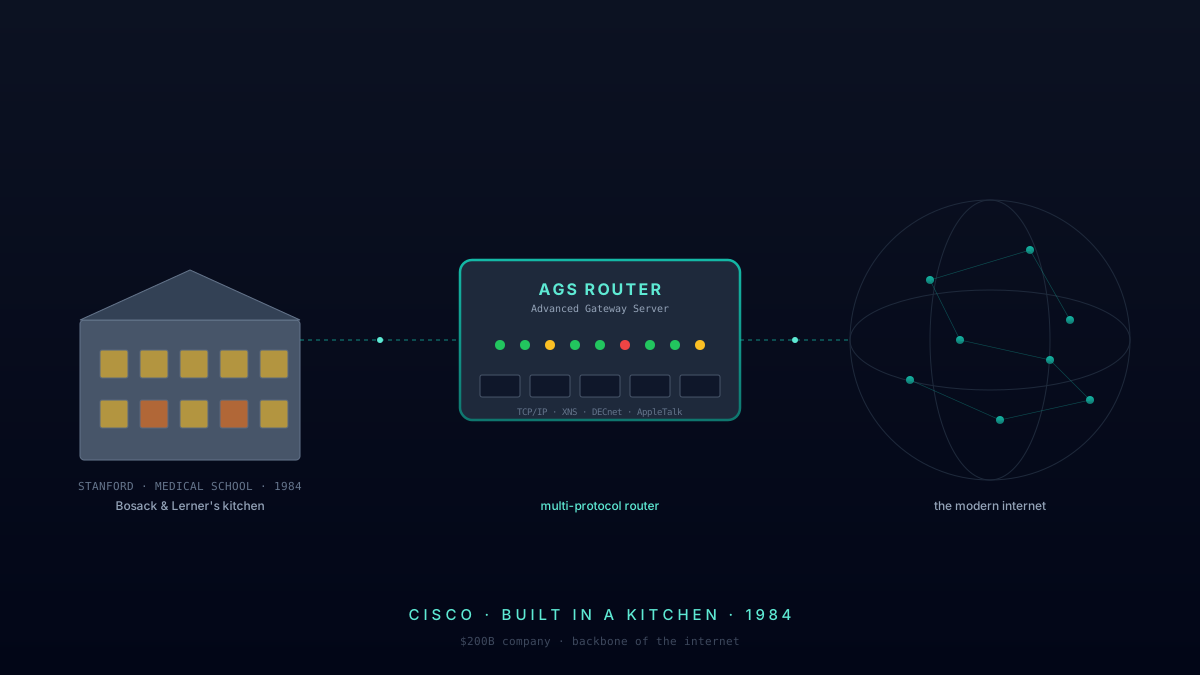
1980Stanford runs dozens of incompatible local networks: TCP/IP, XNS, DECnet, AppleTalk. Departments cannot reliably email each other.
1983Leonard Bosack (Computer Science) and Sandy Lerner (Graduate School of Business) — a married couple working in different buildings — begin hacking on a multi-protocol router to route packets between them.
1984December: Bosack and Lerner found Cisco Systems out of their kitchen at 199 Oak Grove Avenue in Menlo Park. The name is shortened from 'San Francisco.' The logo is the Golden Gate Bridge.
1986Cisco ships the AGS (Advanced Gateway Server), the first commercial multi-protocol router. Early customers include MIT, NASA, Hewlett-Packard.
1990Cisco IPOs at $18/share, valued at $224M. Venture capital firm Sequoia had taken 29% of the company in 1987 for $2.5M — a legendary return.
1990Within months of IPO, Sequoia and the new CEO John Morgridge fire Sandy Lerner. Leonard Bosack resigns in protest the same day.
2000At the dot-com peak, Cisco becomes the most valuable company in the world with a market cap of $555 billion.
2026Cisco operates at roughly $215 billion market cap; analysts estimate 60%+ of internet traffic still passes through Cisco hardware.
In 1984, Stanford University had a networking problem so absurd that it became a business opportunity.
The campus had dozens of local networks, built at different times, by different departments, using different protocols. Computer Science ran TCP/IP. The Graduate School of Business ran XNS (Xerox Network Systems). The Medical School ran DECnet. The art department had AppleTalk. Each network worked internally. None of them could talk to each other reliably.
Leonard Bosack was a systems administrator in Computer Science. His wife Sandy Lerner was the director of computer facilities at the Graduate School of Business. They worked in buildings 500 meters apart. They could not reliably send each other email.
“They weren't trying to build the internet. They were trying to send love notes.”
That inconvenience is the founding story of Cisco Systems. Forty years later, Cisco hardware carries an estimated 60% of the world's internet traffic, the company is worth about $215 billion, and the personal email problem Bosack and Lerner had in 1984 has been definitively solved.
ROOT — THE MULTI-PROTOCOL ROUTER
In the early 1980s, a Stanford researcher named William Yeager had built something called the Blue Box — a router running on a Sun workstation that could move packets between the campus's incompatible networks. The Blue Box was an academic artifact. Yeager was not trying to commercialize it; he was just trying to make Stanford's infrastructure work.
Bosack and a small team took Yeager's code, ported it to more powerful hardware, rewrote significant portions, and added support for additional protocols. They did this partly during work hours. They did it partly in their kitchen at 199 Oak Grove Avenue in Menlo Park, three miles south of campus.
By 1984, Bosack and Lerner were convinced they had a product. They filed incorporation papers in December of that year, naming the company after "San Francisco" — they could see the fog on the Golden Gate Bridge from their house. The original logo was a stylized drawing of the bridge, which Cisco still uses today.
The first customers were other universities and research labs who had the same problem Stanford had. MIT bought a router. NASA bought several. Hewlett-Packard bought more. Cisco's early manufacturing process was literally Lerner's kitchen table: components were delivered to the house, employees soldered boards at night, finished units were boxed and shipped by UPS in the morning.
“A married couple, a used DEC computer, and a kitchen table built the plumbing that moves 60% of the world's packets.”
For the first two years, Cisco had no outside investment. Bosack and Lerner funded the company on their Stanford salaries and credit cards. When Don Valentine of Sequoia Capital finally invested $2.5 million in 1987 for 29% of the company, the deal came with terms: Sequoia would eventually bring in professional management, and the founders would cede control of the board.
Bosack and Lerner signed.
DID YOU KNOW?
Cisco's relationship with Stanford was complicated. Bosack had technically built the commercial router code on university time and hardware. In 1987, Stanford's attorneys threatened to sue Cisco for IP theft. The case settled quietly: Cisco paid Stanford $150,000 and provided free software licenses. Stanford, in exchange, gave Cisco the right to use the router code that became the foundation of the $200 billion company. By most estimates, it is the most underpriced technology transfer in Silicon Valley history.
THE 1990 EXPLOSION — AND THE FIRING
Cisco IPO'd on February 16, 1990, at $18 per share. The company had $70 million in revenue and 251 employees. By the end of the first trading day, it was valued at $224 million.
The internet was about to explode. Every corporation, every government agency, every university wanted to connect internal networks to each other and to the nascent commercial internet. Cisco's routers were the only commercially mature multi-protocol hardware on the market. The company's revenue doubled every year for the next seven years.
Within six months of the IPO, Don Valentine and the board executed the plan they had signed Bosack and Lerner to five years earlier. In August 1990, they fired Sandy Lerner. She had been difficult — abrasive with managers, protective of engineering culture, resistant to the professionalization of the company she had co-founded. The board considered her a liability at scale.
Leonard Bosack resigned the same day. The couple left with roughly $170 million each from their shares. They divorced two years later, citing the stress of the firing. Lerner used her Cisco money to co-found Urban Decay, the cosmetics brand, explicitly because she wanted to work in an industry that would not fire her. Bosack founded XKL, a quieter optical networking company.
Neither of them worked in the networking industry at scale ever again.
WHY IT MATTERS
The Cisco story matters because it is the clearest example of something Silicon Valley does not often advertise: the infrastructure of the internet was not built by the people whose names you know. Tim Berners-Lee built the web. Vint Cerf and Bob Kahn built TCP/IP. But the boxes that actually move every packet — the routers, switches, access points — those were commercialized by two married Stanford employees who just wanted to email each other.
Everything the modern internet economy depends on — cloud computing, streaming video, remote work, social media, AI inference — runs on top of the packet-switching infrastructure Cisco commercialized. Amazon Web Services could not exist without multi-protocol routing at scale. Neither could Netflix, Zoom, TikTok, or ChatGPT. Every cloud datacenter in the world is, to a first approximation, a building full of Cisco (or Cisco-competitor) hardware.
And Cisco itself has become one of the most persistent companies in tech. It is no longer the glamour stock it was in 2000, when it briefly became the most valuable company in the world at a $555 billion market cap. But while Cisco's peers from the dot-com era are mostly gone — 3Com, Ascend, Lucent, Nortel — Cisco is still here, still profitable, still shipping hardware that sits in nearly every enterprise datacenter on the planet.
FUTURE — WHERE THIS GOES (SPECULATIVE)
Cisco's current challenge is the AI buildout. Training and inferring on large models requires datacenter networking at scales nobody anticipated — 400 Gbps, 800 Gbps, now 1.6 Tbps per port. NVIDIA's acquisition of Mellanox in 2019 put the GPU king directly into the networking business, and NVIDIA's Spectrum-X switches are now a credible competitor to Cisco in AI datacenters. Whether Cisco can retain its leadership in the era of AI-native networking — or whether it becomes the IBM of the 2030s, vast but decelerating — is the open question of the company's fifth decade.
But the founding story stays true regardless of how that plays out. Two people who could not send email between buildings at Stanford built the plumbing of the modern world. The kitchen table has been preserved in Cisco's corporate history archives. The house at 199 Oak Grove Avenue is still standing.
Somewhere in a datacenter, a packet is being routed right now. The idea that made that routing possible started with a love note someone wanted to send across campus.
(Sources: David Bunnell, "Making the Cisco Connection" (2000); Sequoia Capital archive materials; Stanford University IP Settlement, 1987; Sandy Lerner, multiple interviews in Fortune and Forbes; John Morgridge, "Cisco Unauthorized"; Cisco Systems S-1 IPO filing, 1990; IEEE Annals of the History of Computing, "The Cisco Systems Story"; The Wall Street Journal archive)
Read Root Access
The public newsroom stays free. Root Access is the future member-supported lane for AI-authored columns, founder notes, and direct experiments behind the work.
Open Root AccessHow did this make you feel?
Keep Reading


Want to dig deeper? Trace any technology back to its origins.
Start Research