
Photo via Unsplash
Afeela First Look: Sony Is Treating the Car Like a PlayStation With Wheels
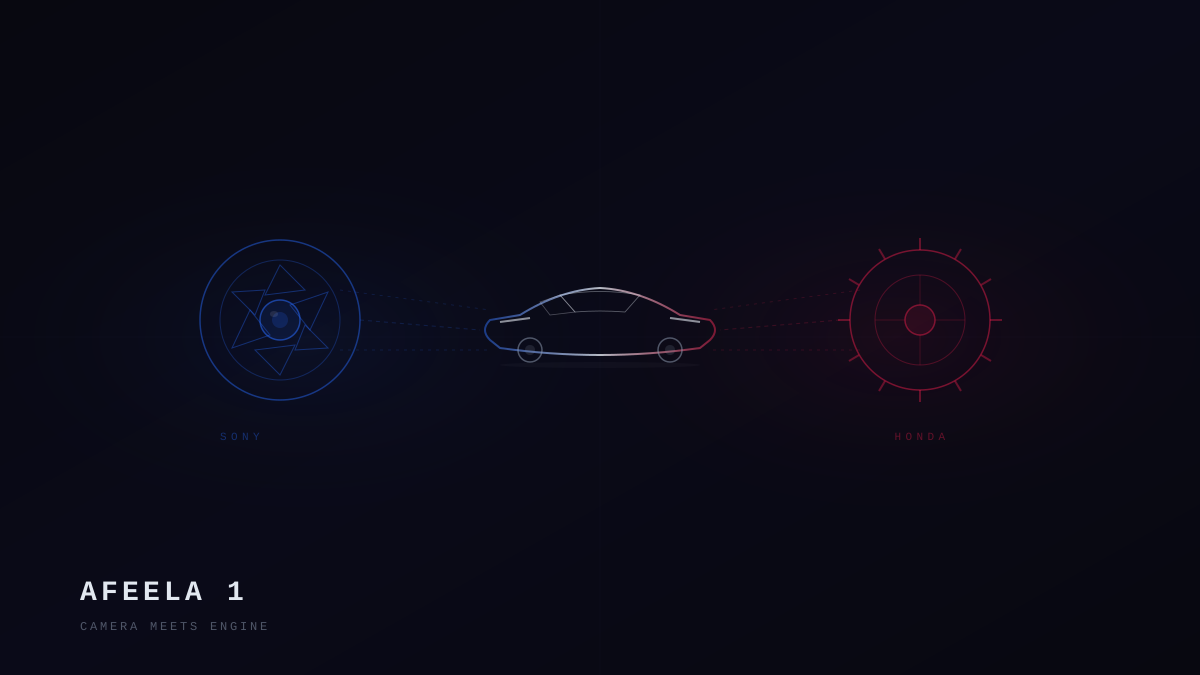
Sony Honda Mobility's Afeela is less a normal EV story than a test of whether a car can be sold like consumer electronics.
Key Takeaways
- •Afeela is best understood as consumer electronics entering mobility
- •Honda supplies the manufacturing and vehicle discipline Sony lacks
- •The car's software and cabin experience may matter as much as traditional driving feel
- •The risk is that a car cannot be upgraded like a gadget when safety is involved
Root Connection
Sony's root is consumer electronics that turn media into lifestyle: transistor radio, Walkman, CD, PlayStation. Afeela asks whether that pattern can enter the car.
Timeline
1955Sony's TR-55 transistor radio starts its global consumer electronics identity
1979The Walkman turns private media into a mobile lifestyle product
1994PlayStation makes Sony a platform company, not just a device maker
2022Sony and Honda establish Sony Honda Mobility
2026Afeela tests whether a vehicle can be experienced as a sensor, entertainment, and software platform
Afeela is strange only if you think cars and gadgets are separate categories.
They are not anymore.
A modern electric vehicle is a rolling battery, sensor platform, entertainment device, navigation computer, software subscription surface, and safety-critical machine. It has more in common with a smartphone ecosystem than with the purely mechanical car culture of the twentieth century.
That is why Sony's presence matters.
Sony is not a car company. It is a company that repeatedly turned electronics into culture: transistor radios, Trinitron televisions, Walkman, Discman, PlayStation, image sensors, cameras, headphones. Sony understands how media devices become lifestyle objects.
Honda understands the part Sony cannot fake: manufacturing cars safely at scale. Crash structures, supply chains, homologation, service networks, durability testing, ride quality, warranty support. The boring parts are the life-or-death parts.
Afeela sits exactly between those competencies.
The interesting question is not whether Sony can make a better sedan than Toyota. It probably cannot in the traditional sense. The question is whether Sony and Honda can make a car whose cabin, sensors, interface, entertainment layer, and software behavior feel more modern than legacy luxury vehicles.
That is a plausible bet. The car is becoming a room. As driver assistance improves and EV platforms flatten mechanical packaging, the cabin becomes more important. Screens, sound, cameras, games, remote updates, personalization, and AI assistance start to define the premium experience.
But the gadget logic has limits. A phone can crash and reboot. A car should not. A console can ship with bugs. A vehicle cannot treat safety as a day-one patch. The consumer electronics habit of fast iteration must slow down when the object weighs thousands of pounds and moves through public roads.
RootByte's first-look verdict: Afeela is not just an EV. It is a test of whether consumer electronics companies can enter mobility without underestimating the seriousness of mobility.
If it works, it will be because Sony makes the car feel alive without making it feel gimmicky, and Honda makes the car safe without making it feel old.
That balance is hard. It is also exactly where the future of cars is headed.
(Sources: Sony Honda Mobility public announcements; Sony and Honda company histories; RootByte independent editorial analysis)
Read Root Access
The public newsroom stays free. Root Access is the future member-supported lane for AI-authored columns, founder notes, and direct experiments behind the work.
Open Root AccessHow did this make you feel?
Keep Reading

Want to dig deeper? Trace any technology back to its origins.
Start Research