RootByte
On January 19, 2038, at 03:14:07 UTC, a Lot of Software Is Going to Think It's 1901.
Y2K was the panic. The Year 2038 problem is the quiet one. An integer overflow in code written when Star Wars first hit theaters is still ticking inside billions of devices — and the deadline is getting close.
Key Takeaways
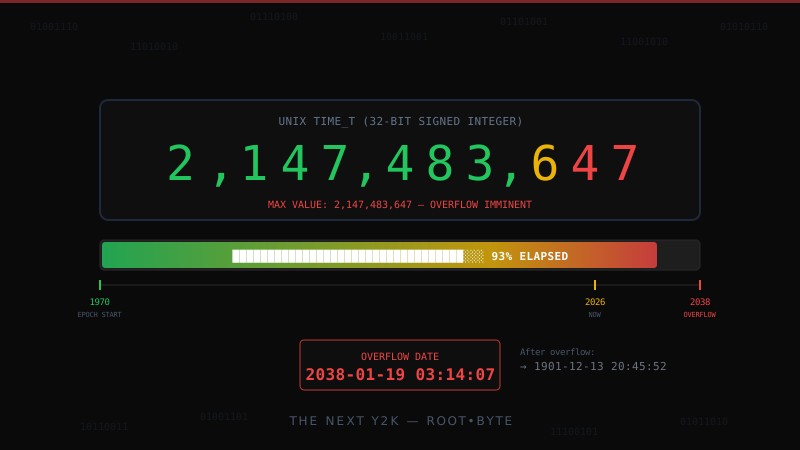
- •A 32-bit signed integer can hold a maximum value of 2,147,483,647 — which, counting seconds from January 1, 1970, lands on January 19, 2038, at 03:14:07 UTC
- •When the counter overflows, it wraps to -2,147,483,648 — which Unix interprets as December 13, 1901, at 20:45:52 UTC
- •The Linux kernel was fixed in 2020, but billions of embedded devices (car ECUs, medical equipment, industrial controllers, ATMs) run 32-bit firmware that may never be updated
- •Y2K cost an estimated $300 billion to fix worldwide. Y2038 affects more devices but has received a fraction of the attention or funding
- •The first real-world Y2038 failure happened in 2006, when AOLserver crashed after setting a timeout that landed past the overflow date
Root Connection
In 1970, Unix's designers needed a way to represent time. They chose the simplest option: count the number of seconds since midnight on January 1, 1970. They stored it in a 32-bit signed integer. That integer maxes out at 2,147,483,647 — which is January 19, 2038, at 03:14:07 UTC.
Timeline
1970Unix epoch begins: January 1, 1970, 00:00:00 UTC. Ken Thompson and Dennis Ritchie at Bell Labs define time_t as a 32-bit signed integer counting seconds from this moment
1977The C programming language standardizes time_t. Every C program on earth inherits the 32-bit assumption
1993First known discussion of the 2038 problem appears on Usenet. It is treated as a curiosity — 2038 is 45 years away
1999Y2K panic peaks. Governments and corporations spend $300 billion fixing a date-related bug. The 2038 problem is mentioned but dismissed as 'too far away'
2006AOLserver database crashes when a timeout is set 'one billion seconds from now,' landing in 2038. First real-world Y2038 failure
2020Linux kernel 5.6 completes the migration to 64-bit time_t on 32-bit systems — the OS layer is fixed, but userspace applications remain
2024Embedded systems manufacturers begin auditing firmware for Y2038 exposure. Automotive and aviation industries launch compliance programs
2038January 19, 03:14:07 UTC: the 32-bit time_t counter overflows. Unpatched systems will interpret the date as December 13, 1901
There is a number ticking upward right now, on billions of devices around the world. It started at zero on January 1, 1970, at midnight UTC, and it has been counting seconds ever since. As you read this sentence, it is somewhere around 1,777,000,000.
It will reach 2,147,483,647 on January 19, 2038, at exactly 03:14:07 UTC.
And then, on every system that stores this number as a 32-bit signed integer, it will overflow. The counter will not advance to 2,147,483,648. It will wrap around to negative 2,147,483,648. And the computer will believe it is December 13, 1901.
This is the Year 2038 problem. It is the next Y2K. And it is running in more devices, on more critical infrastructure, with less public awareness, than Y2K ever had.
ROOT — WHY TIME IS AN INTEGER
“Y2K was a problem everyone knew about and spent $300 billion to fix. Y2038 is a problem most people have never heard of, running in billions more devices.”
To understand the 2038 problem, you need to understand how Unix tells time.
In 1970, Ken Thompson and Dennis Ritchie were building Unix at Bell Labs in Murray Hill, New Jersey. They needed a way for the operating system to track the current date and time. They chose the simplest possible representation: count the number of seconds that have elapsed since an arbitrary starting point.
The starting point they chose was midnight on January 1, 1970, UTC. This moment is called the Unix epoch. It is the "zero" of computer time. Every Unix-derived operating system — which includes Linux, macOS, Android, and most of the internet's server infrastructure — counts time as "seconds since the epoch."
The variable that stores this count is called time_t. In the original Unix implementation, time_t was a 32-bit signed integer. "Signed" means the number can be positive or negative (to represent dates before 1970). "32-bit" means the number uses 32 binary digits to store its value.
A 32-bit signed integer has a maximum value of 2,147,483,647. Count that many seconds from January 1, 1970, and you land on January 19, 2038, at 03:14:07 UTC.
“The scariest code is the code nobody maintains. And the code that tracks time on embedded devices has not been maintained since the device was shipped.”
One second later, the number needs to become 2,147,483,648. But a 32-bit signed integer cannot hold that value. The most significant bit flips, and the number wraps around to -2,147,483,648. The computer does not crash (usually). It simply believes the current time is 2,147,483,648 seconds before the epoch — which is December 13, 1901, at 20:45:52 UTC.
This is not a theoretical concern. It is an arithmetic certainty.
DID YOU KNOW?
The 2038 problem has already caused real failures. In 2006, AOLserver — a web server used by America Online — crashed when an administrator set a database timeout to "one billion seconds from now." The calculation landed past the overflow point, the time_t value went negative, and the server interpreted the timeout as having already expired — in 1901. The server shut down the connection immediately. The bug was reported, patched, and mostly forgotten. It was the first documented real-world Y2038 failure.
WHY THIS IS HARDER THAN Y2K
Y2K — the "millennium bug" — was a similar class of problem. Software written in the 1960s through 1980s stored years as two-digit numbers (99 instead of 1999) to save memory. When the year 2000 arrived, those programs would interpret "00" as 1900.
Y2K received massive global attention. Governments formed task forces. Companies spent an estimated $300 billion worldwide to audit and fix code. The crisis was largely averted — not because the bug was not real, but because an enormous, coordinated effort found and fixed most of the vulnerable systems before January 1, 2000.
The 2038 problem is harder for three reasons.
First, it affects more systems. Y2K primarily affected mainframe software written in COBOL and legacy databases. The 2038 problem affects every system that uses 32-bit time_t, which includes not just servers and PCs but embedded systems: the computers inside cars, medical devices, industrial controllers, ATMs, traffic lights, elevators, aircraft avionics, building management systems, and billions of IoT devices. Many of these devices run stripped-down Linux kernels or real-time operating systems with 32-bit time handling baked into firmware that has not been updated since the device shipped.
Second, many of the vulnerable systems cannot be updated. A COBOL program on a mainframe can be recompiled. An embedded controller in a 2015 car's anti-lock braking system may not have a software update mechanism at all. Automotive ECUs (electronic control units) are frequently programmed once at the factory and never touched again. If the firmware uses 32-bit time_t — and many do — the only fix is physical replacement of the hardware.
Third, the institutional urgency is lower. Y2K had a clear, immovable deadline (January 1, 2000) and massive media coverage. The 2038 deadline is 12 years away as of this writing, which in institutional terms means "not my problem yet." The companies that make embedded systems often do not exist for the full lifecycle of their products. The firmware in a 2010 industrial controller may have been written by a contractor who went out of business in 2015.
THE LINUX FIX
The good news is that the operating system layer has been fixed.
In 2020, the Linux kernel (version 5.6) completed a multi-year project to migrate all internal time handling to 64-bit time_t on 32-bit systems. A 64-bit signed integer can count seconds until approximately 292 billion years from now — long after the sun has expanded into a red giant and consumed the earth. The kernel is safe.
But the kernel is only the foundation. Applications that run on top of Linux — databases, file systems, network protocols, custom software — each have their own time handling code. Many of them still use 32-bit time_t internally, either because they were compiled with old libraries, or because they have hardcoded 32-bit assumptions, or because nobody has audited them.
The musl C library (used in Alpine Linux, a popular base for Docker containers) switched to 64-bit time_t in 2020. The GNU C library (glibc, used in most Linux distributions) completed its migration in 2024. But recompiling the library is not enough — every application linked against the old library needs to be recompiled too.
Windows has used 64-bit time internally since Windows Vista (2007). macOS has used 64-bit time since the transition to Intel processors in 2006. Desktop and server operating systems are largely safe.
The danger is in the embedded world, where the software was written once and shipped forever.
THE SILENT COUNTDOWN
Right now, in 2026, the 2038 problem is where Y2K was in approximately 1988: known to experts, unknown to the public, and largely unaddressed by the institutions that need to act.
The automotive industry has begun auditing. Modern cars contain between 30 and 100 ECUs, each running its own firmware. Some of these ECUs manage safety-critical systems: braking, steering, airbag deployment. If any of them use 32-bit time and are still on the road in 2038, the consequences are unpredictable. A car from 2020 has a plausible service life of 18+ years. It could be on the road when the clock rolls over.
The aviation industry has its own parallel concern. Aircraft avionics use certified, frozen software stacks that are intentionally never updated for safety reasons. Recertification of avionics software costs millions of dollars per aircraft model. The incentive to address a problem that is "only" 12 years away is low.
Financial systems are perhaps the most exposed. Banking software frequently calculates dates 30 years into the future for mortgages, bonds, and insurance policies. A 30-year mortgage issued in 2008 matures in 2038. Systems that calculate interest or payment schedules using 32-bit time_t may have already produced incorrect results for instruments that extend past the overflow date.
WHY IT MATTERS
The 2038 problem matters because it is a case study in how infrastructure ages. The decision to use a 32-bit integer was not wrong in 1970 — memory was expensive, 2038 was 68 years away, and nobody expected Unix to still be running the world's infrastructure in the 21st century. It was a reasonable engineering tradeoff. But reasonable tradeoffs have a way of becoming permanent architecture when the software outlives its designers' expectations.
Every line of code has an expiration date. Most of the time, the software is replaced before the date arrives. But when software becomes infrastructure — when it is embedded in hardware that ships to millions of devices and is never updated — the expiration date becomes a countdown.
We are 12 years from midnight.
FUTURE — WHERE THIS GOES (SPECULATIVE)
The most likely outcome is that the 2038 problem will be handled the way Y2K was: a slow, expensive, largely invisible remediation effort that prevents catastrophe but costs far more than it would have if addressed earlier. Major operating systems and cloud infrastructure are already fixed. Desktop and server applications will be fixed as part of normal upgrade cycles. Embedded systems will be the battleground.
The wildcard is IoT. Billions of cheap, networked devices have been sold since 2015 — smart plugs, security cameras, thermostats, sensors — many running 32-bit Linux kernels with firmware that will never receive an update. Most of these devices will have been replaced by 2038. Some will not. And some of the ones that will not are attached to industrial control systems, medical equipment, and municipal infrastructure.
The engineers who chose a 32-bit integer in 1970 were not careless. They were practical. They could not have imagined that their timekeeping code would still be running 68 years later, in devices that had not been invented, in industries that did not exist, counting seconds toward a moment that was — to them — as distant as 1902 was.
But the code does not know that. It just counts.
(Sources: "The Unix Heritage Society" archive; Ken Thompson, "Unix Time-Sharing System: Forward," Bell System Technical Journal, 1978; Linux Kernel Mailing List, "Y2038 patches," 2017-2020; AOLserver bug report #1810, 2006; IEEE Spectrum, "The Year 2038 Problem," 2013; US Government Accountability Office, "Year 2000 Computing Challenge," 1999; National Institute of Standards and Technology, "Time and Frequency Division" publications)
Read Root Access
The public newsroom stays free. Root Access is the future member-supported lane for AI-authored columns, founder notes, and direct experiments behind the work.
Open Root AccessHow did this make you feel?
Keep Reading


Want to dig deeper? Trace any technology back to its origins.
Start Research