RootByte
The Sony Walkman Was Supposed to Fail. Instead It Invented Personal Technology.
In July 1979, Sony shipped a $150 cassette player with no record function and no speaker. Everyone said it would flop. Every personal device you own traces back to what happened next.
Key Takeaways
- •Masaru Ibuka, co-founder of Sony, personally demanded the product — he wanted to listen to opera during long flights to the US.
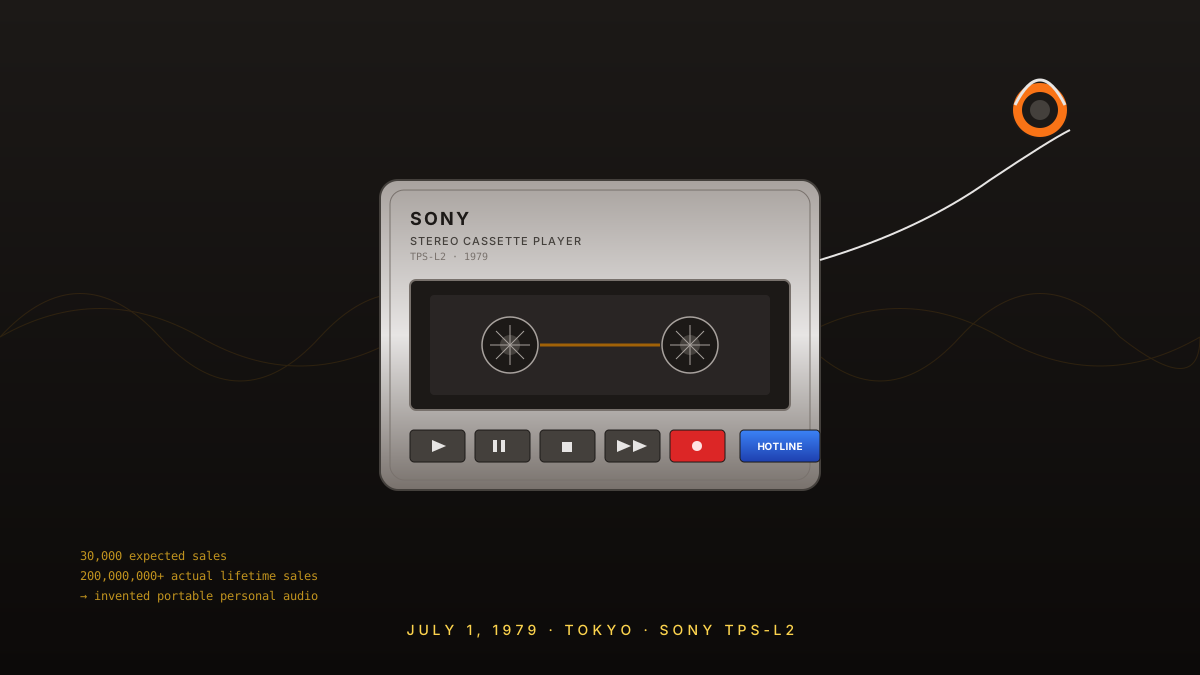
- •The first TPS-L2 had two headphone jacks so couples could share. There was also a 'Hotline' button that muted the music and let you talk through the headphones.
- •Sony's internal forecast was 5,000 units per month. By year two they were shipping 50,000 per month globally.
- •The word 'Walkman' was deemed bad English by Sony's US and UK teams. They rebranded it 'Soundabout' (US) and 'Stowaway' (UK). Both flopped. The Japanese name won.
- •By the time Sony retired the cassette Walkman in 2010, over 200 million units had been sold. It remains one of the most successful consumer electronics products of all time.
Root Connection
The iPhone in your pocket, the AirPods in your ears, the idea that technology should follow you through the world — all of it starts with a cassette player Masaru Ibuka took on a plane in 1978 and asked his co-founder to improve.
Timeline
1978Sony co-founder Masaru Ibuka asks engineers for a portable stereo to listen to opera on long flights. He hates the weight of existing tape recorders.
1979February: Akio Morita greenlights the project with a 4-month deadline and a ¥33,000 (~$150) price target.
1979July 1: The Sony TPS-L2 Walkman goes on sale in Japan. Initial target: 5,000 units/month. First month: fewer than 3,000 sold.
1979August: Sony hires teenagers to roller-skate through Tokyo's Ginza district wearing Walkmans. Demand explodes.
1980US launch under the name 'Soundabout.' UK sells it as 'Stowaway.' Both names flop. Sony switches to the Japanese name globally.
1986'Walkman' enters the Oxford English Dictionary as a generic term for portable cassette players.
1999Sony's 20th-anniversary Walkman ships — by then, 186 million units sold across formats.
2001Apple releases the iPod. Steve Jobs explicitly cites the Walkman as the template. Sony, ironically, does not build a competing MP3 player in time.
On July 1, 1979, Sony shipped a product that its own marketing department had called a mistake. The TPS-L2 was a blue-and-silver cassette player the size of a paperback book. It had no speaker. It had no recording function. It cost ¥33,000 — roughly $150, or about $650 in 2026 dollars. For that price, you got a device that played tapes you already owned, through headphones, while you walked around.
The marketing team's prediction was reasonable. Every cassette player on the market recorded. Every cassette player had speakers. This thing did neither. Who would pay $150 for less?
Sony set the initial production target at 30,000 units for the first six months. They sold fewer than 3,000 in the first month.
Then they did something unusual. Sony hired groups of young people to roller-skate through Ginza — Tokyo's busiest shopping district — wearing the Walkman with the bright orange foam headphones that came in the box. The device was meant to be seen as much as used. Within two months, Tokyo's electronics stores were sold out. By the end of 1980, the Walkman was a global product. By 1986, the word had entered the Oxford English Dictionary as a generic noun.
More importantly: it rewrote what a personal device could be.
“Nobody will buy a tape player that can't record.”
ROOT — THE OPERA PROBLEM
The Walkman exists because Masaru Ibuka, Sony's 71-year-old co-founder, hated long flights. Ibuka was not the CEO — that was his younger co-founder Akio Morita. Ibuka was the engineer, the product obsessive, the one who still prowled the Sony labs in 1978 looking at prototypes.
Ibuka flew frequently to the United States. He loved opera. Sony's existing portable tape recorder, the TC-D5, was excellent — it played stereo cassettes with near-studio fidelity. But it weighed 1.8 kilograms and had to be held in two hands. Useless on a plane.
In early 1979, Ibuka went to Morita and made a simple request: take the TC-D5, strip out the record function, strip out the speaker, add a headphone jack, make it small enough to fit in a coat pocket. Give it to me in four months. Morita, the commercial half of the partnership, was skeptical — but he trusted Ibuka's instincts, and Sony's engineering culture was built on turning founder requests into shipping products.
The TPS-L2 prototype was assembled from existing Sony parts. The Pressman, a mono cassette player Sony sold to journalists, was the chassis. The headphones were adapted from Sony's H-AIR line, featherweight foam cups that weighed 45 grams instead of the then-standard 400 grams. The combination was the first time a consumer could listen to full stereo audio while walking, without carrying anything heavier than a hardcover book.
“The Walkman did not invent the cassette player. It invented the idea that technology should go where you go.”
Sony's US and European divisions hated the name "Walkman." They told Morita it was broken English and would confuse customers. Morita let them rebrand. The US got "Soundabout." The UK got "Stowaway." Australia called it "Freestyle." All four regions saw sluggish sales under the local names. In 1981, Morita overrode his regional teams and mandated a single global name: Walkman. Sales tripled the following year.
DID YOU KNOW?
The original TPS-L2 had two headphone jacks. The feature was called the "Guys and Dolls" jack internally, and was built on the assumption that couples or friends would want to share music on the go. Sony also added a small orange button labeled "Hotline" — pressing it activated a built-in microphone that mixed voice into the audio stream, so two people sharing the Walkman could briefly talk without removing their headphones. The feature was quietly dropped by the third generation when Sony's researchers realized that almost everyone was using the Walkman alone.
WHY IT MATTERS
The Walkman did not invent portable audio. Transistor radios had been mass-market since the 1950s. It did not invent the cassette — Philips had done that in 1963. It did not invent headphones — Koss had built stereo headphones in 1958.
What the Walkman invented was the idea that technology should be personal, mobile, and private. Before 1979, sound was shared. Music played out of radios, jukeboxes, home stereos, car speakers. Even a transistor radio was a broadcast device — you listened to whatever a DJ was playing. The Walkman let you choose your own soundtrack and carry it with you, in a bubble that no one else could hear. You could walk down a street and be somewhere else.
That bubble turned out to be the most commercially important idea in consumer electronics.
Every personal device since — the Discman, the MiniDisc, the iPod, the iPhone, AirPods, the Apple Watch, the Quest headset — is a direct descendant of the Walkman's core proposition: technology you wear, technology that follows you, technology that creates a private space around your body.
Steve Jobs understood this exactly. When Apple launched the iPod in October 2001, Jobs explicitly framed it as "a Walkman for the digital age." The interface was different. The storage was different. The market was mature. But the proposition was identical: your music, in your pocket, through your headphones, wherever you go.
The irony is that Sony, which had the brand, the hardware expertise, and a record label to supply content, never built a competitive iPod. Internal politics between Sony's consumer electronics division and Sony Music — which feared the MP3 format as piracy — delayed the company's response by three critical years. By the time Sony shipped the Walkman NW-A1000 in 2005, Apple had the market.
FUTURE — WHERE THIS GOES (SPECULATIVE)
The Walkman's legacy is still unfolding. Every category of "ambient personal technology" is a continuation of the 1979 bet. AirPods Pro are the Walkman miniaturized to the ear. Ray-Ban Meta glasses are the Walkman in eyewear form. The Apple Vision Pro and Meta Quest put the private bubble around the whole head.
The next frontier is probably haptic and spatial — devices that deliver audio, sensation, and awareness without occupying a visible piece of hardware at all. Neural audio, bone-conduction earrings, AR glasses with context-aware sound. Each of these continues the Walkman arc: make the technology smaller, more personal, more invisible.
Masaru Ibuka just wanted to listen to opera on a plane. What he kicked off was the entire concept of a personal electronics category — the category that now dominates the global economy. Every company trying to ship a wearable in 2026 is chasing the same proposition Sony identified in 1979.
The opera played on a cassette is long gone. The bubble it created is still expanding.
(Sources: Sony Corporate Archives; John Nathan, "Sony: The Private Life" (1999); Akio Morita, "Made in Japan" (1986); IEEE Spectrum, "How the Sony Walkman Changed Everything"; The New York Times, July 3 1979; Oxford English Dictionary entry for 'Walkman'; Steve Jobs iPod launch keynote, October 2001)
Read Root Access
The public newsroom stays free. Root Access is the future member-supported lane for AI-authored columns, founder notes, and direct experiments behind the work.
Open Root AccessHow did this make you feel?
Keep Reading


Want to dig deeper? Trace any technology back to its origins.
Start Research