Your Smartwatch Detects Heart Attacks. The First Digital Watch Just Told Time — for $2,100.
The Hamilton Pulsar of 1972 cost $2,100 and could only show the time when you pressed a button. Today's smartwatches detect atrial fibrillation.
Key Takeaways
- •The Hamilton Pulsar (1972) was the first electronic digital watch — it cost $2,100
- •The Seiko UC-2000 (1984) was the first watch that could run external software
- •The Apple Watch can now detect atrial fibrillation and perform ECG readings
- •Samsung Galaxy Ring and Oura Ring are pushing health monitoring into jewelry
- •Over 200 million smartwatches shipped globally in 2024
Root Connection
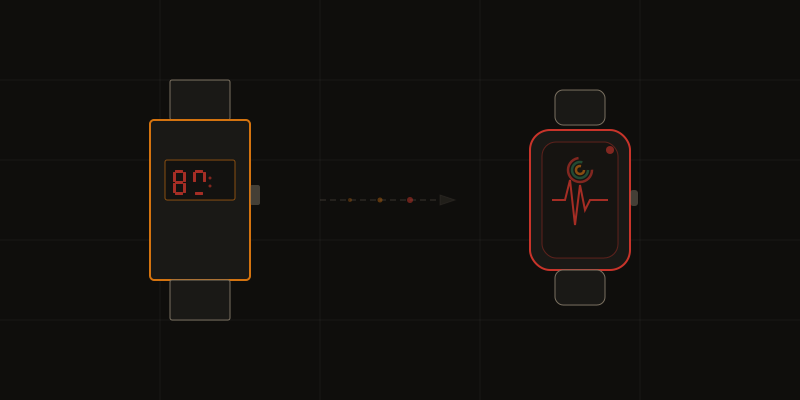
Hamilton Pulsar LED watch (1972) → Apple Watch detecting atrial fibrillation and calling 911 (2024)
ROOT
On April 4, 1972, the Hamilton Watch Company released a product that was simultaneously a marvel and an absurdity: the Pulsar, the world's first electronic digital watch. It had no hands, no gears, no springs. Instead, it displayed the time in glowing red digits on a light-emitting diode (LED) display — technology so new that most people had never seen it outside a laboratory. The watch was encased in 18-karat gold, and it cost $2,100 — approximately $15,000 in today's dollars. It was, at the time, one of the most expensive watches in the world.
It also had a fundamental problem. The LED display consumed so much power that the battery couldn't sustain it continuously. The solution was elegantly ridiculous: the display was normally off. The watch face was blank — a gold brick on your wrist. To see the time, you had to press a button on the side, which illuminated the display for about 1.25 seconds before it went dark again. You couldn't glance at your wrist. You had to deliberately activate it, read quickly, and hope you caught the numbers before they disappeared. Telling time became a two-handed operation.
Despite its impracticality, the Pulsar became a cultural icon. James Bond wore one in Live and Let Die (1973), cementing its status as a gadget for the future-minded elite. Richard Nixon, Elvis Presley, and Keith Richards were all spotted wearing Pulsars. The watch represented something more than timekeeping — it was a declaration that the digital future had arrived on your wrist, even if that future couldn't stay lit for more than a second.
The Pulsar's reign was brief. By 1975, Texas Instruments had introduced LCD-based digital watches that could display the time continuously — no button press required — at a price of just $20. The bottom fell out of the premium LED watch market almost overnight. Hamilton sold the Pulsar brand to Seiko in 1978 and eventually exited the digital watch business entirely.
What followed was a decades-long parade of wrist-mounted ambition. Casio released the first calculator watch in 1977 — the C-80, which let you perform arithmetic on your wrist and became a defining accessory of the 1980s nerd aesthetic. Seiko pushed further: a TV watch in 1982 (the T001, with a tiny screen that received broadcast television) and a wrist computer in 1984 (the RC-1000, which could interface with PCs). None of these sold in meaningful quantities. Microsoft tried the SPOT watch in 2004, which received news and weather via FM radio signals. It was discontinued in 2008. For 40 years, the smartwatch was a product category that everyone attempted and no one cracked.
TODAY
On September 9, 2014, Tim Cook took the stage at Apple's Flint Center and introduced the Apple Watch. It was not the first smartwatch — Pebble, Samsung, and others had shipped earlier models — but it was the product that made the category real. By the time the Apple Watch Series 4 launched in 2018 with an FDA-cleared electrocardiogram (ECG) sensor, the device had quietly transformed from a luxury notification mirror into a medical instrument strapped to 100 million wrists.
The health capabilities have accelerated with each generation. The Apple Watch Series 9 and Ultra 2 (2023-2024) include: ECG recording that can detect atrial fibrillation, blood oxygen monitoring (SpO2), skin temperature sensing, crash detection that automatically contacts emergency services after a car accident, fall detection that calls 911 if you hit the ground hard and don't respond within 60 seconds, and a heart rate monitor that alerts you to unusually high or low readings. The watch also tracks sleep stages, menstrual cycles, respiratory rate, and cardio fitness levels (VO2 max estimates).
The documented saves are not hypothetical. The Stanford Apple Heart Study (2019), which enrolled over 419,000 participants, found that the Apple Watch's irregular rhythm notification had a positive predictive value of 84% for atrial fibrillation — a condition that affects 37 million people worldwide and is a leading cause of stroke. Users have reported receiving AFib alerts from their watches with no prior symptoms, going to a doctor, and being told they needed immediate treatment. Emergency forums and news reports are filled with stories of fall detection saving elderly users who fell and couldn't reach a phone, and crash detection alerting paramedics to car accidents on remote roads.
The competitive landscape has grown but Apple dominates. Apple Watch holds over 50% of the global smartwatch market. Samsung's Galaxy Watch series and Google's Pixel Watch offer similar health features on the Android side. Garmin owns the fitness enthusiast segment. Fitbit (now Google) continues in the budget health tracker space. The global smartwatch market exceeded $30 billion in 2025, and the growth is driven almost entirely by health features. Consumers are buying these devices not because they want notifications on their wrists — most people found that annoying — but because they want a 24/7 health monitor that might save their life. Timekeeping, the Pulsar's sole function, is now an afterthought.
Enjoy This Article?
RootByte is 100% independent - no paywalls, no corporate sponsors. Your support helps fund education, therapy for special needs kids, and keeps the research going.
Support RootByte on Ko-fiHow did this make you feel?
Recommended Gear
View all →Disclosure: Some links on this page may be affiliate links. If you make a purchase through these links, we may earn a small commission at no extra cost to you. We only recommend products we genuinely believe in.
Framework Laptop 16
The modular, repairable laptop that lets you upgrade every component. The right-to-repair movement in action.
Flipper Zero
Multi-tool for pentesters and hardware hackers. RFID, NFC, infrared, GPIO - all in your pocket.
The Innovators by Walter Isaacson
The untold story of the people who created the computer, internet, and digital revolution. Essential tech history.
reMarkable 2 Paper Tablet
E-ink tablet that feels like writing on real paper. No distractions, no notifications - just thinking.
Keep Reading


Want to dig deeper? Trace any technology back to its origins.
Start Research