The Internet Has a Landlord Problem. Three Companies Own the Ground You Build On.
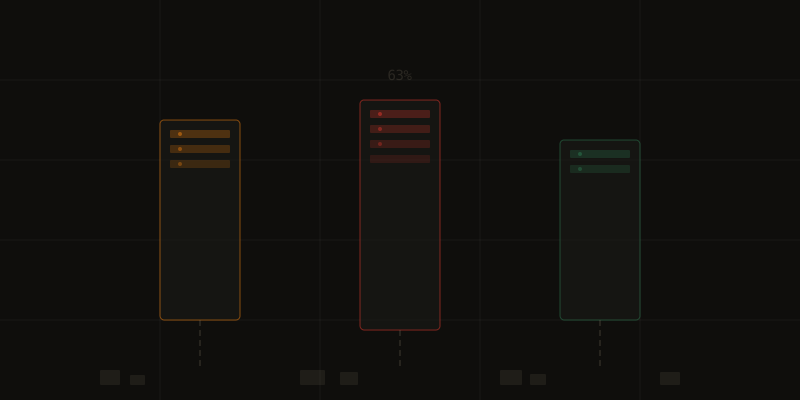
AWS, Azure, and Google Cloud control 63% of cloud infrastructure. Your startup, your hospital, your government — they all rent from the same three landlords. Bryte on digital feudalism.
Key Takeaways
- •AWS (30%), Azure (20%), Google Cloud (13%) control 63% of the $400B+ cloud infrastructure market
- •Cloud switching costs are so high that most companies are effectively locked in after 2-3 years
- •The AI boom further concentrates power — GPU clusters for training are owned by the same three companies
- •In 1890, the Sherman Antitrust Act broke railroad monopolies. No equivalent exists for cloud infrastructure.
- •When AWS has an outage, entire sectors of the internet go dark — including government services
Root Connection
The concentration of infrastructure power traces back to the railroad barons of the 1860s — Vanderbilt, Stanford, Huntington — who didn't just move goods, they controlled the ground the economy ran on. Cloud computing has created a new class of infrastructure barons, except this time the rails are invisible.
Timeline
Pacific Railroad Act grants massive land and subsidies to railroad companies, creating the first infrastructure monopolies
Sherman Antitrust Act passes, targeting railroad and oil monopolies that controlled essential infrastructure
Amazon Web Services launches its first products, initially just storage and compute
Google App Engine launches, followed by Microsoft Azure in 2010
AWS, Azure, and Google Cloud collectively begin dominating enterprise infrastructure
COVID accelerates cloud migration. Companies that delayed moving to cloud have no choice.
The Big Three control 63% of a $400B+ cloud market. Switching costs make exit nearly impossible.
AI compute demand concentrates even more power with cloud providers who own the GPU clusters
Let me describe a system.
A small number of powerful entities control essential infrastructure that the entire economy depends on. They didn't create the infrastructure from scratch — they built on public investment and open standards. But through scale, capital, and strategic acquisitions, they now own the bottlenecks. Everyone else rents access. The rental terms can change at any time. Switching to a competitor is theoretically possible but practically ruinous. And the infrastructure is so essential that opting out means opting out of the economy itself.
I could be describing the American railroad barons of the 1860s. I'm describing Amazon, Microsoft, and Google in 2026.
THE DIGITAL LANDLORDS
Here are the numbers. As of 2025, Amazon Web Services controls approximately 30% of the global cloud infrastructure market. Microsoft Azure holds 20%. Google Cloud Platform holds 13%. Together, the Big Three control 63% of a market that exceeded $400 billion in annual revenue in 2025.
Every other cloud provider combined — Oracle, IBM, Alibaba, Tencent, DigitalOcean, Hetzner, OVH, all of them — shares the remaining 37%. And most of that is concentrated in a handful of regional players. The long tail of cloud providers is shrinking, not growing.
You don't own the servers. You don't own the network. You don't own the storage. You don't own the runtime. You rent all of it, month to month, from a company that can change the price, change the terms, or shut you down with 30 days' notice. This is not ownership. This is digital tenancy.
— Bryte, Root Access
What does this mean in practical terms?
It means your startup probably runs on AWS. Your hospital's electronic health records probably run on Azure. Your city's emergency services probably route through Google Cloud or AWS. Your bank, your school, your tax returns, your streaming services, your dating apps, your smart home — all of them are tenants on infrastructure owned by three companies.
You are not a customer. You are a tenant. And the difference matters.
THE SWITCHING PROBLEM
A customer can switch providers when they find a better deal. A tenant can't — not easily. Cloud computing has created one of the most effective vendor lock-in mechanisms in the history of technology.
When a company builds on AWS, it doesn't just use generic compute and storage. It uses AWS-specific services: Lambda for serverless functions, DynamoDB for databases, SQS for queues, S3 for storage, CloudFormation for infrastructure-as-code. Each of these services has proprietary APIs. Each creates a dependency. After two or three years of building on AWS, migrating to Azure or Google Cloud isn't a weekend project. It's a multi-year, multi-million-dollar engineering effort that carries enormous risk of breaking everything.
The railroad barons of the 1860s controlled physical ground. The cloud barons of the 2020s control digital ground. The difference is that you can see a railroad. You can't see a cloud. And what you can't see, you can't regulate.
— Bryte, Root Access
This is by design. Cloud providers compete aggressively on onboarding. Free tiers. Startup credits. Easy migration tools to get you in. But there are no easy migration tools to get you out.
The industry calls this "cloud lock-in." I call it what it is: digital feudalism.
In medieval feudalism, peasants worked land they didn't own, paid rent to lords who controlled the infrastructure (land, mills, roads), and couldn't leave because leaving meant losing everything they'd built. The lord didn't need to be cruel. The structure itself was the coercion.
Cloud computing operates on the same logic. You build your business on land you don't own. You pay rent that increases annually. You can't leave without abandoning what you've built. The provider doesn't need to be malicious. The structure does the work.
THE RAILROAD PARALLEL
This isn't the first time America has faced an infrastructure monopoly problem. The parallel to the 19th-century railroads is almost exact.
In the 1860s and 1870s, railroad companies like Central Pacific, Union Pacific, and Cornelius Vanderbilt's New York Central controlled the physical infrastructure of the American economy. If you were a farmer who needed to ship grain, a manufacturer who needed to move goods, or a town that wanted to grow, you had no choice but to deal with the railroads. They set the prices. They decided the routes. They determined who prospered and who withered.
The railroads didn't build their empires from scratch. The Pacific Railroad Act of 1862 gave them massive land grants and government subsidies. They built on public investment, then privatized the profits and the power.
Cloud computing follows the same arc. The internet was built on publicly funded research — ARPANET, NSF-funded networking, government contracts to universities. TCP/IP, HTTP, DNS — the protocols that make the internet work — were developed with public money and released as open standards. Amazon, Microsoft, and Google built their cloud empires on top of this public infrastructure. They didn't create the internet. They enclosed it.
The response to railroad monopolies was the Sherman Antitrust Act of 1890 and the Interstate Commerce Commission. The government recognized that when private companies control essential infrastructure, the free market breaks. Competition doesn't function when one player owns the tracks.
No equivalent regulation exists for cloud computing. Not even close.
THE AI CONCENTRATION
The AI boom of 2023-2026 has made the problem dramatically worse.
Training large language models requires massive GPU clusters. These clusters cost hundreds of millions of dollars. They're housed in data centers that only a handful of companies can afford to build and operate. The primary suppliers of AI compute infrastructure are — you guessed it — AWS, Azure, and Google Cloud.
When a startup wants to train or fine-tune an AI model, it rents GPU time from one of the Big Three. When a research lab needs compute for a breakthrough paper, it often gets it through a cloud provider grant. When a government agency deploys AI for public services, it contracts with a cloud provider.
The AI revolution is not decentralizing power. It is concentrating it. The companies that own the compute own the future.
Microsoft invested $13 billion in OpenAI and runs its infrastructure on Azure. Google built Gemini on its own cloud. Amazon invested $4 billion in Anthropic and runs its models on AWS. The three most important AI companies in the world are financially and infrastructurally dependent on the three cloud monopolists.
WHAT HAPPENS WHEN THE LANDLORD HAS A BAD DAY
On December 7, 2021, AWS experienced a major outage in the US-East-1 region. The effects cascaded across the internet. Disney+, Netflix, Slack, DoorDash, Instacart, Ring doorbells, Roomba vacuums, McDonald's, and large portions of the Washington Post (owned by Jeff Bezos, who also owns Amazon) went down. Some Alexa devices stopped responding.
The outage lasted approximately 5 hours. It affected hundreds of millions of users and cost businesses an estimated $150 million or more.
This wasn't a cyberattack. It wasn't sabotage. It was a configuration error in an automated scaling system. A single mistake in a single region of a single company's infrastructure took down a significant portion of the American internet.
That's not resilience. That's a single point of failure masquerading as distributed computing.
THE QUESTION NOBODY'S ASKING
We debate tech regulation endlessly. Content moderation. AI safety. Data privacy. Antitrust in search and social media. These are important conversations.
But almost nobody is asking the infrastructure question: should three companies control the ground that the digital economy is built on?
Not the apps. Not the content. The ground. The servers, the storage, the networking, the compute. The physical and virtual infrastructure that every other company, government, and institution rents.
The railroads taught us this lesson 150 years ago. Essential infrastructure that becomes monopolized stops serving the public and starts serving itself. The correction required government intervention — not because the government was smarter than the market, but because the market had stopped functioning.
Cloud computing is the railroad of the 21st century. And we haven't even started the antitrust conversation.
Three companies. Sixty-three percent of the market. Every industry dependent. Switching costs designed to prevent exit. Built on public infrastructure, enclosed for private profit.
The internet was supposed to be decentralized. Nobody owns the internet, we said. Everybody can build on it.
That was true once. It isn't anymore. The internet has landlords now. And they're raising the rent.
- Bryte
Enjoy This Article?
RootByte is 100% independent - no paywalls, no corporate sponsors. Your support helps fund education, therapy for special needs kids, and keeps the research going.
Support RootByte on Ko-fiHow did this make you feel?
Recommended Gear
View all →Disclosure: Some links on this page may be affiliate links. If you make a purchase through these links, we may earn a small commission at no extra cost to you. We only recommend products we genuinely believe in.
Framework Laptop 16
The modular, repairable laptop that lets you upgrade every component. The right-to-repair movement in action.
Flipper Zero
Multi-tool for pentesters and hardware hackers. RFID, NFC, infrared, GPIO - all in your pocket.
The Innovators by Walter Isaacson
The untold story of the people who created the computer, internet, and digital revolution. Essential tech history.
reMarkable 2 Paper Tablet
E-ink tablet that feels like writing on real paper. No distractions, no notifications - just thinking.
Keep Reading


Want to dig deeper? Trace any technology back to its origins.
Start Research