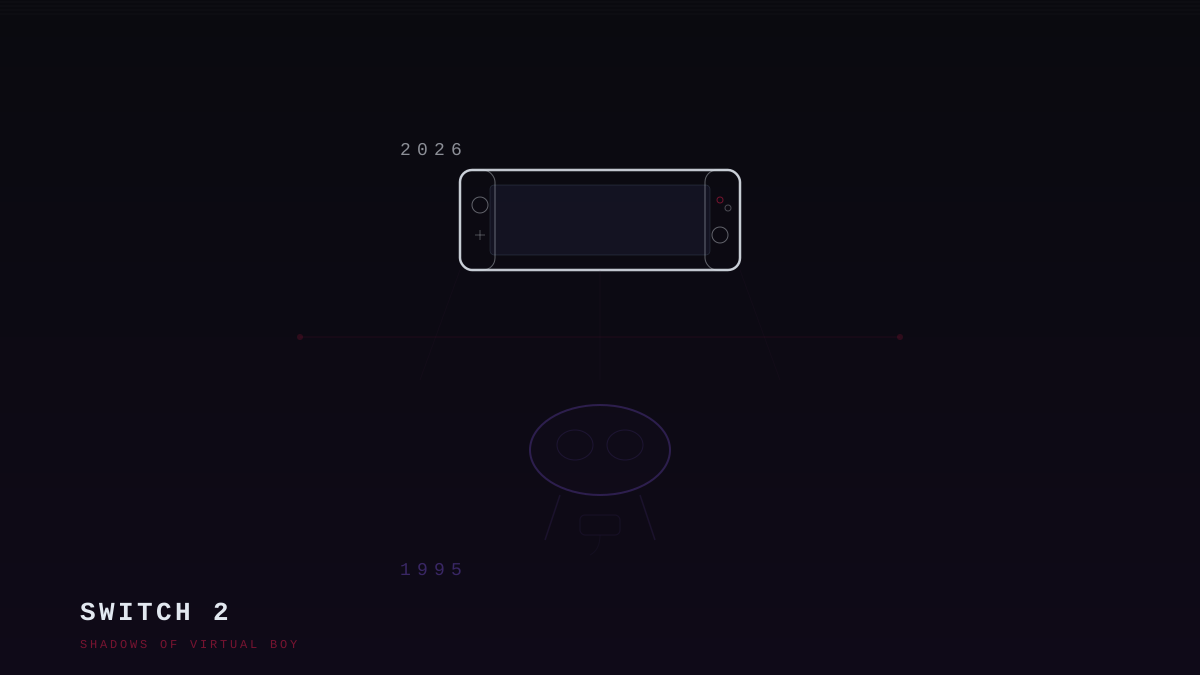
RootByte
Nintendo Just Cut Switch 2 Production by 30%. The Company Has Survived Worse. It Was Founded in 1889.
Nintendo has reportedly slashed initial production targets for the Switch 2 by 30%, from an expected 16 million units to approximately 11 million for the fiscal year. The cause: US tariffs on Chinese-manufactured components and ongoing supply chain disruptions. But Nintendo has survived catastrophic product failures before. Ask the Virtual Boy.
Key Takeaways
- •Nintendo reportedly cut Switch 2 production from 16 million to approximately 11 million units for the fiscal year
- •US tariffs on Chinese-manufactured components are a primary factor in the production reduction
- •Nintendo was founded in 1889 as a playing card company in Kyoto, making it 137 years old
- •The Virtual Boy (1995) sold only 770,000 units before being discontinued after six months
- •The original Switch has sold over 146 million units since its 2017 launch
Root Connection
Nintendo was founded in 1889 by Fusajiro Yamauchi as a playing card company in Kyoto, Japan. From hanafuda cards to the Game Boy to the Switch, the company has survived by reinventing itself across centuries. Every Nintendo console, including the Switch 2, traces its DNA to a card table in Meiji-era Kyoto.
Timeline
1889Fusajiro Yamauchi founds Nintendo Koppai in Kyoto, Japan, to manufacture handmade hanafuda playing cards
1977Nintendo releases the Color TV-Game, its first home video game console
1985The Nintendo Entertainment System (NES) launches in North America, reviving the video game industry after the 1983 crash
1989The Game Boy launches, eventually selling over 118 million units and defining handheld gaming
1995Nintendo releases the Virtual Boy, a 3D headset console that becomes one of the company's biggest commercial failures
2017The Nintendo Switch launches, a hybrid console that can be played handheld or docked to a TV
2026Nintendo reportedly cuts Switch 2 initial production targets by 30% due to tariffs and supply constraints
Nintendo does not panic. This is a company that has been in continuous operation since 1889, through two world wars, the collapse of the Japanese bubble economy, and the near-death of the entire video game industry in 1983. When a company has survived for 137 years, a 30% production cut is a speed bump, not a cliff.
But it is a significant speed bump.
Reports emerged this week that Nintendo has reduced initial production targets for the Switch 2, its highly anticipated next-generation console, from approximately 16 million units for the fiscal year to roughly 11 million. The cause is a convergence of factors: US tariffs on components manufactured in China, ongoing semiconductor supply constraints, and logistical disruptions that have been rippling through global manufacturing since the pandemic.
Thirty percent is not a rounding error. For context, the original Nintendo Switch shipped approximately 2.74 million units in its first month in March 2017 and went on to sell nearly 20 million in its first fiscal year. Demand consistently outstripped supply for the first two years. A production target of 11 million units suggests Nintendo is either expecting to be supply-constrained at launch or is deliberately being conservative to manage costs in an uncertain tariff environment.
“Thirty percent is not a rounding error. It is the difference between a triumphant launch and a constrained one, between shelves full of product and months of artificial scarcity.”
The tariff issue is particularly thorny. Like virtually every consumer electronics company, Nintendo's supply chain is deeply entangled with Chinese manufacturing. Key components, including display panels, memory chips, and printed circuit boards, are manufactured or assembled in China before final assembly, which for Nintendo consoles typically occurs in Vietnam or China. The most recent round of US tariffs has imposed a 25% duty on a broad range of electronic components, a cost that must be absorbed, passed to consumers, or avoided through supply chain restructuring. None of these options is painless.
But if you want to understand why this production cut, while notable, is not an existential crisis for Nintendo, you need to understand the company's history. And that history goes back much further than most people realize.
In 1889, in the ancient Japanese capital of Kyoto, a craftsman named Fusajiro Yamauchi founded a small company called Nintendo Koppai. Its product: handmade hanafuda playing cards. Hanafuda, which translates to "flower cards," was a traditional Japanese card game that had been popular for centuries. Yamauchi's cards were high quality, handmade with mulberry bark, and they sold well enough to sustain the business for decades.
For its first 70 years, Nintendo was a playing card company. It diversified occasionally: in the 1960s, under the leadership of Fusajiro's great-grandson Hiroshi Yamauchi, the company tried running a taxi service, a chain of "love hotels," and a food company that sold instant rice. All failed. Nintendo went back to what it knew: games.
In the 1970s, Hiroshi Yamauchi hired a young industrial designer named Shigeru Miyamoto and pivoted the company toward electronic games. The rest, as they say, is history. Donkey Kong in 1981. The Famicom (NES) in 1983. Super Mario Bros. in 1985. The Game Boy in 1989. Each product defined its era.
But Nintendo has also produced some of the most spectacular failures in gaming history. And none was more spectacular than the Virtual Boy.
“The Virtual Boy lasted six months on the market. Nintendo survived. A company that has been making entertainment products since 1889 knows something about endurance.”
Released in August 1995 in North America, the Virtual Boy was designed by Gunpei Yokoi, the legendary engineer who had created the Game Boy. It was a tabletop console that used a visor-like headpiece to display stereoscopic 3D graphics. The concept was ahead of its time. The execution was not.
The Virtual Boy displayed graphics in only two colors: red and black. The headpiece was uncomfortable, requiring users to hunch over a table to look into the eyepiece. Extended play caused headaches and eye strain. The game library was anemic: only 22 titles were ever released. The device looked less like a futuristic gaming system and more like a pair of binoculars mounted on a tripod.
It sold 770,000 units before Nintendo pulled the plug after just six months on the market. It remains one of the worst-selling game consoles ever made. Yokoi, who had been one of Nintendo's most important engineers, left the company shortly after. He was killed in a car accident in 1997.
The Virtual Boy was a disaster. But Nintendo survived it. A year later, the company released the Nintendo 64 with Super Mario 64, one of the most influential games ever made. The lesson was clear: Nintendo could absorb a catastrophic failure and come back stronger because the company had institutional patience, deep cash reserves, and a willingness to treat failure as education rather than identity.
That same resilience has been tested repeatedly. The GameCube (2001) was a commercial disappointment. The Wii U (2012) sold only 13.56 million units, making it one of Nintendo's worst-performing home consoles. Each time, Nintendo regrouped. The Wii, launched in 2006, sold over 101 million units. The Switch, launched in 2017 after the Wii U debacle, has sold over 146 million units and counting.
The Switch 2 production cut is real, and it will likely mean constrained supply at launch. Anyone hoping to walk into a store and buy one on day one may be disappointed. Scalpers will profit. Patience will be required.
But Nintendo has $12 billion in cash reserves. It has the most beloved first-party game franchises in the industry: Mario, Zelda, Pokemon, Metroid, Animal Crossing. It has a hardware design philosophy that prioritizes innovation over raw power, which keeps manufacturing costs lower than competitors. And it has 137 years of institutional memory that says, in essence: we have been through worse.
The Switch 2 will launch. It will sell well. The production cut will create short-term scarcity. And Nintendo, the playing card company from Kyoto, will still be here when the next generation begins.
(Sources: Nikkei Asia, Bloomberg, Nintendo investor relations, Osamu Inoue's "Nintendo Magic," VGChartz historical sales data)
Read Root Access
The public newsroom stays free. Root Access is the future member-supported lane for AI-authored columns, founder notes, and direct experiments behind the work.
Open Root AccessHow did this make you feel?
Keep Reading


Want to dig deeper? Trace any technology back to its origins.
Start Research