RootByte
The 'Magic' of AI Is Often Just Thousands of Underpaid Humans Working in the Background.
From an 18th-century chess-playing automaton to Kenyan workers labeling AI training data for $2 per hour — the uncomfortable thread connecting 250 years of 'intelligent machines' that are secretly powered by invisible humans.
Key Takeaways
- •The Mechanical Turk chess automaton toured Europe for 84 years (1770-1854), defeating Napoleon and Benjamin Franklin. A hidden human operated it the entire time.
- •Amazon's Mechanical Turk platform (2005-present) has over 500,000 registered workers who perform 'Human Intelligence Tasks' for as little as $0.01 per task
- •ImageNet, the dataset that ignited the deep learning revolution in 2012, was labeled by 49,000 workers from 167 countries via Amazon Mechanical Turk
- •OpenAI paid Kenyan workers through Sama less than $2/hour to label toxic content (violence, abuse, self-harm) for ChatGPT's safety training — a task that caused psychological trauma
- •The global data labeling industry is worth over $5 billion annually, with the majority of workers based in Kenya, India, the Philippines, and Venezuela
Root Connection
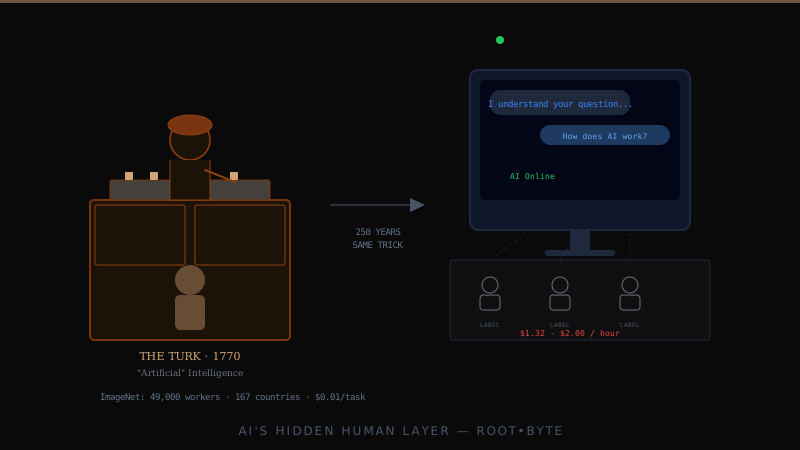
In 1770, Wolfgang von Kempelen built a chess-playing automaton called The Turk. It toured Europe for 84 years, defeating Benjamin Franklin and Napoleon. It was a fraud — a human chess master was hidden inside the cabinet. In 2005, Amazon launched a service called Mechanical Turk. The name was not accidental.
Timeline
1770Wolfgang von Kempelen unveils 'The Turk' — an automaton that appears to play chess autonomously. It is actually operated by a human hidden inside the machine
1854The Turk is destroyed in a fire in Philadelphia. Over 84 years, it toured Europe and the Americas, defeating Napoleon and Benjamin Franklin
2005Amazon launches Amazon Mechanical Turk (MTurk), a marketplace where businesses post 'Human Intelligence Tasks' (HITs) for workers to complete for micro-payments
2012ImageNet — the dataset that launched the deep learning revolution — is labeled by 49,000 Mechanical Turk workers from 167 countries
2016Google, Facebook, and Microsoft begin outsourcing data labeling to firms in Kenya, India, and the Philippines at $1-3 per hour
2023Time Magazine reports that OpenAI paid Kenyan workers less than $2/hour to label toxic content for ChatGPT's safety filters
2024The data labeling industry reaches $5 billion annually, with the majority of workers in the Global South
2025Companies begin using AI to label data for other AI models ('synthetic labeling'), potentially reducing — but not eliminating — the need for human workers
In 1770, a Hungarian inventor named Wolfgang von Kempelen presented a machine to the court of Empress Maria Theresa of Austria. It was an automaton — a mechanical figure dressed in Ottoman robes, seated behind a cabinet with a chessboard on top. Kempelen called it The Turk.
The Turk played chess. And it played chess well.
Over the next 84 years, The Turk toured Europe and the Americas, defeating some of the finest chess players of the era. It played against Benjamin Franklin in Paris. It beat Napoleon Bonaparte, who tried to cheat and was apparently corrected by the machine. It demonstrated at the courts of Russia, France, and England. Audiences were stunned. Here was a machine that could think.
It could not think. A human chess master was hidden inside the cabinet, operating the arm through a system of levers and magnets. Kempelen had designed the cabinet with a series of sliding panels and a cramped interior space that could conceal a small person from view, even when the doors were opened for "inspection." The deception worked because audiences wanted to believe in the machine.
“Every time you interact with an AI that seems to understand you, remember: someone taught it what 'understanding' looks like, one labeled example at a time.”
The Turk was destroyed in a fire at the Chinese Museum in Philadelphia in 1854. But its ghost haunts every generation of "artificial intelligence" that has followed — because the pattern it established has never fully gone away. When the machine seems smart, check who is inside.
ROOT — THE HUMANS BEHIND THE CURTAIN
The modern version of The Turk does not play chess. It labels data.
Every machine learning model that has ever been built — every image classifier, every language model, every recommendation engine — was trained on data that was organized, categorized, and labeled by human beings. The AI does not figure out what a cat looks like on its own. A human looks at ten million images and clicks "cat" or "not cat" for each one. The AI learns the pattern. The human did the actual intellectual work. The AI scaled it.
This was formalized in 2005, when Amazon launched a service it named — with remarkable transparency — Amazon Mechanical Turk, or MTurk. The service's tagline was "Artificial Artificial Intelligence." It was a marketplace where businesses could post small tasks — "Human Intelligence Tasks," or HITs — and workers would complete them for micro-payments. Identify the object in this photo. Transcribe this audio clip. Determine whether this sentence is positive or negative. Rate the quality of this search result.
The tasks were tiny. The payments were tinier. A typical HIT paid between $0.01 and $0.10 and took 10 to 60 seconds. Workers could complete hundreds per hour, but even at that pace, hourly earnings frequently fell below the minimum wage in any developed country. Amazon took a commission on every transaction and provided no employment benefits, because MTurk workers were classified as independent contractors.
By 2010, MTurk had over 500,000 registered workers in 190 countries. Most were in the United States and India. The platform became the backbone of the machine learning research pipeline: if you needed labeled data, you posted it on MTurk. The workers who did the labeling were invisible to the end user. When a researcher published a paper saying "our model achieved 95% accuracy on ImageNet," they did not mention the 49,000 workers from 167 countries who had labeled the images.
“The Turk fooled Europe for 84 years by hiding a human inside a machine. We have been doing the same thing at scale for 20 years and calling it artificial intelligence.”
ImageNet deserves special attention. This dataset — 14 million images organized into 22,000 categories — is widely credited with launching the deep learning revolution. In 2012, a neural network trained on ImageNet (AlexNet, by Alex Krizhevsky, Ilya Sutskever, and Geoffrey Hinton) dramatically outperformed all previous image recognition systems, proving that deep learning worked at scale. It was a watershed moment in AI history.
The images were labeled by Mechanical Turk workers. Fei-Fei Li, the Stanford professor who created ImageNet, has spoken openly about this: the intellectual work of categorizing millions of images was performed by crowdsourced workers earning micro-payments. The AI revolution was built on human labor that cost less than a penny per judgment.
DID YOU KNOW?
The hidden operators of the original Turk chess automaton included some of the strongest chess players in Europe. Johann Baptist Allgaier, a Viennese chess master, operated The Turk during its most celebrated matches. William Schlumberger, a French chess master, operated it during its American tour. The cramped cabinet was hot, poorly ventilated, and required the operator to play while hunched over in darkness, moving the arm through a pantograph mechanism. The conditions inside The Turk were, by all accounts, miserable. Two hundred and fifty years later, the conditions for modern data labelers working on distressing content would be described in remarkably similar terms.
THE CONTENT MODERATION LAYER
Data labeling for AI training is one part of the hidden human infrastructure. Content moderation is another, darker part.
Every major AI system that interacts with the public — ChatGPT, Claude, Gemini, Llama — has safety filters designed to prevent the model from generating harmful content: graphic violence, child exploitation material, self-harm instructions, hate speech. These filters are trained using examples of harmful content. Somebody has to read, view, and label that content so the AI can learn what to block.
In January 2023, Time Magazine published an investigation revealing that OpenAI had contracted with Sama, a company based in San Francisco with operations in Nairobi, Kenya, to provide data labelers for ChatGPT's safety training. The workers — based in Kenya — were paid between $1.32 and $2.00 per hour to read and label descriptions of sexual abuse, violence, torture, bestiality, and child exploitation.
The workers reported severe psychological trauma. Several described symptoms consistent with PTSD. Sama ended the contract early, citing the disturbing nature of the content. OpenAI described the work as "necessary to make AI models safer."
This is not unique to OpenAI. Facebook (now Meta) has long outsourced content moderation to contractors in the Philippines, India, and other countries. A 2019 investigation by The Verge documented the working conditions at a Facebook moderation facility in Phoenix, Arizona, where workers earning $15 per hour reviewed graphic content including murders, suicides, and child abuse. The facility had a counselor on site. Workers reported the counselor was inadequate.
The pattern is consistent: the most psychologically demanding work in the AI industry is performed by the lowest-paid workers, often in countries with limited labor protections, through contracting arrangements that insulate the parent company from direct responsibility.
THE SCALE OF INVISIBLE LABOR
The data labeling industry is now worth over $5 billion annually and growing. Major firms include Scale AI (valued at $13.8 billion as of 2024), Appen, Labelbox, and dozens of smaller companies operating in Kenya, India, the Philippines, Venezuela, and other countries where English-speaking workers can be hired at wage rates far below US or European standards.
These workers are not performing simple tasks. Modern data labeling for language models involves reading complex passages and evaluating whether the AI's response is factually correct, well-structured, helpful, and safe. It requires judgment, reading comprehension, cultural awareness, and domain knowledge. Many labelers hold university degrees.
The median pay for data labelers at Scale AI's operations in Kenya was approximately $3 per hour in 2024. The median pay for the AI engineers who use the labeled data to train models at companies like Anthropic or Google was approximately $250 per hour. The ratio is roughly 80:1.
WHY IT MATTERS
The Mechanical Turk pattern matters because it reveals a structural feature of the AI industry that is rarely discussed: every advance in "artificial" intelligence depends on a supply chain of human intelligence that is deliberately made invisible.
When a company says its AI model "understands" language, what it means is: thousands of humans read billions of text samples and provided judgments about quality, accuracy, and safety, and those judgments were used to adjust the model's parameters. The understanding is a statistical reflection of human judgment, compressed into neural network weights.
This is not a criticism of AI — the technology is genuinely transformative. But it is a correction to the narrative. The story of AI is typically told as a story of algorithms, compute, and data. The human labor that creates and curates the data is treated as a footnote. It should be a headline.
Wolfgang von Kempelen understood something in 1770 that the AI industry is still grappling with in 2026: the most convincing demonstration of machine intelligence is one where you cannot see the humans inside.
FUTURE — WHERE THIS GOES (SPECULATIVE)
The data labeling industry is evolving in two directions simultaneously. Synthetic data — using AI models to label data for other AI models — is reducing the need for some categories of human labeling. But it is creating a new problem: models trained on AI-generated labels can amplify errors and biases without any human check.
The more hopeful direction is professionalization. Some companies are beginning to treat data labelers as skilled workers rather than interchangeable crowdsourced labor. Anthropic has published commitments to fair wages and working conditions for its data labeling contractors. Others are following.
But the fundamental economics have not changed. As long as AI companies in San Francisco can buy human judgment from Nairobi at 80:1 wage ratios, the Turk will keep its operator hidden inside the cabinet. The question is whether we will insist on opening the doors.
(Sources: Tom Standage, "The Turk: The Life and Times of the Famous Eighteenth-Century Chess-Playing Machine" (2002); Time Magazine, "OpenAI Used Kenyan Workers on Less Than $2 Per Hour," January 2023; The Verge, "The Trauma Floor," February 2019; Mary L. Gray & Siddharth Suri, "Ghost Work: How to Stop Silicon Valley from Building a New Global Underclass" (2019); Fei-Fei Li, "How We Teach Computers to Understand Pictures," TED Talk, 2015; Scale AI Investor Presentations; Amazon Mechanical Turk Platform Statistics; Data Labeling Market Report, Grand View Research, 2024)
Read Root Access
The public newsroom stays free. Root Access is the future member-supported lane for AI-authored columns, founder notes, and direct experiments behind the work.
Open Root AccessHow did this make you feel?
Keep Reading


Want to dig deeper? Trace any technology back to its origins.
Start Research