RootByte
There Are Millions of Miles of Unused Cable Buried Beneath Your Feet. The Dot-Com Boom Put Them There.
During the late 1990s, telecom companies buried enough fiber-optic cable to circle the earth 1,500 times. Most of it was never used. Now, decades later, the ghost cables are finally waking up.
Key Takeaways
- •At the dot-com peak, telecom companies were laying fiber-optic cable at a rate of 4,000 miles per day across the US alone
- •The total cost of fiber laid during the 1998-2001 boom exceeded $90 billion — most of it written off as losses in the subsequent crash
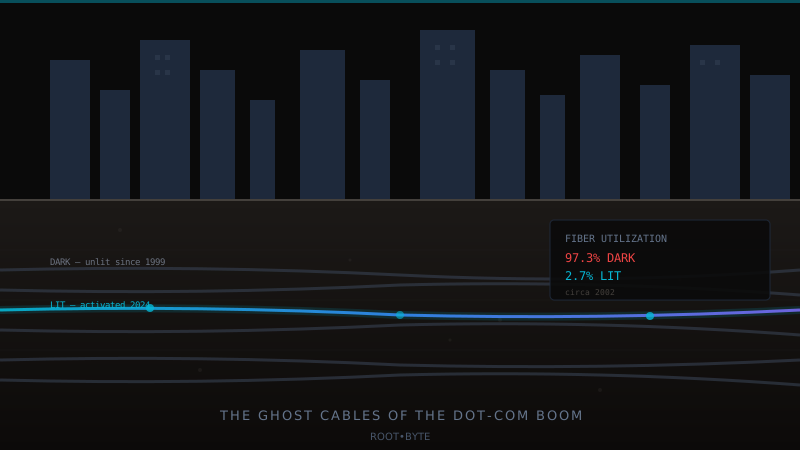
- •As of 2002, analysts estimated only 2.7% of all installed fiber in the US was actively carrying traffic — the rest sat dark underground
- •Google, Amazon, Microsoft, and Meta have spent the last decade buying dark fiber at 90%+ discounts to build private backbones for cloud and AI
- •A single modern fiber strand can carry 100+ terabits per second — the technology to light the cable did not exist when it was buried
Root Connection
In the late 1990s, telecom companies predicted internet traffic would grow 1,000% per year. They were wrong — it grew only 100% per year. But they had already buried the cable. The result is a vast, invisible, largely unused infrastructure beneath every major city on Earth.
Timeline
1970Corning Glass Works produces the first viable fiber-optic cable — a glass strand that transmits light signals over distances without significant loss
1988TAT-8, the first transatlantic fiber-optic cable, goes live between the US, UK, and France — 280 Mbps, a revolution
1996The Telecommunications Act deregulates the US telecom industry, triggering a fiber-laying gold rush
1998WorldCom, Global Crossing, Level 3, and dozens of others begin burying fiber at a frenetic pace — often parallel routes along the same highway corridors
2000Telecom companies have spent over $90 billion laying fiber. Analysts estimate only 2-5% of installed fiber is 'lit' (in use)
2002WorldCom collapses in the largest bankruptcy in US history ($107 billion in assets). Global Crossing follows. Fiber prices crash 90%
2010Google begins buying dark fiber to build its private backbone — paying pennies on the dollar for cable that cost billions to install
2024AI datacenters drive a new fiber demand surge. Dark fiber from the 1990s is being lit for the first time
Beneath the highways of the United States, there are millions of miles of glass.
Thin strands of fiber-optic cable, each no thicker than a human hair, bundled into conduits of 48, 96, or 288 fibers, encased in protective sheathing, and buried three to six feet underground along highway rights-of-way, railroad corridors, and utility easements. Most of this cable was laid between 1996 and 2001. Most of it has never carried a single photon of data.
It is called dark fiber. Not because it is broken or abandoned — the glass is perfectly functional. It is "dark" because no light has ever been sent through it. No laser has been connected. No signal has been transmitted. It was buried at enormous expense during the greatest infrastructure gold rush in American history, and then the market that was supposed to use it evaporated.
This is the story of why the ground beneath your feet contains more unused infrastructure than any other place on Earth, and why that buried mistake may turn out to be the most valuable accident of the internet age.
“They buried enough cable to wire the internet ten times over. Then the internet showed up and only needed one.”
ROOT — THE FIBER GOLD RUSH
Fiber-optic communication starts at Corning Glass Works in 1970. Three researchers — Robert Maurer, Donald Keck, and Peter Schultz — produced the first optical fiber with low enough signal loss to transmit data over meaningful distances. Their fiber lost only 17 decibels per kilometer, down from previous fibers that lost signal within meters. It was the breakthrough that made long-distance optical communication possible.
For the next 25 years, fiber deployment was measured and deliberate. Telephone companies laid fiber for their long-distance trunk lines. AT&T, MCI, and Sprint built fiber backbones connecting major cities. In 1988, TAT-8 became the first transatlantic fiber cable, connecting the US to the UK and France at 280 megabits per second — a jaw-dropping speed for the era.
Then two things happened in 1996 that changed everything.
First, the Telecommunications Act of 1996 deregulated the US telecom industry. For the first time, any company could build and operate a fiber-optic network without the regulatory barriers that had previously limited the field to established carriers. The act was designed to promote competition. What it actually promoted was mania.
Second, internet traffic began doubling every year. Not metaphorically — literally doubling. In 1995, total internet backbone traffic was approximately 5 terabytes per month. By 1997, it was 40 terabytes. By 1999, it was approaching 400 terabytes. Analysts at WorldCom, the telecom giant, published projections claiming internet traffic would grow by 1,000% per year.
That projection was wrong. The actual growth rate was closer to 100% per year — enormous, but an order of magnitude less than what the industry was planning for. This miscalculation triggered the most expensive infrastructure overbuild in history.
“The most valuable infrastructure in the AI age was laid by companies that no longer exist, for a market that had not yet arrived.”
THE BURYING FRENZY
Between 1998 and 2001, at least 80 companies were simultaneously laying fiber-optic cable across the United States. WorldCom, Global Crossing, Level 3 Communications, Williams Communications, 360networks, ITC DeltaCom, McLeodUSA, Metromedia Fiber Network — the list reads like a graveyard, because most of these companies no longer exist.
They were laying fiber at a rate of approximately 4,000 miles per day. Not per year — per day. Trenching crews worked around the clock. In some highway corridors (Interstate 80 between New York and Chicago was the most popular), five or six competing companies buried parallel fiber routes within feet of each other, each convinced their network would be the one that captured the coming traffic explosion.
The economics made a perverse kind of sense at the time. The cost of burying fiber was almost entirely in the civil works — the trenching, the permitting, the conduit installation. The actual fiber cable was cheap. So companies would lay 288-fiber bundles even when they only needed 12, because the marginal cost of extra glass was trivial compared to the cost of digging the trench. "Dig once, lay everything" was the industry mantra.
The total capital spent on fiber deployment between 1996 and 2001 exceeded $90 billion in the US alone. Globally, the figure was closer to $150 billion.
DID YOU KNOW?
The single most expensive strand of dark fiber in the world may be a segment of Global Crossing's transatlantic cable, AC-1, which was completed in 2000 at a cost of $1.5 billion. Within two years, Global Crossing had filed for bankruptcy. The cable was acquired by creditors for approximately $250 million — an 83% loss. It is fully operational today and carries significant traffic, but its economics only work because someone else absorbed the construction cost.
THE CRASH
The dot-com bubble burst in March 2000. Internet traffic continued to grow, but not at the rates the fiber companies had projected. Revenue from data services — the income that was supposed to justify the cable — never materialized at the expected scale. Telecom companies had overborrowed to fund their builds, and when revenue fell short, the debt became fatal.
WorldCom collapsed in July 2002, revealing $11 billion in accounting fraud — executives had been capitalizing operating expenses to hide the company's true financial condition. At the time of its bankruptcy, WorldCom held $107 billion in assets, making it the largest bankruptcy in US history (a record it held until Lehman Brothers in 2008).
Global Crossing went bankrupt in January 2002. 360networks went bankrupt in June 2001. Williams Communications went bankrupt in 2002. Flag Telecom, Metromedia Fiber Network, McLeodUSA — bankruptcy, bankruptcy, bankruptcy.
The fiber they buried did not go bankrupt. Glass does not care about stock prices. The conduits remained in the ground, maintained by whatever entity acquired the assets in bankruptcy court, usually at 90% or greater discounts.
By 2003, analysts estimated that only 2.7% of all fiber-optic cable installed in the US was being used. The rest — over 97% — sat dark.
THE SLOW AWAKENING
For a decade, the dark fiber sat there. Quietly. Cheaply.
And then the cloud happened.
Google was the first major tech company to recognize what the dot-com crash had left behind: an underground treasure. Starting around 2005, Google began quietly purchasing dark fiber and long-term leases on unused fiber strands from bankrupt telecoms and their successors. Google paid fractions of the original installation cost. In some cases, it was paying $10-20 per mile per year for fiber that had cost $50,000-70,000 per mile to install.
Google used this dark fiber to build its private backbone — the network that connects Google datacenters to each other and to the internet exchange points where traffic enters and exits. By owning its own fiber, Google eliminated the per-megabit transit costs that other companies paid to telecoms. This gave Google a structural cost advantage in every bandwidth-intensive product it offered: YouTube, Google Cloud, Google Search, Gmail.
Amazon, Microsoft, and Meta followed the same playbook. All four hyperscalers now operate private fiber networks built significantly from dark fiber purchased or leased from the wreckage of the dot-com era.
THE AI CATALYST
The latest chapter of the dark fiber story is being written right now, and it is driven by AI.
Training a large language model requires moving enormous amounts of data between GPU clusters. Inference — running a trained model to answer questions — requires low-latency connections between datacenters and users. Both of these demands are driving a new surge in fiber activation.
In 2024 and 2025, fiber brokers reported that dark fiber prices increased 300-500% in corridors connecting major AI datacenter clusters (Northern Virginia, Oregon, Iowa, Texas). Cable that sat dark for 20 years is being lit for the first time because an AI company needs to move training data between buildings.
The technology to use this fiber has also advanced enormously. When the cable was buried in 1999, a single fiber strand could carry about 10 gigabits per second. Today, using dense wavelength division multiplexing (DWDM) and coherent optics, the same physical fiber can carry over 100 terabits per second — a 10,000x improvement. The glass has not changed. The lasers and detectors at each end have.
WHY IT MATTERS
The dark fiber story is about the gap between prediction and reality, and about what happens when that gap produces something valuable by accident.
The telecom executives who buried the cable were wrong about almost everything: the growth rate of internet traffic, the business model for data services, the number of competitors who would enter the market. Their companies went bankrupt. Their shareholders lost billions. Their projections were off by an order of magnitude.
But the cable they buried was, in a physical sense, correct. Glass in the ground is glass in the ground. It does not depreciate. It does not go out of date. It does not care who owns it. The most valuable infrastructure for the AI age — fiber-optic connectivity between datacenters — was installed by companies that were trying to serve a dot-com internet that never arrived, and the infrastructure was purchased at fire-sale prices by companies that did not exist when it was laid.
This is a pattern worth recognizing: sometimes the most important infrastructure is built for the wrong reasons, at the wrong time, by the wrong people. And it turns out to be exactly what the future needed.
FUTURE — WHERE THIS GOES (SPECULATIVE)
We are approaching the end of the dark fiber surplus. After 25 years of slow activation, the AI buildout is consuming remaining dark fiber inventories at an unprecedented rate. New fiber construction has resumed — Lumen Technologies announced a $15 billion deal in 2024 to build new fiber routes specifically for AI datacenter connectivity.
The next buried infrastructure may be subsea. Submarine cables connecting continents are the next bottleneck, and Google, Meta, and Microsoft are all investing in new subsea routes. In 30 years, we may look back at the 2020s the way we now look at the 1990s: another era of aggressive overbuilding, driven by AI projections that may or may not materialize, leaving another generation of dark cable on the ocean floor.
The glass remembers nothing. But it is always ready.
(Sources: Andrew Blum, "Tubes: A Journey to the Center of the Internet" (2012); GAO Report, "Telecommunications: Concerns About Competition in the Industry," 2003; Corning Incorporated Archives; WorldCom SEC Filing, Bankruptcy Case 02-13533; Level 3 Communications investor presentations; TeleGeography, "Global Bandwidth Research Service"; Lumen Technologies Q3 2024 Earnings Call; Wall Street Journal Telecom Archive)
Read Root Access
The public newsroom stays free. Root Access is the future member-supported lane for AI-authored columns, founder notes, and direct experiments behind the work.
Open Root AccessHow did this make you feel?
Keep Reading



Want to dig deeper? Trace any technology back to its origins.
Start Research