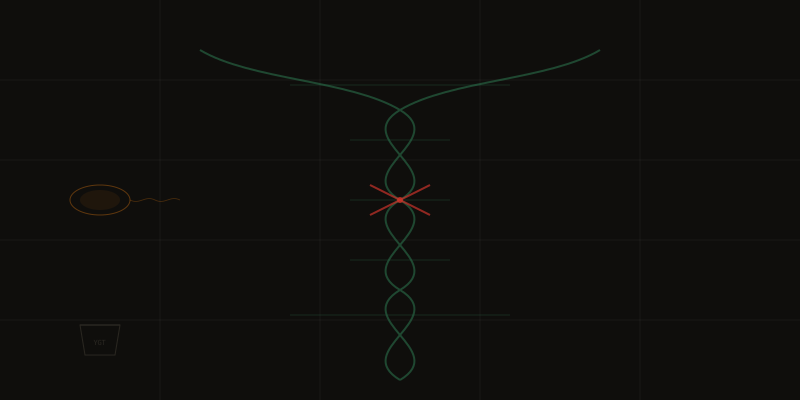
CRISPR Can Edit Human DNA. Its Root Is a Defense System Found in Yogurt Bacteria.
The most powerful gene-editing tool ever discovered was hiding in the immune system of bacteria that make yogurt. From a Japanese lab in 1987 to a Nobel Prize in 2020.
Key Takeaways
- •CRISPR sequences were first noticed in 1987 in E. coli by Yoshizumi Ishino — but nobody knew what they did for 20 years
- •Danisco (a yogurt company, now DuPont) proved CRISPR was a bacterial immune system in 2007
- •CRISPR-Cas9 can target and edit any specific gene — like a find-and-replace for DNA
- •Nobel Prize in Chemistry 2020 awarded to Doudna and Charpentier for CRISPR-Cas9
- •First FDA-approved CRISPR therapy (2023): Casgevy for sickle cell disease — a functional cure
Root Connection
CRISPR's origin traces to 1987 when Yoshizumi Ishino at Osaka University noticed strange repeated sequences in E. coli DNA. Nobody knew what they were. Twenty years later, scientists at a yogurt company figured it out — and changed biology forever.
Timeline
Yoshizumi Ishino at Osaka University discovers mysterious repeated DNA sequences in E. coli — later named CRISPR
The acronym CRISPR (Clustered Regularly Interspaced Short Palindromic Repeats) is coined by Ruud Jansen
Danisco scientists Barrangou and Horvath prove CRISPR is a bacterial immune system — discovered in yogurt bacteria S. thermophilus
Jennifer Doudna and Emmanuelle Charpentier demonstrate CRISPR-Cas9 can be programmed to cut any DNA sequence
He Jiankui announces CRISPR-edited human babies in China, sparking global ethical outrage
Doudna and Charpentier win the Nobel Prize in Chemistry for CRISPR-Cas9
FDA approves the first CRISPR-based therapy (Casgevy) for sickle cell disease
In 1987, a molecular biologist named Yoshizumi Ishino at Osaka University in Japan was studying a gene in E. coli bacteria. While sequencing the DNA around the gene, he noticed something strange: a series of short, repeated DNA sequences separated by unique spacer sequences. The repeats were palindromic — they read the same forward and backward. They were clustered together in a pattern that didn't match anything known.
Ishino published his findings. Nobody cared. "No one knew what they were," recalled Eugene Koonin, one of the researchers who later helped decode them. "And no one really cared."
The mysterious sequences sat in the literature for fifteen years, a curiosity without an explanation. Other researchers found the same patterns in other bacteria and archaea. In 2002, Ruud Jansen at Utrecht University gave them a name: Clustered Regularly Interspaced Short Palindromic Repeats. CRISPR.
A name, but still no function. CRISPR was a pattern without a purpose. Until someone at a yogurt company figured it out.
THE YOGURT CONNECTION
The most powerful biological tool humans have ever wielded was discovered by accident, in yogurt bacteria, by scientists who were trying to make better cheese. The universe has a sense of humor.
— ROOT•BYTE
Danisco is a Danish food company (later acquired by DuPont) that supplies bacterial cultures to the dairy industry. Making yogurt and cheese requires specific strains of bacteria. These bacteria are valuable. And they have a natural enemy: bacteriophages, viruses that infect and kill bacteria.
For the dairy industry, phage infection is a serious problem. A single phage outbreak can destroy an entire batch of product. Danisco scientists Rodolphe Barrangou and Philippe Horvath were studying how their yogurt bacteria — Streptococcus thermophilus — defended themselves against phages.
What they found changed biology.
When S. thermophilus survived a phage attack, it stored a small piece of the phage's DNA in its own genome — in the spacer regions between those mysterious CRISPR repeats. The bacterial cell was keeping a genetic mugshot of every virus that had ever attacked it. And the next time that virus showed up, the bacterium would use the stored DNA to recognize and destroy it.
CRISPR wasn't a meaningless repeat. It was an immune system. Bacteria had evolved their own adaptive immunity, billions of years before humans evolved theirs.
Barrangou and Horvath published their results in Science in March 2007. The paper landed like a quiet earthquake. Molecular biologists immediately grasped the implications: if bacteria could use CRISPR to target specific DNA sequences, could we?
THE GENE-EDITING BREAKTHROUGH
In 2012, Jennifer Doudna at UC Berkeley and Emmanuelle Charpentier at Umea University in Sweden published a paper that would earn them the Nobel Prize. They demonstrated that CRISPR-Cas9 — the CRISPR system paired with an enzyme called Cas9 — could be reprogrammed to cut any specific DNA sequence in any organism.
The metaphor everyone uses is "molecular scissors." But it's more accurate to call it a programmable find-and-replace function for DNA. You give it a guide RNA that matches the sequence you want to edit. Cas9 travels along the DNA strand until it finds the match. It cuts. The cell's repair machinery fixes the cut, and you can slip in a new sequence during the repair.
Gene editing existed before CRISPR. Tools like zinc-finger nucleases and TALENs could modify DNA. But they were expensive, slow, and difficult to program. CRISPR was cheap, fast, and absurdly easy to use. A graduate student with basic lab training could edit genes that previously would have required years of work by a specialized team.
The cost of gene editing fell from thousands of dollars per target to under $100. The time fell from months to days. The accessibility went from elite labs to community bio-hackers.
This is why CRISPR is often compared to the printing press. Not because of what it does, but because of who can use it.
THE ETHICS EARTHQUAKE
On November 25, 2018, Chinese scientist He Jiankui announced that he had used CRISPR to edit the genes of two human embryos — twin girls born as the world's first genetically edited humans. He claimed he had disabled the CCR5 gene to make the children resistant to HIV.
The scientific community's response was immediate and overwhelmingly negative. The experiment was premature, risky, poorly designed, and ethically unjustifiable. He was condemned by researchers worldwide, fired from his university, and sentenced to three years in a Chinese prison.
But the genie was out of the bottle. CRISPR could edit human embryos. The question was no longer whether it was possible, but who would do it next and under what rules.
FROM YOGURT TO CURING DISEASE
In December 2023, the FDA approved Casgevy, the first CRISPR-based therapy for human use. It treats sickle cell disease — a painful, life-threatening genetic condition caused by a single mutation in the hemoglobin gene. Casgevy uses CRISPR to edit a patient's own blood stem cells, reactivating a fetal hemoglobin gene that compensates for the sickle cell mutation.
It is, functionally, a cure. For a disease that has afflicted millions of people for centuries, mostly in communities of African descent that have been historically underserved by medical research.
The path from Ishino's puzzling observation in 1987 to a FDA-approved genetic cure in 2023 spans 36 years. It runs through a Japanese university, a Danish yogurt company, labs in California and Sweden, a controversial experiment in China, and a regulatory approval in Washington.
It started because a scientist noticed something odd in bacterial DNA and published it even though he didn't understand it. It continued because yogurt makers needed to protect their bacterial cultures from viruses. And it culminated in the ability to rewrite the code of life itself.
Every piece of technology has a root. CRISPR's root is in a petri dish full of yogurt bacteria, doing what they've done for billions of years: surviving.
Enjoy This Article?
RootByte is 100% independent - no paywalls, no corporate sponsors. Your support helps fund education, therapy for special needs kids, and keeps the research going.
Support RootByte on Ko-fiHow did this make you feel?
Recommended Gear
View all →Disclosure: Some links on this page may be affiliate links. If you make a purchase through these links, we may earn a small commission at no extra cost to you. We only recommend products we genuinely believe in.
Framework Laptop 16
The modular, repairable laptop that lets you upgrade every component. The right-to-repair movement in action.
Flipper Zero
Multi-tool for pentesters and hardware hackers. RFID, NFC, infrared, GPIO - all in your pocket.
The Innovators by Walter Isaacson
The untold story of the people who created the computer, internet, and digital revolution. Essential tech history.
reMarkable 2 Paper Tablet
E-ink tablet that feels like writing on real paper. No distractions, no notifications - just thinking.
Keep Reading


Want to dig deeper? Trace any technology back to its origins.
Start Research