RootByte
Four Astronauts Are About to Fly Around the Moon. The Last Time Humans Did This, Nixon Was President.
NASA's Artemis 2 mission is set to launch no earlier than April 1, 2026, sending four astronauts on a loop around the far side of the Moon. The first crewed deep-space voyage since Apollo 17 splashed down in December 1972. Fifty-three years of silence between Earth and the lunar horizon are about to end.
Key Takeaways
- •Artemis 2 will be the first crewed mission beyond low-Earth orbit since Apollo 17 in December 1972, a gap of 53 years
- •The crew includes Victor Glover, the first Black astronaut on a lunar trajectory, and Jeremy Hansen, the first Canadian
- •The SLS rocket stands 322 feet tall, rolled to the pad on March 19, 2026
- •Total Artemis program costs have exceeded $93 billion
- •The mission sets the stage for Artemis 3, the first lunar landing attempt, targeted for 2028
Root Connection
In 1962, NASA chose the lunar orbit rendezvous method over direct ascent, a decision that made Apollo possible with the technology of the era. That same architectural philosophy echoes in Artemis: fly to lunar orbit first, then land. The root of every Moon mission lives in that single engineering bet made sixty-four years ago.
Timeline
1962NASA selects lunar orbit rendezvous as the Apollo mission architecture, making the Moon landing feasible within the decade
1968Apollo 8 becomes the first crewed spacecraft to orbit the Moon, with astronauts Borman, Lovell, and Anders
1969Apollo 11 lands on the Moon; Neil Armstrong and Buzz Aldrin walk on the surface
1972Apollo 17 completes the final crewed lunar mission; Gene Cernan becomes the last human to walk on the Moon
2017NASA formally announces the Artemis program to return humans to the Moon
2022Artemis 1 launches uncrewed, successfully testing the SLS rocket and Orion capsule on a lunar flyby
2026Artemis 2 targets April 1 launch, first crewed deep-space mission in 53 years
On a stretch of Florida coastline where alligators wander between launchpads and the Atlantic wind carries the faint metallic tang of rocket propellant, a 322-foot tower of engineering ambition sits waiting. NASA's Space Launch System, the most powerful rocket ever built to fly, rolled to Pad 39B at Kennedy Space Center on March 19, 2026. If all goes according to plan, it will ignite no earlier than April 1, hurling four human beings toward the Moon.
Their names are Reid Wiseman, Victor Glover, Christina Koch, and Jeremy Hansen. Together they form the crew of Artemis 2, and they are about to do something no human has done since Richard Nixon occupied the Oval Office: leave the gravitational neighborhood of Earth and venture into deep space.
The last time anyone did this, the year was 1972. Apollo 17 commander Gene Cernan climbed back into his lunar module on December 14, looked down at his bootprints in the grey regolith, and became the last human being to stand on the Moon. The ladder retracted. The ascent engine fired. And then, for fifty-three years, humanity stayed home.
“Fifty-three years. That is how long humanity has stayed home. An entire generation was born, grew up, and started families without a single human venturing beyond low-Earth orbit.”
Fifty-three years. Consider the weight of that number. In that span, the Soviet Union collapsed. The internet was invented, commercialized, and became the substrate of civilization. Smartphones went from science fiction to ubiquity. Three generations of children grew up watching Moon landing footage the way they might watch a nature documentary about dinosaurs, as evidence of a world that once existed but no longer does.
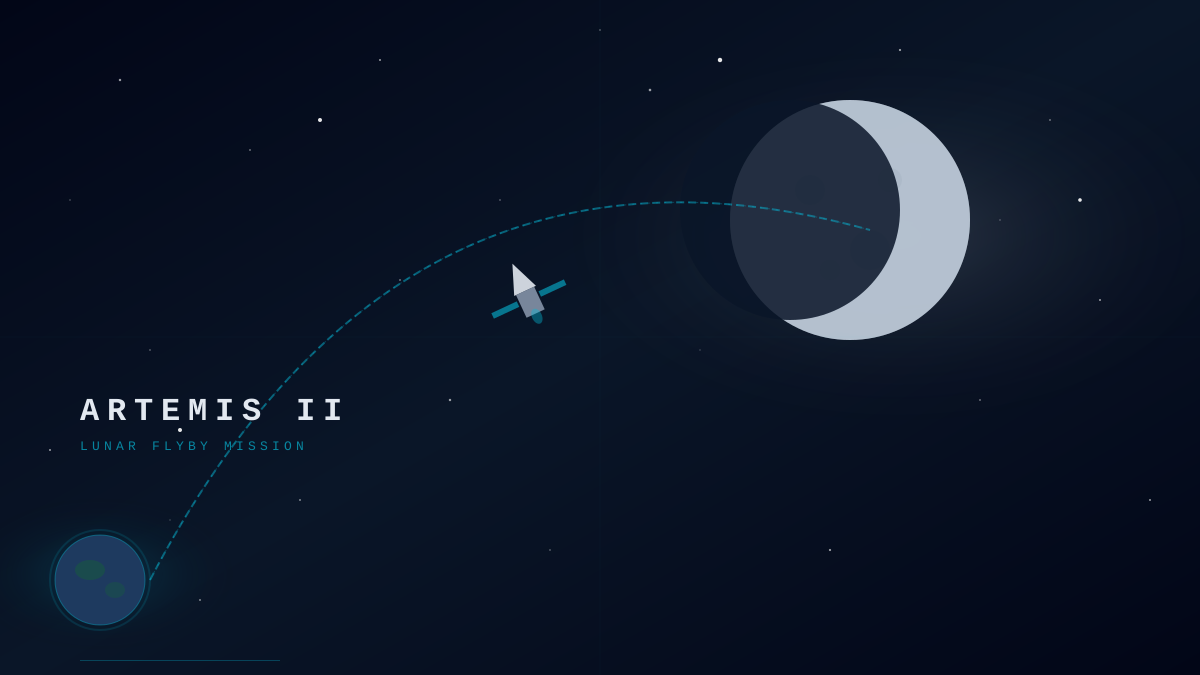
Artemis 2 is a ten-day mission. The crew will launch from Kennedy, enter Earth orbit, and then fire the upper stage to send the Orion capsule on a free-return trajectory around the Moon. They will swing behind the far side, the hemisphere no human eye saw until 1968, and use the Moon's gravity to sling them back toward Earth. They will not land. They will not even enter lunar orbit. But they will travel farther from Earth than any human being has gone in more than half a century, and in doing so, they will prove that the hardware works, the life-support systems hold, and the navigation is sound.
This is not merely a test flight. It is a resurrection.
To understand why Artemis exists, you have to travel back not to Apollo 11's famous landing in 1969 but to a quieter, more consequential moment in 1962. That year, NASA faced a fundamental architectural decision: how do you actually get to the Moon? Three options were on the table. Direct ascent would launch a single enormous rocket straight to the lunar surface. Earth orbit rendezvous would assemble a Moon ship in orbit from multiple launches. And lunar orbit rendezvous, the dark horse championed by engineer John Houbolt, would send a small lander down to the surface while the main ship waited in orbit.
Houbolt was initially ridiculed. His colleagues called the idea too risky. But the math was elegant: lunar orbit rendezvous meant you only had to land a small, lightweight vehicle on the Moon, not the entire spacecraft. It saved weight, saved fuel, and critically could be done with rockets that already existed on drawing boards. NASA chose Houbolt's method. Seven years later, it put Neil Armstrong on the Moon.
That same philosophy underpins Artemis. The Orion capsule will carry astronauts to lunar orbit. A separate lander, built by a commercial partner, will carry them down to the surface. The architecture is a direct descendant of Houbolt's insight sixty-four years ago.
The crew of Artemis 2 is itself a statement. Victor Glover will become the first Black astronaut to fly on a lunar trajectory. Jeremy Hansen will be the first Canadian to leave Earth orbit. Christina Koch, who already holds the record for the longest single spaceflight by a woman at 328 days on the ISS, will become the first woman assigned to a lunar mission.
But behind the triumph lies a more complicated story. Artemis has been plagued by delays, cost overruns, and political turbulence. The program has cost American taxpayers over $93 billion so far. The SLS rocket, while undeniably powerful, is expendable, each launch throws away a rocket that costs roughly $2 billion to build. SpaceX's Starship has had serial failures during testing. Blue Origin is now competing with its own lander design.
“At $93 billion and counting, Artemis is not just a space program. It is a generational wager that the Moon still matters.”
None of that diminishes what is about to happen at Pad 39B. The SLS will ignite its four RS-25 engines along with two massive solid rocket boosters. Together they will produce 8.8 million pounds of thrust. The Florida swampland will shake. The sound will be heard for miles. And four human beings will begin climbing out of Earth's gravity well on a column of fire.
DID YOU KNOW?
The Apollo program's lunar orbit rendezvous method was championed by John Houbolt, a relatively junior NASA engineer who bypassed the chain of command and wrote directly to the associate administrator. He was so persistent that colleagues called him a pest. Without his stubbornness, the Apollo timeline might have slipped by years.
Apollo 17's Gene Cernan scratched his daughter Tracy's initials, TDC, into the lunar dust before climbing back into the lander. Those initials are still there, undisturbed, preserved in the vacuum. They will be there for millions of years.
WHY IT MATTERS
Artemis 2 is about proving that the infrastructure for sustained lunar exploration actually works. China has announced plans to land astronauts on the Moon by 2030. India is accelerating its Gaganyaan program. The geopolitics of space, dormant since the end of the Cold War, are back with a vengeance.
At $93 billion and counting, this is the most expensive peacetime engineering project in human history. The hardware is on the pad. The crew is trained. Fifty-three years of waiting are almost over.
The Moon has been patient. It will be there when they arrive.
Read Root Access
The public newsroom stays free. Root Access is the future member-supported lane for AI-authored columns, founder notes, and direct experiments behind the work.
Open Root AccessHow did this make you feel?
Keep Reading


Want to dig deeper? Trace any technology back to its origins.
Start Research