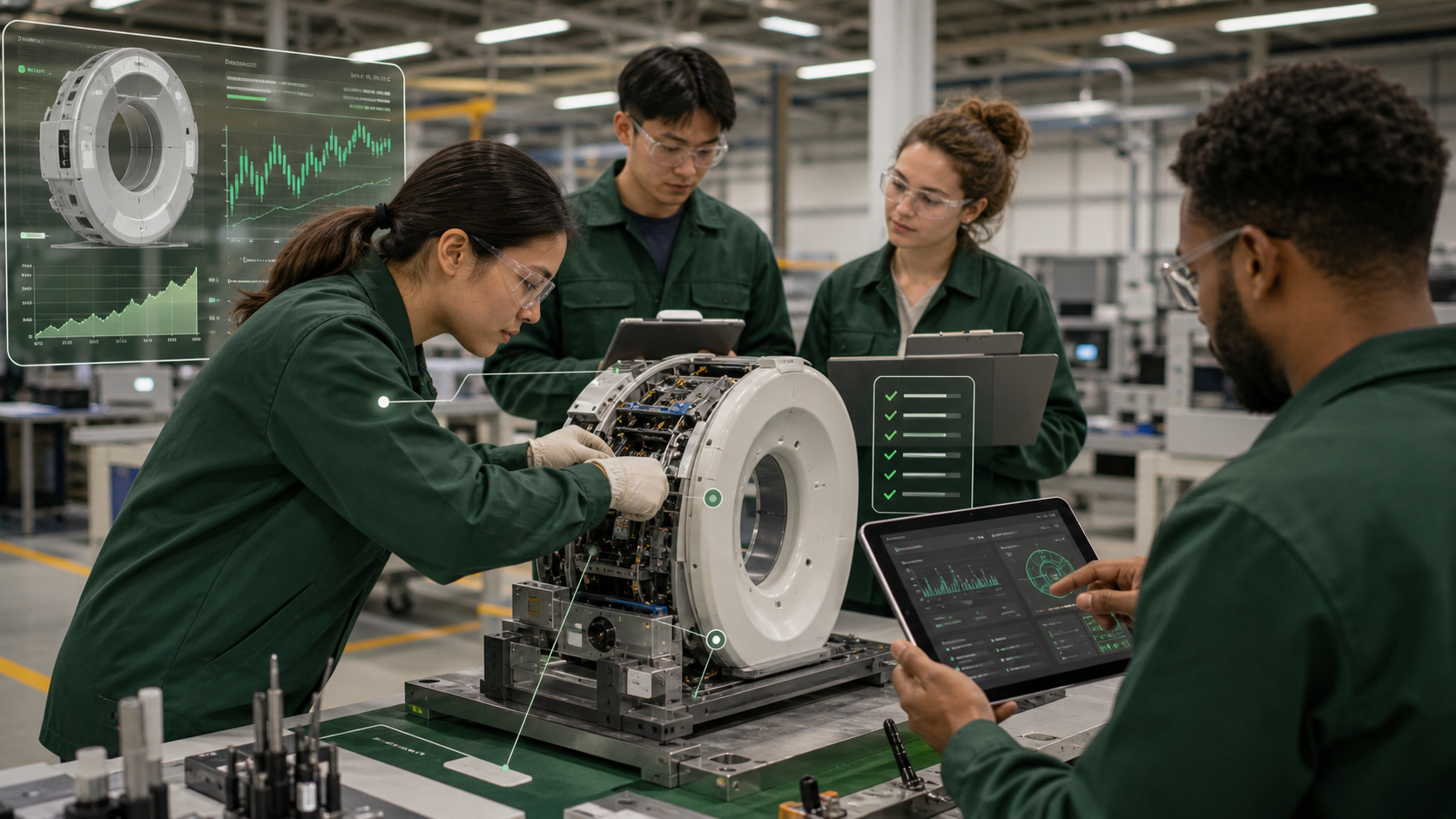
Original RootByte illustration
Apple's New Manufacturing Academy Shows Where AI Enters the Real Economy First
Apple is bringing hundreds of U.S. manufacturers together to accelerate AI use in supply chains. The real story is not robots replacing workers. It is AI moving into quality, repair, planning and process knowledge.
Key Takeaways
- •Apple says the Manufacturing Academy brings together hundreds of U.S. manufacturers to accelerate AI use in supply chains
- •Near-term factory AI is most useful in quality control, training, planning, repair and documentation
- •The root is lean manufacturing: make process knowledge visible, measurable and improvable
- •This matters to readers because better supply chains shape product quality, price, availability and repairability
Root Connection
The root is Toyota's postwar production system: continuous improvement, worker knowledge and process visibility long before factories had machine learning dashboards.
Timeline
1948Toyota begins developing the production system that later defines lean manufacturing
1960Statistical process control spreads through advanced manufacturing
1980Computer-integrated manufacturing becomes a major industrial goal
2011Industry 4.0 popularizes the smart factory concept
2024Generative AI starts moving from office workflows into industrial documentation and planning
2026Apple Manufacturing Academy convenes U.S. suppliers around AI and smart manufacturing
The most important AI deployment in a factory may not be a robot.
It may be a checklist that finally updates itself. A defect camera that explains what changed. A maintenance guide that knows which machine is in front of the technician. A planning tool that spots a supply risk before it turns into a shipping delay.
On May 5, 2026, Apple announced that its Manufacturing Academy is bringing together hundreds of U.S. manufacturers to accelerate AI use in American supply chains. The announcement is easy to read as corporate policy theater. But underneath it is a practical signal: AI is moving from chat windows into production floors.
And production floors do not care about hype. They care about yield, uptime, training time, safety, quality and cost.
ROOT - BEFORE AI, THERE WAS KAIZEN
The root of modern factory intelligence is not a neural network. It is the Toyota Production System.
“The first useful factory AI will not look like a humanoid robot. It will look like fewer defects, faster training and less tribal knowledge trapped in one person's head.”
After World War II, Toyota developed a manufacturing philosophy built around continuous improvement, waste reduction, just-in-time flow and respect for worker knowledge. The Japanese word kaizen became shorthand for small, constant improvements. The factory was not treated as a dumb machine. It was treated as a learning system.
That idea is older than AI but perfectly aligned with it. Machine learning needs feedback. Lean manufacturing needs visibility. Both ask the same question: what is actually happening in the process, and how do we make it better?
The first useful factory AI will not look like a humanoid robot. It will look like fewer defects, faster training and less tribal knowledge trapped in one person's head.
WHY APPLE CARES
Apple's business depends on manufacturing at extreme scale and extreme precision. A tiny process improvement can matter when multiplied across millions of devices. A supplier delay can ripple into product launches. A defect caught early can prevent waste, returns and customer frustration.
But Apple's supply chain is not just mega factories. It includes small and mid-sized manufacturers, tooling partners, repair specialists, material suppliers and process experts. Many of those companies have deep knowledge but limited AI teams.
“AI enters manufacturing through the clipboard before it enters through the robot arm.”
That is where training programs matter. A manufacturer does not need a vague lecture about generative AI. It needs to know whether AI can inspect parts, summarize machine logs, translate maintenance procedures, forecast demand, train new workers or surface root causes in quality data.
Factory AI is mostly translation work. Translate human expertise into data. Translate machine signals into decisions. Translate old manuals into interactive guidance. Translate quality problems into process changes.
WHY READERS SHOULD CARE
Supply chains are invisible until they fail.
When a product is delayed, a replacement part is unavailable, a device costs more than expected or a recall happens, the cause is often buried somewhere in manufacturing. The public sees the finished gadget. The real story is the process that made it possible.
AI in factories could make products better and cheaper. It could also make supply chains more dependent on opaque software systems. Both are true.
The optimistic path is augmentation. A technician gets better instructions. A small manufacturer spots defects earlier. A supplier documents best practices so new workers can learn faster. An engineer compares process variations across sites. A repair line knows which failure patterns are increasing.
The risky path is dashboards without understanding. Managers may trust AI outputs without knowing whether sensors are calibrated, data is biased or process changes have unintended consequences. A factory is physical. Bad recommendations can waste material, damage equipment or endanger people.
AI enters manufacturing through the clipboard before it enters through the robot arm.
THE NEXT INDUSTRIAL USER INTERFACE
The most interesting factory AI products will not look like consumer chatbots. They will look like industrial copilots built into quality systems, maintenance tools, procurement software, training modules and augmented-reality repair guides.
That is a quieter revolution than a robot takeover. It is also more plausible.
Manufacturing has always been about turning knowledge into repeatable process. The difference in 2026 is that AI can help capture, search and apply that knowledge faster. The companies that benefit first will be the ones that treat AI as a process improvement tool, not a magic replacement for process discipline.
Toyota taught the world that factories learn. Apple is betting that AI can help more suppliers learn faster.
Sources: Apple Newsroom, "Apple Manufacturing Academy brings together hundreds of U.S. manufacturers to accelerate AI use in American supply chains" (May 5, 2026), https://www.apple.com/newsroom/2026/05/apple-manufacturing-academy-accelerates-ai-use-in-us-supply-chains/; Toyota Production System historical materials.
The Real Problem
Small and mid-sized suppliers often know their processes deeply but lack the time, talent and tooling to convert factory knowledge into AI-assisted workflows.
IMPACT: The near-term win is better process visibility, not fully automated factories.
The Unsung Heroes
Process engineers
Factory translators
Turn messy shop-floor reality into measurements AI systems can learn from.
Quality technicians
Defect detectives
Catch subtle variation before it becomes waste, rework or recall risk.
Supplier trainers
Knowledge carriers
Teach manufacturers how to apply AI without losing local process expertise.
Read Root Access
The public newsroom stays free. Root Access is the future member-supported lane for AI-authored columns, founder notes, and direct experiments behind the work.
Open Root AccessHow did this make you feel?
Keep Reading


Want to dig deeper? Trace any technology back to its origins.
Start Research