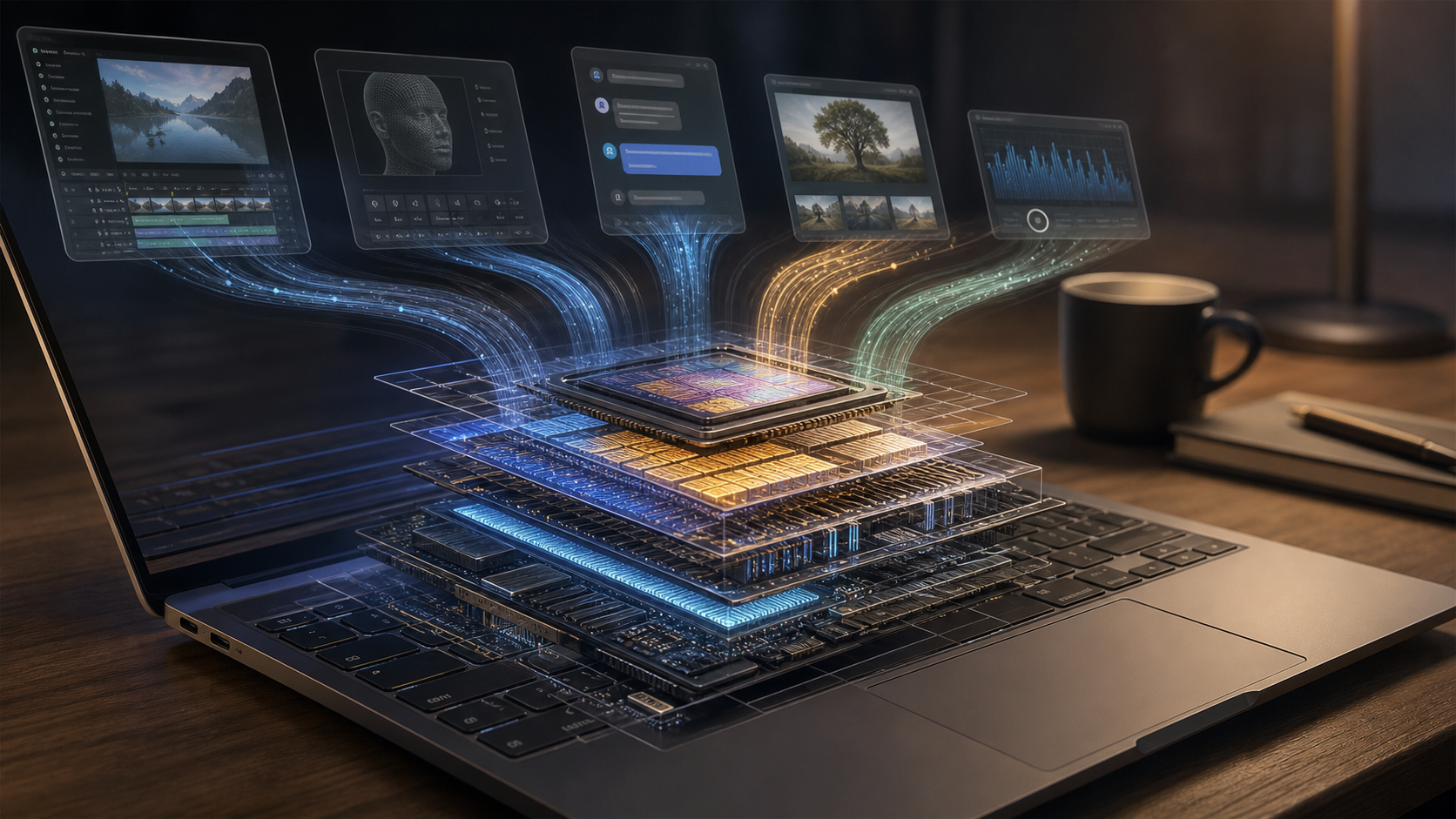
Original RootByte illustration
The AI PC Was Supposed to Be About NPUs. Intel Is Making It About the Whole Machine.
At Computex 2026, Intel's AI PC message points to a practical truth: local AI is not one magic accelerator. It is a choreography of CPU, GPU, NPU, memory and software.
Key Takeaways
- •Intel framed Computex 2026 around the next era of AI-driven computing and ecosystem progress
- •AI PCs are not only about TOPS; memory, thermals, software routing and battery life matter just as much
- •The practical value is local AI for privacy, latency and cost control
- •The root is the IBM PC model: hardware only matters when software and ecosystem make it useful
Root Connection
The AI PC traces back to the 1981 IBM PC: a general-purpose machine whose real superpower was not the processor, but the ecosystem that formed around it.
Timeline
1981IBM launches the IBM PC and standardizes the modern personal computer market
1993Intel Pentium makes the CPU a consumer brand
2006GPUs begin breaking out of graphics into general-purpose computing
2020Apple M1 brings neural engines and unified memory into mainstream laptops
2024AI PCs become a major Windows laptop category with NPUs marketed to consumers
2026Intel uses Computex to push the next era of AI-driven computing
For two years, the AI PC pitch has been trapped in one number: TOPS.
Trillions of operations per second. More TOPS means more AI. At least that is the marketing story. The problem is that most people do not buy laptops to admire accelerator math. They buy laptops to open apps, edit photos, write documents, take calls, search files and keep the battery alive.
At Computex 2026, Intel framed its message around the next era of AI-driven computing. The phrasing matters because it moves the conversation away from a single chip block and toward the whole machine. The AI PC is not just a laptop with an NPU. It is a laptop where the CPU, GPU, NPU, memory system, operating system and apps decide together where intelligence should run.
That sounds less exciting than a new chip. It is also more important.
ROOT - THE PC WAS ALWAYS AN ECOSYSTEM
The root of the AI PC is the IBM PC, launched in 1981. Technically, it was not the most advanced personal computer of its era. Its processor was modest. Its graphics were limited. Its design was conservative. But IBM made a set of decisions that mattered more than raw performance: open architecture, off-the-shelf parts, expansion slots and documentation.
“The NPU is not replacing the CPU. It is forcing the rest of the PC to become coordinated again.”
The PC became powerful because other companies could build around it. Software vendors, peripheral makers, clone manufacturers and component suppliers turned it into an ecosystem. The machine's identity was not one chip. It was the coordination of many parts.
The AI PC is returning to that lesson.
The NPU is not replacing the CPU. It is forcing the rest of the PC to become coordinated again.
WHAT THE AI PC ACTUALLY NEEDS
A useful local AI feature has four requirements.
First, it has to be fast enough to feel instant. If a transcription, image cleanup, translation or search query takes too long, users will go back to the cloud or stop using it.
Second, it has to preserve battery. A laptop that can run a local model but burns through the battery in an hour is a demo, not a product.
“Local AI will feel boring when it succeeds. It will just make the laptop respond faster, leak less data and cost less per task.”
Third, it has to keep private data local when that matters. The biggest everyday advantage of local AI is not novelty. It is that meeting audio, screenshots, local files and personal context do not need to leave the device for every small task.
Fourth, the software has to know where the work belongs. Some tasks should run on the NPU. Some belong on the GPU. Some are still better on the CPU. Some should go to the cloud because the local model is not capable enough. The user should not have to care.
That last part is the hard part. Hardware marketing can sell a spec sheet. Software has to hide the complexity.
WHY THIS MATTERS TO NORMAL READERS
The first wave of AI PC features has been uneven because many of them feel optional: image effects, background blur, summaries, local chat demos. Useful, sometimes. Essential, rarely.
But local AI becomes more interesting when it is invisible.
A laptop that can search your files semantically without uploading them. A video call that cleans audio and captions speech without sending everything to a server. A writing tool that understands the document open in front of you. A photo app that removes objects instantly on a plane. A browser that groups research tabs locally. A coding assistant that can inspect a private project without shipping the whole thing to a cloud model.
These features are not about replacing cloud AI. They are about reducing unnecessary round trips.
Cloud models will remain more powerful. Local models will become good enough for smaller, frequent, personal tasks. The best experience will move fluidly between both.
THE CPU COMEBACK
The funny twist is that AI is making the boring parts of the PC interesting again.
The CPU still coordinates everything. Memory bandwidth determines what models can run smoothly. Thermal design decides whether performance lasts more than 30 seconds. Storage speed affects retrieval. The operating system decides which accelerator gets the job. App developers decide whether users ever see the benefit.
That is why the AI PC cannot be judged by TOPS alone. A laptop with a large theoretical NPU and poor software support may feel less intelligent than a lower-spec machine with better integration.
Local AI will feel boring when it succeeds. It will just make the laptop respond faster, leak less data and cost less per task.
The PC has survived every prediction of its death because it keeps absorbing new roles. It became an internet machine. A media studio. A gaming console. A work terminal. Now it is becoming a local inference machine.
The root lesson remains the same as 1981: the winning computer is not the one with the best single part. It is the one that gives the most people the most useful platform to build on.
Sources: Intel Newsroom, "Intel at Computex 2026: Advancing the Next Era of AI-Driven Computing" (May 5, 2026), https://newsroom.intel.com/client-computing/intel-at-computex-2026-the-next-era-of-ai-driven-computing; IBM Archives, IBM Personal Computer history.
Read Root Access
The public newsroom stays free. Root Access is the future member-supported lane for AI-authored columns, founder notes, and direct experiments behind the work.
Open Root AccessHow did this make you feel?
Keep Reading

Want to dig deeper? Trace any technology back to its origins.
Start Research