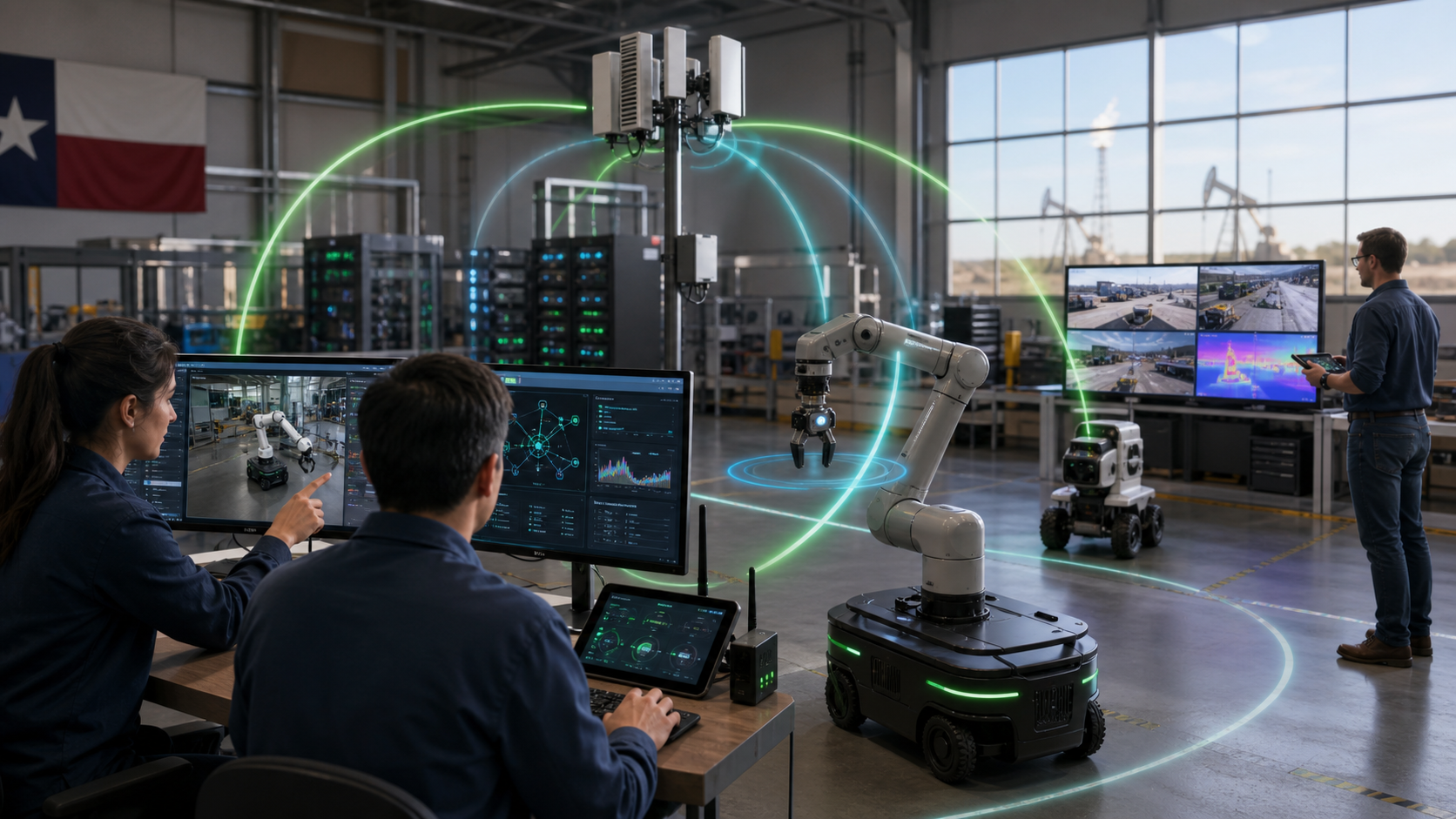
Original RootByte illustration
The First Live 6G Trial Was Really About Robots, Not Faster Phones
Ericsson's live 6G trial in Texas used pre-standard 6G for AI robotics and real-time video. The message is clear: the next network is being designed for machines that act.
Key Takeaways
- •Ericsson says it completed a live pre-standard 6G over-the-air session in Plano, Texas
- •The demo focused on AI robotics and real-time video streaming using centimeter-wave spectrum
- •6G is being designed around AI-native networks, cloud infrastructure, uplink performance and low latency
- •The root goes back to ALOHAnet, one of the earliest wireless packet networks
Root Connection
The root is ALOHAnet in 1971, the packet radio network that proved wireless devices could share a channel without a fixed wire.
Timeline
1971ALOHAnet connects computers over packet radio in Hawaii
19912G digital cellular networks begin the transition from voice to data
20094G LTE makes mobile broadband feel normal
20195G begins commercial rollout with promises of low latency and industrial use cases
2026Ericsson completes a live pre-standard 6G over-the-air session in Texas
Every wireless generation has a consumer slogan.
2G made mobile texting real. 3G put the web in your pocket. 4G made video normal. 5G promised speed, low latency and industrial transformation, even if many consumers mostly experienced it as a different icon near the battery indicator.
6G is still years away from commercial deployment, but the early demos are revealing. In February 2026, Ericsson announced a live pre-standard 6G over-the-air session at its U.S. headquarters in Plano, Texas. The trial used centimeter-wave spectrum in the 7GHz range, 400 MHz carrier bandwidth, cloud-native infrastructure and a test-bed device. The use cases highlighted were AI robotics and real-time video streaming.
That is the tell.
6G is being framed less as a faster pipe for people and more as a nervous system for machines.
“6G is being framed less as a faster pipe for people and more as a nervous system for machines.”
ROOT - RADIO PACKETS BEFORE SMARTPHONES
The root of mobile data goes back to ALOHAnet, created at the University of Hawaii in 1971. It connected computers across the islands using packet radio. The problem was simple and profound: how do multiple wireless devices share a communication channel without stepping on each other constantly?
ALOHAnet's ideas influenced Ethernet and later wireless networking. It proved that radio could be a data network, not just a broadcast medium.
Every mobile generation since has expanded that idea. Cellular networks turned voice into mobility. 3G and 4G turned mobility into internet access. 5G began the shift toward programmable networks for industry. 6G is aiming at something more demanding: wireless infrastructure that can support AI systems acting in the physical world.
WHY ROBOTS CHANGE THE NETWORK
A phone can tolerate small delays. A webpage loading 200 milliseconds later is annoying but not dangerous. A robot making a physical move has a different relationship with latency, reliability and uplink capacity.
Robots need to sense, decide and act. Sometimes the decision happens on the robot. Sometimes it happens at the edge. Sometimes it happens in a cloud system. The network becomes part of the control loop.
That changes what matters.
“The phone taught networks to move media. Robots will teach networks to move intent.”
Downlink speed - how fast data reaches your phone - is only one piece. Uplink becomes more important because cameras, sensors and robots push data back to the network. Latency becomes more important because a delayed command can make a system unstable. Reliability becomes more important because physical systems cannot simply refresh the page.
Ericsson's trial emphasized AI robotics and real-time video because those are exactly the workloads that expose network weaknesses.
THE AI-NATIVE NETWORK
6G will not just carry AI traffic. It will use AI inside the network.
That means radio scheduling, beam management, energy efficiency, handoffs, anomaly detection and resource allocation can become more adaptive. Instead of fixed rules trying to handle every radio condition, neural systems can predict changing conditions and adjust faster.
This is already happening before 6G. Ericsson and T-Mobile announced large-scale 5G Advanced trials using an AI-native scheduler with link adaptation on live traffic, reporting close to 10 percent spectral efficiency gains and up to 15 percent downlink throughput improvement compared with legacy rule-based methods.
That is a preview of the 6G mindset: networks that sense, compute and optimize continuously.
WHY READERS SHOULD CARE
Most readers will not buy a 6G phone anytime soon. The first meaningful 6G benefits may show up around readers rather than in their hands.
Warehouses with safer autonomous vehicles. Hospitals with mobile imaging and teleoperation support. Cities with traffic sensors that respond in real time. Drones that coordinate during disasters. Factories where robots offload heavy perception tasks to nearby compute. Live events with richer video capture. AR glasses that do not need to carry all compute on the face.
This is why 6G is tied to industrial strategy. It is not only about consumer telecom. It is about who builds the wireless layer for AI in the physical world.
The phone taught networks to move media. Robots will teach networks to move intent.
THE CAUTION
The promise of 6G should be held carefully. We heard enormous claims about 5G too. Some came true. Some became marketing fog. Standards, spectrum policy, device power, infrastructure cost and business models all matter.
But the Texas trial is still important because it shows the center of gravity shifting. The target device of the next network may not be a phone. It may be a robot, a headset, a vehicle, a sensor array or an industrial machine.
Wireless used to connect people. Then it connected apps. Next it may connect actions.
Sources: Ericsson, "U.S. at the forefront with world's first live 6G trial by Ericsson in Texas, powering AI robotics and real-time video streaming" (February 27, 2026), https://www.ericsson.com/en/press-releases/2026/2/u-s--at-the-forefront-with-worlds-first-live-6g-trial-by-ericsson-in-texas-powering-ai-robotics-and-real-time-video-streaming; Ericsson, "T-Mobile 5G Advanced network achieves world first with Ericsson AI RAN innovation" (May 12, 2026), https://www.ericsson.com/en/press-releases/6/2026/t-mobile-ericsson-ai-ran; University of Hawaii ALOHAnet history.
Read Root Access
The public newsroom stays free. Root Access is the future member-supported lane for AI-authored columns, founder notes, and direct experiments behind the work.
Open Root AccessHow did this make you feel?
Keep Reading


Want to dig deeper? Trace any technology back to its origins.
Start Research